


Quick Answer: Who Was Yan Fu?
Yan Fu (严复, Yán Fù, 1854–1921) was a late Qing translator and reform writer. His best-known work, Tianyan lun (天演论, Tiānyǎn Lùn), is a Chinese rendering and adaptation of Thomas Henry Huxley’s Evolution and Ethics and its introductory essay.[1][2][3][5]
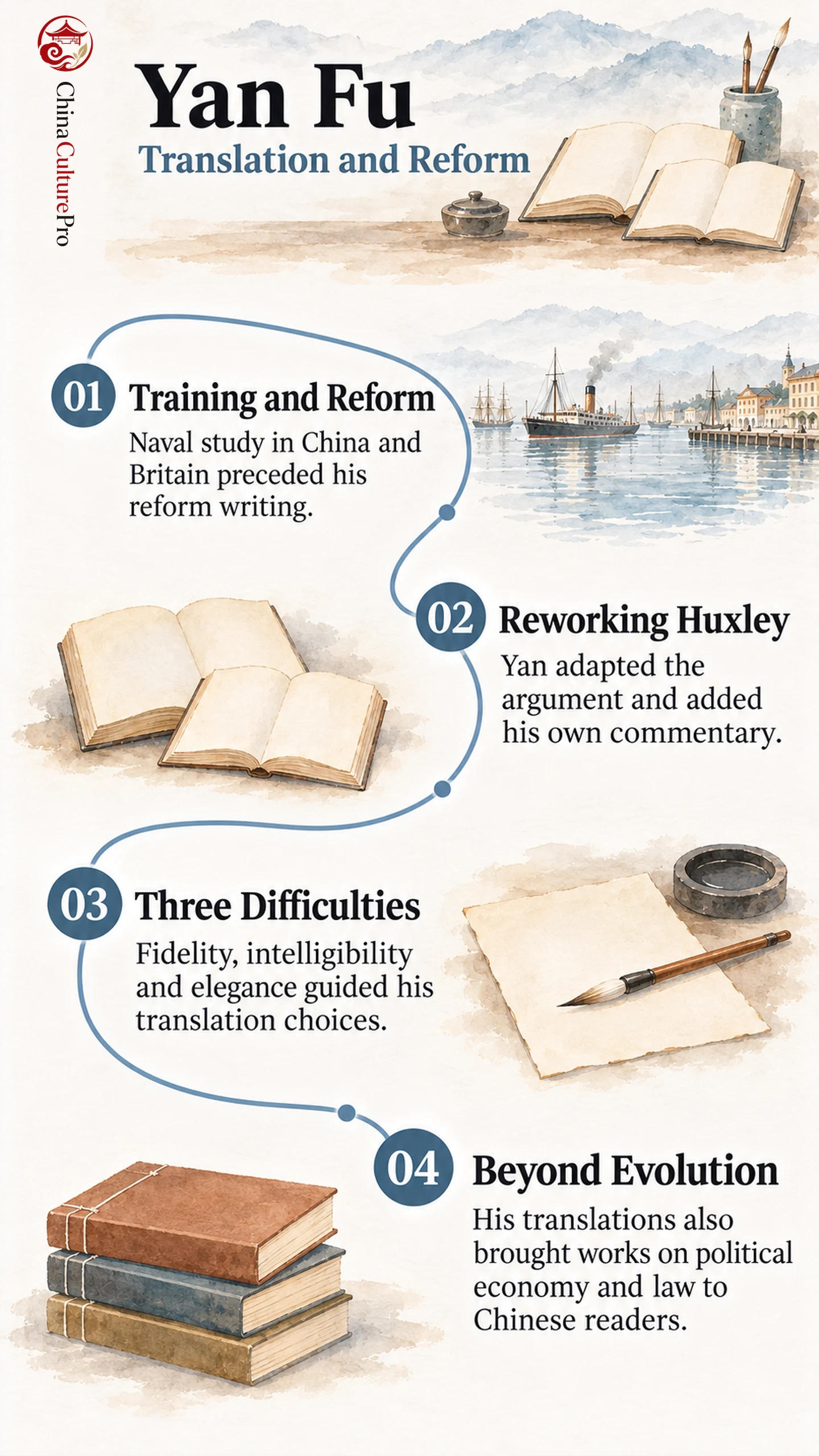
- Background: Naval training in Fuzhou and Britain preceded his career as a reform writer.
- Translation: He added notes that connected the work to late Qing debates.
- Other books: He also translated major works of political economy, law and social thought.
His notes on translation explain some of the choices that turned an English argument into a Chinese book with its own readership.
Yan Fu wrote for Chinese readers facing questions that Huxley had approached from another setting. A comparison of their books reveals how a translator could move an argument across languages, explain unfamiliar ideas and enter a debate of his own.
Naval Education and Late Qing Reform
Yan came from Fujian and studied at the Fuzhou naval school. He traveled to Britain in 1877 for advanced naval training and later taught in China. His education gave him access to English-language writing alongside his knowledge of Chinese literary forms. Both mattered when he began addressing broader questions of education, government and national strength.[1]
In the 1890s, as the Qing dynasty faced military defeat and pressure from abroad, Yan wrote essays about reform. His 1895 essays connect political change with the problem of national survival. That setting helps explain the questions he brought to Huxley. He was writing for readers already considering what made states and institutions strong or vulnerable.[1][6][7]
How Tianyan Lun Reworked Huxley
Huxley distinguishes the processes that produce struggle in nature from the ethical choices people make in society. In the introductory essay he uses a garden to explain the distinction. A gardener creates conditions that favor selected plants, changing the outcome that would follow if the plot were left untended. Huxley treats gardening as human activity within nature. The example shows how deliberate choices can change which plants survive.[3]
Yan rearranged wording and inserted his own commentary. The preface describes occasional additions and changes of order as ways to convey the meaning of a difficult passage. He drew on Herbert Spencer in developing his own discussion of competition and survival, a subject on which his emphasis differed from Huxley’s. The Chinese work began appearing in newspaper installments in 1897. The book followed in 1898. Its influence came in part from the way the argument and notes reached readers together.[4][5][6][7]
For readers working with historical sources, it helps to identify whose voice a passage presents. A claim in Yan’s commentary may belong to his argument even when it is printed beside his rendering of Huxley.[3][4][5]
What Xin, Da and Ya Meant in His Preface
In his translation notes, Yan names three difficulties often summarized as fidelity, intelligibility and elegance (信、达、雅, xìn, dá, yǎ). Fidelity concerns the meaning being carried over. Intelligibility concerns whether the new reader can follow it. Elegance concerns the language in which Yan thought the argument would carry weight. He favored an older literary register for the demanding ideas he was trying to convey.[4][6]
Yan explains that an English sentence can introduce a term, pause to qualify it and then return to the main clause. Copying that order can obscure the point in Chinese. Cutting out the qualifications can lose meaning. He therefore describes reordering or supplementing wording to make the argument intelligible. He also warns readers against treating the liberties he took in this particular book as a general rule.[4]
Beyond Evolution: Political Economy and Law
Yan translated Adam Smith’s Wealth of Nations as Yuan fu (原富, Yuán Fù) and Montesquieu’s Spirit of the Laws as Fa yi (法意, Fǎ Yì). Their subjects range from political economy to the institutions that organize law and government. Research on Yan’s working drafts also shows that he began the Smith project while he was still revising his Huxley translation.[2][6]
The overlap shows that Yan was working on several bodies of ideas at once. Rendering a term about trade or government presented a different problem from rendering a claim about nature and ethics.[2][6]
FAQs About Yan Fu
Did Yan Fu translate Darwin in Tianyan Lun?
Tianyan lun drew on Thomas Henry Huxley’s Evolution and Ethics. Yan adapted Huxley’s lecture and its introduction and added his own comments about evolutionary ideas.
Why is Yan Fu also written Yen Fu?
Yen Fu is an older romanization of the same Chinese name. Yan Fu is the form used in modern Hanyu Pinyin.
Did Yan Fu apply his translation principles as a fixed formula?
He described practical difficulties. His discussion of English syntax shows why choices about word order, explanation and style varied with the source and reader.
Sources
[1] Contextual Dictionary of Chinese Cultural Knowledge, Springer. Yan Fu (1854–1921)
[2] National Museum of China. Yan Fu’s manuscript of his rendering of Huxley
[3] Thomas Henry Huxley. Evolution and Ethics, and Other Essays
[4] Yan Fu. Translation Notes to Tianyan Lun
[5] British Journal for the History of Science, Cambridge University Press. Translation and transmutation: the Origin of Species in China
[6] Shen Guowei, Kansai University. Yan Fu’s xin, da, ya in modern translation history
[7] Encyclopedia of China, Berkshire Publishing. Evolution and Ethics