


Quick Answer: Who Was Zhou Yu?
Zhou Yu (周瑜, Zhōu Yú, 175–210) commanded forces for Sun Quan (孙权, Sūn Quán) and helped defeat Cao Cao at Red Cliffs (赤壁, Chìbì) in 208. The historical record places him at the center of an allied campaign with several commanders.[1][2][3]
- Before the battle: He helped build the Sun family’s power south of the Yangtze.
- At Red Cliffs: He helped lead the allied operation, while Huang Gai (黄盖, Huáng Gài) proposed the fire attack.
- In literature: A novel and a Song lyric give him different roles in the memory of the battle.
The decision to fight, the command of troops and the design of the fire attack belonged to different people.
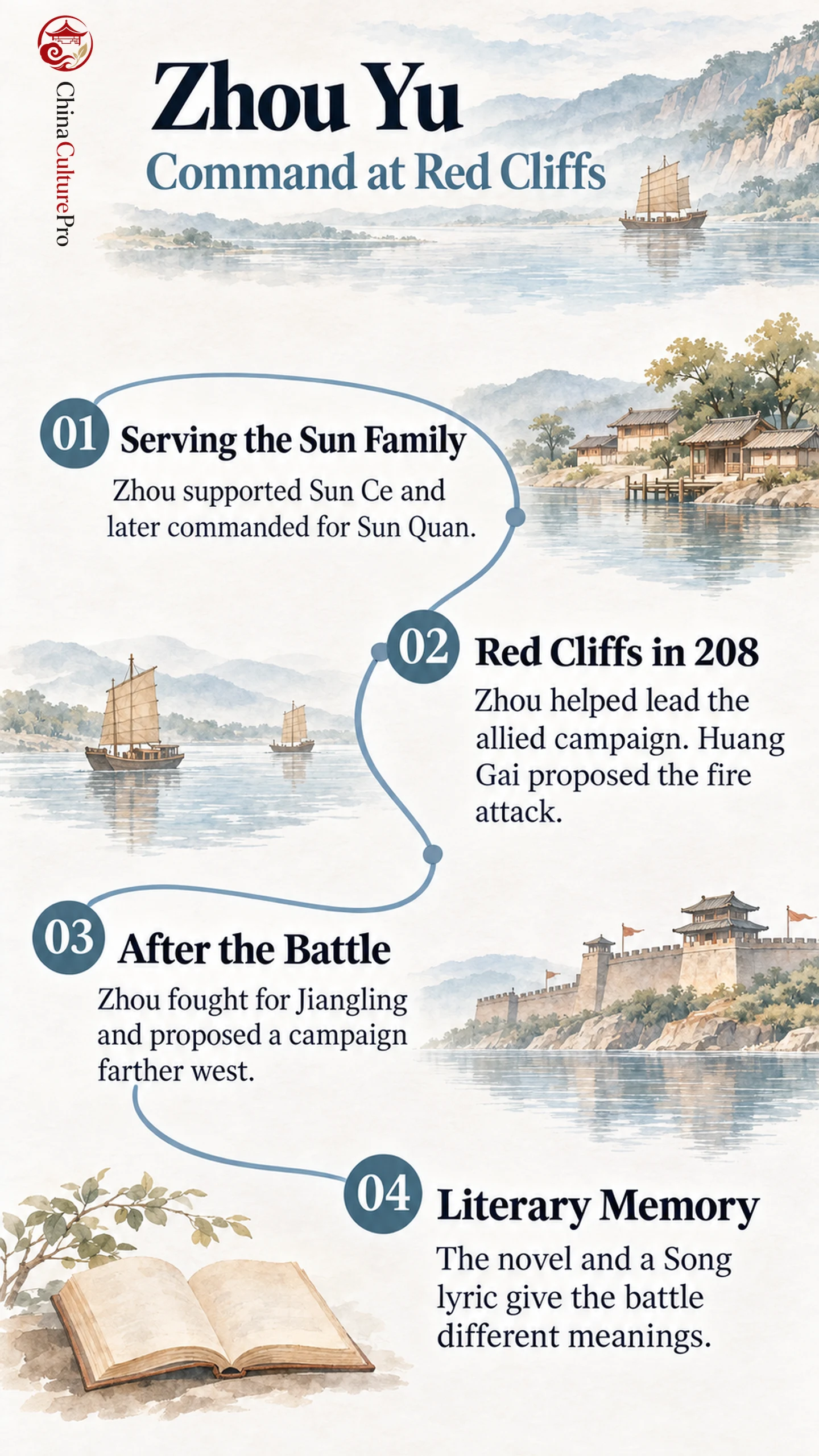
Red Cliffs is often remembered as a battle won by fire. The historical record also shows who decided to fight, who led the allied forces and who proposed the tactic. Following those roles makes Zhou Yu’s contribution easier to see.
From Sun Ce’s Campaigns to Sun Quan’s Command
Zhou Yu’s military career began before the alliance at Red Cliffs. He was close to Sun Ce (孙策, Sūn Cè) and brought troops to support his campaigns across the Yangtze. When Sun Quan succeeded Sun Ce, Zhou became one of his leading commanders. Those campaigns helped create the power base from which the Sun family could later face Cao Cao.[1][3]
Red Cliffs took place in the last years of the Han, before the three rival dynasties had all been proclaimed. Its place in Three Kingdoms history comes from the way the campaign affected the positions of rulers who would shape that later period.[3]
Who Did What at Red Cliffs
When Cao Cao advanced south, Zhou supported resistance. Sun Quan decided to send forces, with Zhou Yu and Cheng Pu among the leaders. They fought alongside Liu Bei and his forces. Sun Quan authorized the expedition, Zhou and Cheng Pu had field responsibilities, and Liu Bei contributed an allied force.[1][3]
Chen Shou credits Huang Gai, an officer under Zhou, with proposing the fire attack. He reasoned that Cao Cao’s vessels lay close together and could be set ablaze. The biography describes a feigned surrender, prepared vessels and a wind that helped the fire reach the camp. The biography also says Cao’s troops were already suffering from illness. The fire attack struck an army under strain.[1][2]
What Zhou Yu Did After the Battle
Cao Cao withdrew north, leaving Cao Ren to hold Jiangling farther upstream. Zhou continued fighting for control of Jiangling. The biography also records his concerns about Liu Bei’s future power and a plan for campaigning farther west. The alliance met the immediate danger from Cao Cao, while its members continued to have interests of their own.[1][3]
Zhou died in 210 while preparing for a later campaign. By then he had helped win the battle, fought for Jiangling and proposed a separate western campaign. The last proposal remained unrealized when he died.[1][3]
How Poetry and the Novel Changed the Story
In the Romance of the Three Kingdoms, Zhuge Liang (诸葛亮, Zhūgě Liàng) performs a ritual associated with bringing the wind. The historical biography describes the wind as a condition of the fire attack. The novel makes it an occasion to display a character’s extraordinary ability.[1][4]
Su Shi’s Song lyric gives Zhou a different literary role. It imagines him composed as the enemy fleet burns, using the commander’s composure to sharpen the contrast with the destruction around him. The poem uses the remembered commander to reflect on history and the passage of time. The poem asks readers to look back at a remembered figure, while the novel builds suspense about what the characters can do next.[5]
FAQs About Zhou Yu
Did Zhou Yu plan the fire attack by himself?
The historical record credits Huang Gai with proposing the tactic. Zhou Yu helped direct the allied force that carried it out.
Did Zhuge Liang summon the wind in the historical account?
The historical account mentions wind that spread the fire. The ritual associated with Zhuge Liang belongs to the novel.
Did Zhou Yu die at Red Cliffs?
He survived the battle and fought afterward at Jiangling. He died in 210 while preparing for another campaign.
Sources
[1] Chen Shou, Records of the Three Kingdoms. Chapter 54: Zhou Yu
[2] Chen Shou, Records of the Three Kingdoms. Chapter 55: Huang Gai
[3] Rafe de Crespigny, Australian National University. Generals of the South
[4] Romance of the Three Kingdoms. Chapter 49: The east wind and the fire attack
[5] Su Shi. Remembering the Past at Red Cliffs