


Quick Answer: Who Was Zhang Zhidong?
Zhang Zhidong (张之洞, Zhāng Zhīdòng, 1837–1909) was a senior Qing official who promoted industry and educational reform. He launched the Hanyang Ironworks (汉阳铁厂, Hànyáng Tiěchǎng), wrote Exhortation to Learning (劝学篇, Quànxué Piān) and helped develop new schools and regulations.[1][2][3][4][5]
- Industry: His ironworks depended on access to ore, fuel and trained workers.
- Writing: He argued for keeping classical learning while adopting new subjects.
- Education: He founded a school in Wuchang and helped draft national rules with other officials.
The factory, treatise and school system show how Zhang’s ideas took different forms in practice.
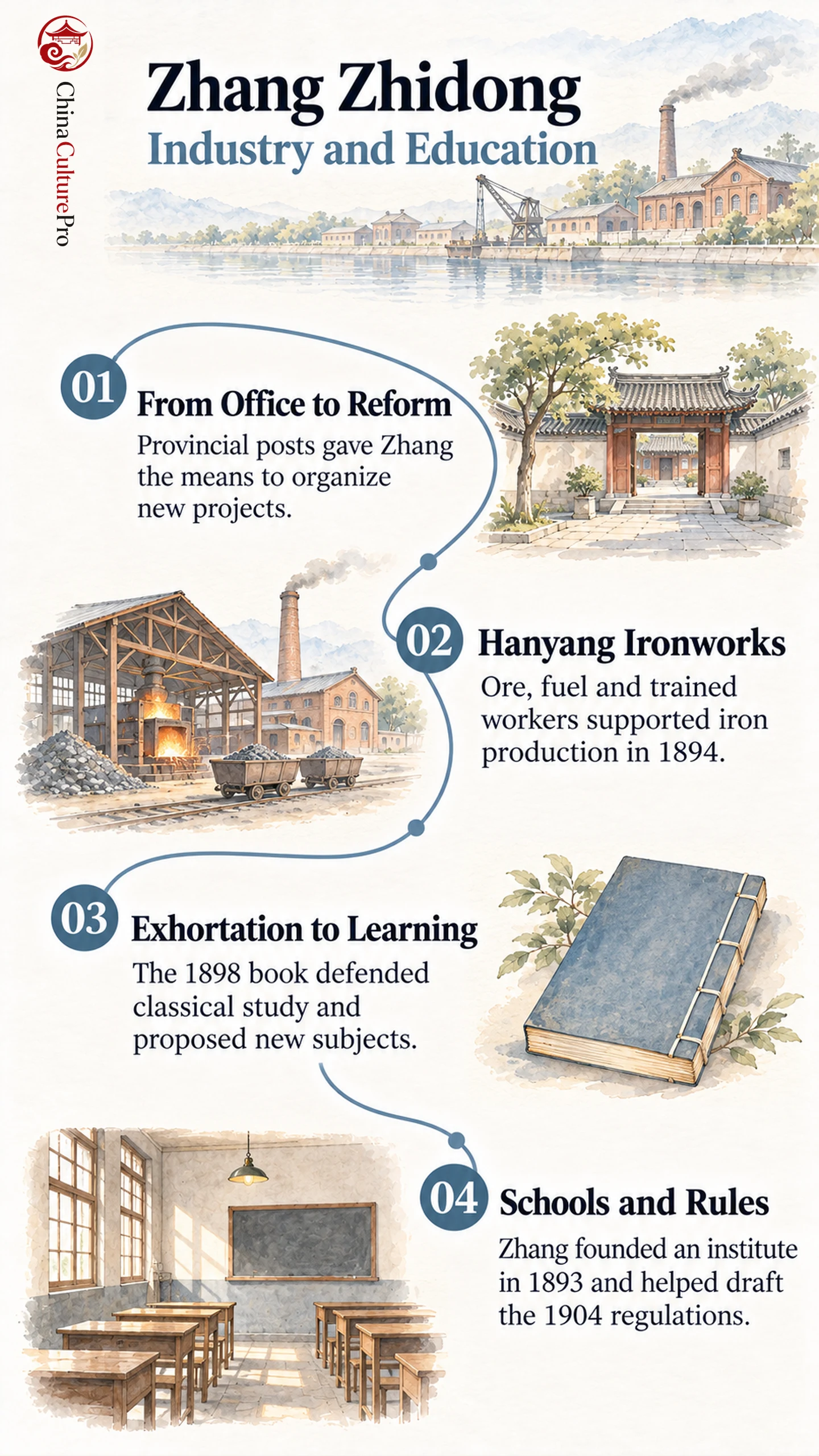
Building a steelworks and designing a school curriculum required different kinds of preparation. Zhang Zhidong worked on both. His projects in Hubei and his 1898 writing show how a Qing official linked training, industrial production and the aims of government.
From Classical Office to Provincial Reform
Zhang entered office through the imperial examination system and served in the Hanlin Academy. As governor-general in Guangdong and Guangxi and later in Hubei and Hunan, he gained opportunities to organize industrial and educational projects. His work in the late Qing joined an education in classical texts to the administrative demands of provincial office.[1][3]
The ironworks plans moved with his appointment. He began planning the project in Guangdong and arranged for equipment to be ordered abroad. After his transfer, he set up an office in Hubei to organize the factory, ore surveys and coal supply. His new office could direct the people and supplies the project needed in Hubei.[1]
What the Hanyang Ironworks Needed to Operate
The ironworks needed more than furnaces. Zhang’s administration arranged to obtain ore from Daye and sought reliable sources of coal. It imported equipment and sought technical expertise. In 1893, he sent a group of Chinese artisans to Belgium for training. Learning how to operate equipment was part of the project alongside buying and installing it.[1]
The Hanyang furnaces began producing iron in 1894. That date marks the start of production, after the earlier work of surveying mines, preparing the site and arranging supplies. The project connected extraction, transport, fuel and work at the furnaces. For a steady supply of iron, fuel and ore had to reach the furnaces when the trained workforce was ready to use them.[1]
What Exhortation to Learning Actually Proposed
In Exhortation to Learning, published in 1898, Zhang argued for studying both old and new learning. He treated the classics, Chinese history and political writings as foundations. He placed Western history, government and technical subjects among the new forms of learning. That division informs the familiar shorthand about Chinese learning as the foundation and Western learning for practical use.[2][3]
Zhang groups taxation and law under the study of government. He treats mathematics, mining and medicine as technical subjects. Both belonged in the education he proposed. He discusses how students of different ages should approach them. Read alongside Yan Fu’s translation projects, his argument shows another way late Qing officials and writers decided what foreign knowledge to introduce and how to teach it.[2][3]
From a Provincial School to National Regulations
The Ziqiang Institute (自强学堂, Zìqiáng Xuétáng), which Zhang founded in Wuchang in 1893, included foreign languages, mathematics, natural studies and commerce. Wuhan University traces its lineage to that institute. The university’s later names and organization came through successive changes, including adoption of the Wuhan National University name in 1928.[4]
In the early 1900s Zhang took part in preparing rules for a broader school system. He worked with Zhang Baixi and Rongqing on regulations issued in 1904 for a system extending from elementary schooling to higher education. The Wuchang institute had opened five years before his 1898 book. The national regulations followed in a later round of reform.[3][4][5]
FAQs About Zhang Zhidong
Did Zhang Zhidong found Wuhan University?
Wuhan University traces its origins to the Ziqiang Institute, which Zhang founded in 1893. Its later university structure and name took shape through subsequent changes.
Did he want Western learning limited to machinery?
His proposals included machinery and technical subjects, as well as government, foreign history and other practical fields.
Was he the sole author of the 1904 school regulations?
He helped draft the regulations with Zhang Baixi and Rongqing. They were part of a wider effort to organize schooling in the late Qing.
Sources
[1] Yang Dongliang, Institute of Qing History, Renmin University of China. Zhang Zhidong and the Hanyang Ironworks
[2] Zhang Zhidong. Exhortation to Learning
[3] SAGE Journals. Cai Yuanpei’s Knowledge Taxonomy and the Divide Between Science and Metaphysics in Modern China
[4] Wuhan University. Wuhan University institutional history
[5] Hubei Daily, Cnhubei. Chronology of Zhang Zhidong’s life