

Quick Answer: Who Was the Zhengtong Emperor?
Zhu Qizhen (朱祁镇, Zhū Qízhèn, 1427–1464) was the Ming ruler whose first reign used the era name Zhengtong (正统, Zhèngtǒng). After his capture at Tumu (土木, Tǔmù) in 1449, his brother took the throne. Zhu Qizhen later returned to power under the era name Tianshun (天顺, Tiānshùn). His temple name was Yingzong (英宗, Yīngzōng).[1][2][3][5]
- 1449: He was captured after the Ming expedition suffered defeat at Tumu.
- 1450: He returned to Beijing while his brother remained in power.
- 1457: A palace coup restored him to the throne.
His return to the capital and his restoration as emperor were separate events.
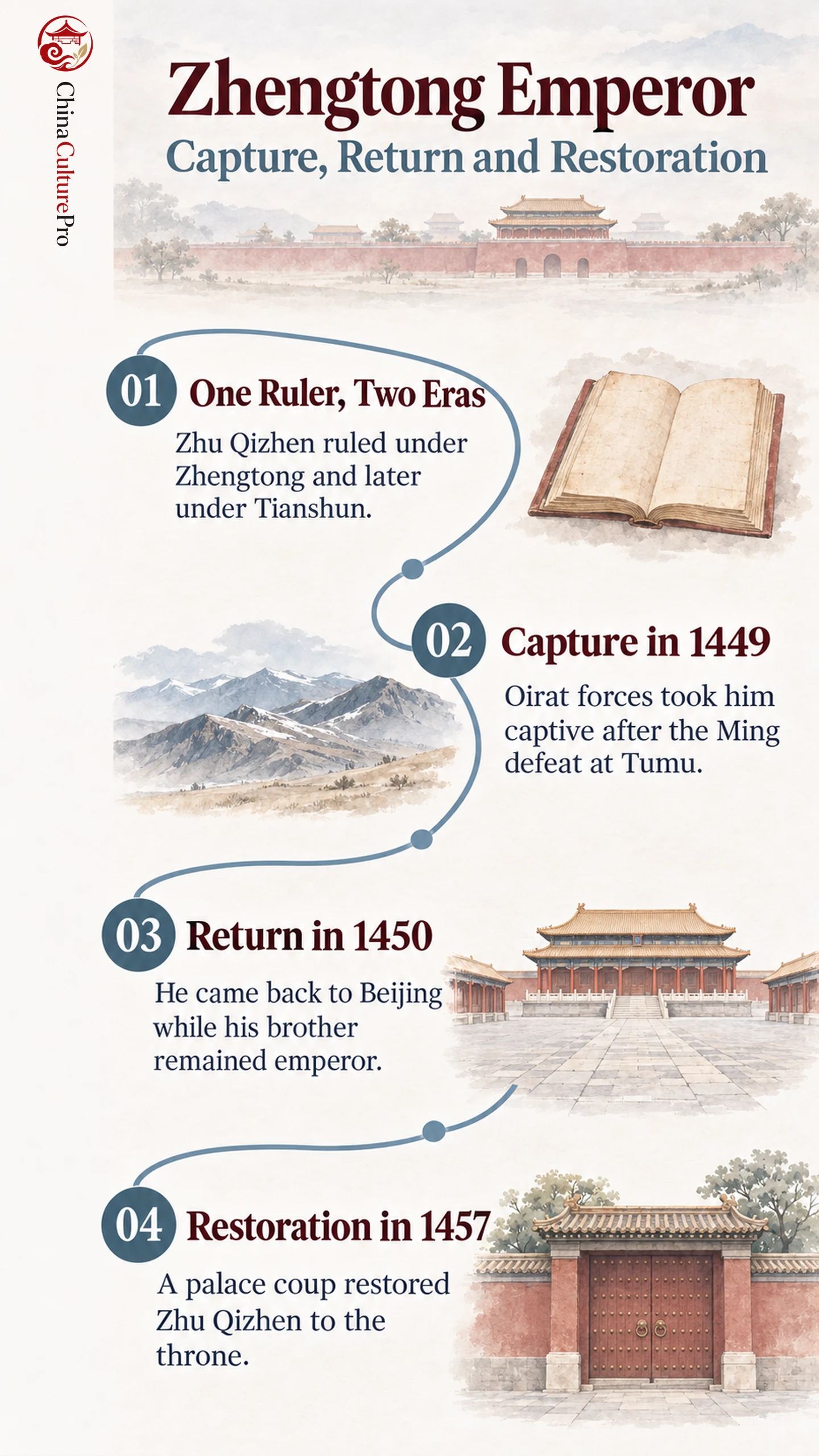
The Zhengtong Emperor went from commanding an expedition to living under confinement in Beijing. To follow how he returned to power, separate three events that accounts often compress. He was captured in one year, released in another and restored years later.
One Emperor, Two Era Names
Zhu Qizhen inherited the Ming throne in 1435 after the death of his father, the Xuande Emperor. The court designated the following year as the first year of Zhengtong. That is why a chronology can begin his rule in 1435 while a table of era dates begins Zhengtong in 1436.[1][3]
In Chinese imperial naming, an era name dates a period of rule, while a temple name identifies a ruler in ancestral commemoration. Yingzong refers to Zhu Qizhen across both reigns. Jingtai (景泰, Jǐngtài) was the era of his brother Zhu Qiyu, who took the throne in the interval.[1][2][5]
The Tumu Crisis of 1449
In 1449, Zhu Qizhen led an expedition against Oirat forces under Esen. The Palace Museum’s account emphasizes the influence of the eunuch Wang Zhen in the campaign. The army withdrew from the direction of Datong, changed its route and was overtaken at Tumu, near present-day Huailai in Hebei. The Ming army suffered a serious defeat, and Esen’s forces took the emperor captive.[1][3]
The withdrawal shows how the Ming frontier defenses depended on what armies could do between fortified positions. It also created a crisis of government. The court of the Ming dynasty had to organize defense and determine who could rule while the emperor was absent.[1][2][4]
Why His Return in 1450 Did Not Restore Him
Zhu Qiyu initially acted as regent. Zhu Qizhen’s young son Zhu Jianshen was named heir, but the court then elevated Zhu Qiyu himself to the throne. Under the new emperor, the war minister Yu Qian helped organize the defense of Beijing. With an emperor in Beijing directing the government, holding Zhu Qizhen gave Esen less leverage over the Ming government.[2][4]
When Zhu Qizhen came back in 1450, he held the title of retired emperor (太上皇, tàishànghuáng) and lived under confinement in the Southern Palace. Zhu Qiyu remained on the throne. The court later replaced Zhu Jianshen as heir with Zhu Qiyu’s own son, who died during the reign.[2][3][4][5]
The 1457 Coup and the Tianshun Reign
Zhu Qiyu became seriously ill in 1457. A group including Shi Heng, Xu Youzhen and the eunuch Cao Jixiang brought Zhu Qizhen back to the throne. The change is commonly called the Seizing of the Gate. Zhu Qizhen announced the Tianshun era. The palace action came more than six years after he had returned to Beijing.[2][5]
Yu Qian, who had helped defend Beijing after Tumu, was executed following the restoration. The return of the former emperor also meant a reversal for one of the officials who had defended the capital during his captivity. Zhu Qizhen remained on the throne until his death in 1464.[2][5]
FAQs About the Zhengtong Emperor
Were the Zhengtong and Tianshun emperors the same person?
Yes. Both era names refer to periods of rule by Zhu Qizhen, whose temple name was Yingzong.
Why do some references start his rule in 1435 and others in 1436?
He took the throne in 1435. The first year designated Zhengtong was 1436.
Did the Ming dynasty end at Tumu?
The defeat left the emperor captive and created a succession crisis. The Ming court continued under Zhu Qiyu and later restored Zhu Qizhen.
Sources
[1] History of the Ming. Chapter 10: Earlier Annals of Yingzong
[2] History of the Ming. Chapter 11: Annals of the Jingtai Emperor
[3] Palace Museum, Beijing. Zhengtong Emperor
[4] Palace Museum, Beijing. Political Changes and Imperial Succession After the Tumu Incident
[5] Palace Museum, Beijing. Tianshun Emperor