

Quick Answer: Who Was Genghis Khan?
Genghis Khan (成吉思汗, Chéngjísī Hán in Mandarin), also spelled Chinggis Khan, founded the Mongol Empire in 1206 and ruled until his death in 1227. The Chinese reading transcribes his title; it is not a pronunciation guide to Mongolian.[1]
- Rise: United competing steppe groups through alliances and warfare.
- Expansion: Directed conquests in northern China and Central Asia.
- Succession: Left an empire that continued expanding and changing under his descendants.[1][3]
He did not personally complete every later Mongol conquest, and the Yuan dynastic name was proclaimed decades after his death.[6]
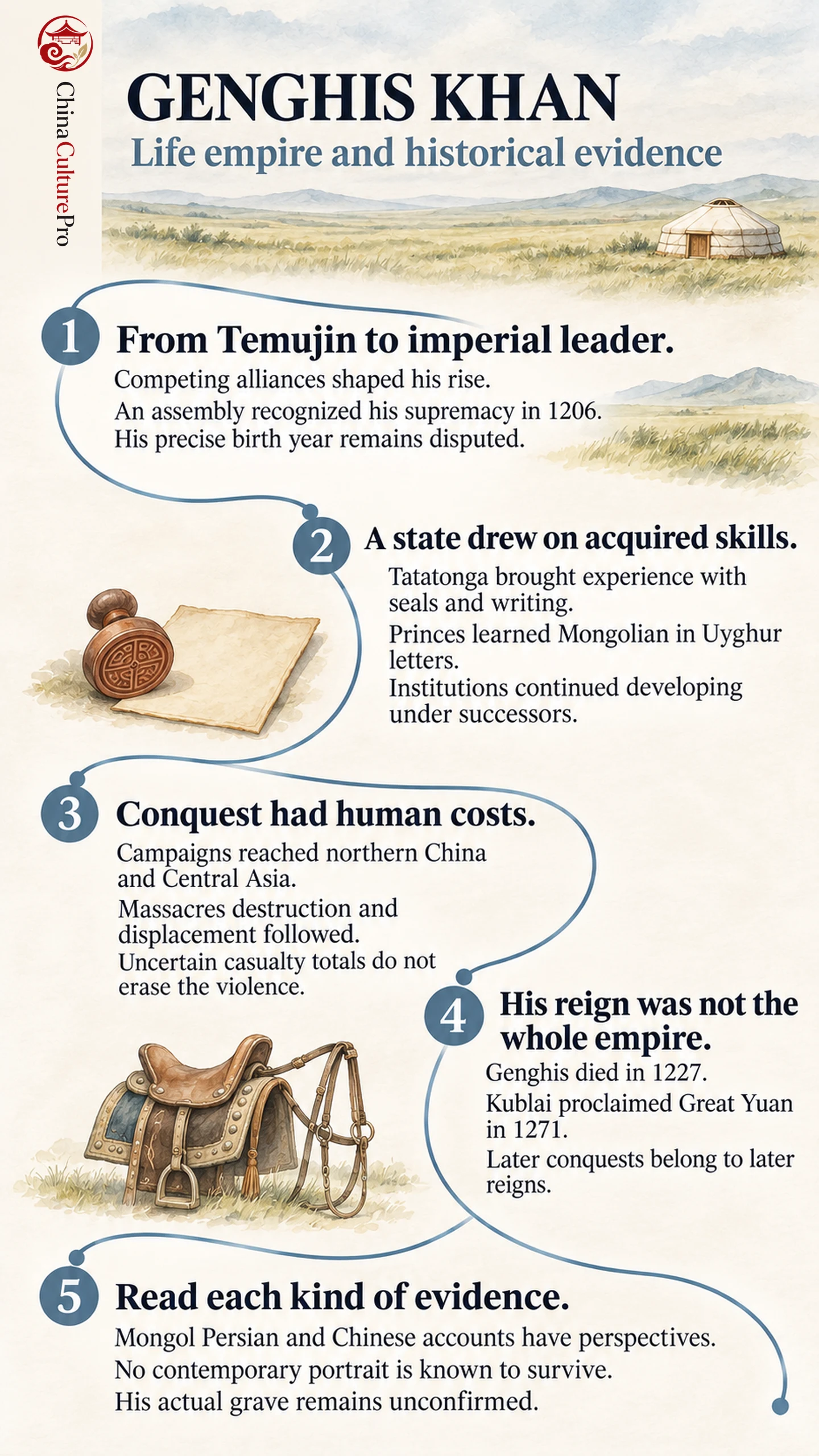
Genghis Khan’s life connects the politics of the Mongolian steppe with a wider history of conquest and empire. Understanding his legacy means separating his own campaigns from those of his descendants, and examining state-building alongside the destruction his armies caused.
Temüjin’s Early Life and Rise to Power
His personal name was Temüjin, rendered in Chinese as 铁木真 (Tiěmùzhēn). He was born in northeastern Mongolia during the twelfth century. The familiar date 1162 is traditional; 1167 is another scholarly proposal. Neither should be presented as an uncontested birth date.[1][2][4]
Traditional accounts describe his father’s death, departing followers and a household supported by his mother. These hardship narratives are not independently verified childhood diaries.[4]
His later power depended on personal followers and shifting alliances. Toghril of the Kereyit and Jamuqa were important associates before the struggle for supremacy turned them into rivals. Warfare incorporated defeated groups as well as eliminating opponents; unification was a contested political process.[1][2]
An assembly of princes and leading men recognized his supremacy in 1206. This is the key transition from Temüjin’s rise to the leadership of a new imperial formation.[1]
Building a Mongol State
The new state drew on existing steppe political practices while organizing resources beyond the steppe. Military command, relations among the ruling family, trade and the employment of people from conquered societies all contributed to its development.[3]
A concrete example concerns the Uyghur official Tatatonga. His biography records that he had served the Naiman ruler and was captured carrying that ruler’s seal. Genghis valued his loyalty, retained him and ordered him to teach the princes to write Mongolian using Uyghur letters.[7]
The account connects conquest with the adoption of administrative skills. It describes seals as instruments for authorizing transactions and appointments, and writing as knowledge brought into the ruling household. This is more specific than imagining government operated through cavalry alone.[7]
The imperial system was not finished in 1206. Under his successor Ögödei, governing mechanisms and fiscal policies developed further. Institutions, like territorial expansion, must be assigned to the appropriate reign.[3]
Conquests During His Lifetime
His campaigns moved in several directions. The dates below mark major stages, rather than the complete extent of the empire reached by later generations.[1]
| Period | Campaign context |
|---|---|
| 1209 | A major campaign against the Tangut state of Western Xia ended in an agreement. |
| 1211–1215 | War against the Jurchen Jin began in 1211; Mongol forces took Zhongdu, near modern Beijing, in 1215. |
| 1219 onward | Mongol armies invaded the Khwarazmian empire and captured major Central Asian cities. |
| 1226–1227 | The final campaign against Western Xia coincided with the end of his life. |
The Jurchen Jin dynasty survived until 1234, after Genghis’s death. The conquest of Western Xia and warfare in Central Asia should likewise be distinguished from the later conquest of southern China.[1][2]
Conquest involved massacres, destruction and displacement, particularly in the campaigns across Khwarazm and Khorasan. Medieval casualty figures can be vastly exaggerated; uncertainty about totals does not make the underlying violence doubtful. Later commercial links do not cancel those costs.[2]
Death, Succession and the Later Yuan Dynasty
Genghis died in 1227 during the campaign against Western Xia. His successors inherited both a ruling family’s claims and a state that continued developing. The empire’s later reach cannot be read directly from a map of his lifetime.[1][3]
His grandson Kublai Khan proclaimed the dynastic name Great Yuan in 1271. This was a later political act, not another name given to the 1206 assembly. The Yuan dynasty belongs to the history of his descendants’ rule.[6]
The History of Yuan (元史, Yuánshǐ), compiled under Ming, places him at the beginning of its imperial annals as Yuan Taizu (元太祖, Yuán Tàizǔ), a posthumous ancestral designation. Such retrospective placement explains why he appears in lists of Yuan rulers without having proclaimed the Yuan name in his lifetime.[1][6]
Sources, Portraits and Historical Legacy
The Secret History of the Mongols, known in Chinese as 蒙古秘史 (Ménggǔ Mìshǐ), is an anonymous thirteenth-century narrative containing family memories and legitimating stories. Persian histories provide another perspective; neither is an impartial transcript.[5]
No contemporaneous portrait is known to survive. Later representations cannot securely establish his appearance. His actual burial location also remains unconfirmed; the existence of memorial traditions does not itself identify a physical grave.[5][8]
The long-term movement of goods, people and skills belongs within Silk Road history, but much of the imperial network developed beyond his reign. Historical assessment must keep that later exchange alongside the coercion and displacement involved in creating the empire.[3]
The distinction between history and later legend is therefore about assigning claims to their evidence, dates and political settings. It allows military achievement, state formation and the experiences of conquered populations to remain visible in the same account.
FAQs About Genghis Khan
Was Genghis Khan born in 1162?
1162 is a widely used traditional date; 1167 has also been proposed. His precise birth year remains disputed, while his death in 1227 is much more securely dated.[1][2][4]
Did Genghis Khan found the Yuan dynasty?
He founded the Mongol Empire in 1206. Kublai Khan proclaimed the Yuan dynastic name in 1271, and Genghis received a place in its ancestral imperial history.[1][6]
Has Genghis Khan’s grave been confirmed?
No authenticated grave has been confirmed. Searches and theories should be distinguished from a securely identified burial.[8]
Sources
[1] Song Lian and other Ming compilers. History of Yuan, Chapter 1: Taizu
[2] David O. Morgan, Encyclopaedia Iranica. Čengīz Khan
[3] Ruth W. Dunnell, Cambridge University Press. The Rise of Chinggis Khan and the United Empire, 1206–1260
[4] Columbia University, Asia for Educators. Mongols in World History: Key Figures
[5] Columbia University, Asia for Educators. Mongols in World History: The Myth of Chinggis
[6] History of Yuan compilers. History of Yuan, Chapter 7: Shizu
[7] History of Yuan compilers. History of Yuan, Chapter 124: Tatatonga
[8] Parissa DJangi, National Geographic. Genghis Khan’s Burial Place Is a Mystery: Can Modern Science Solve It?