
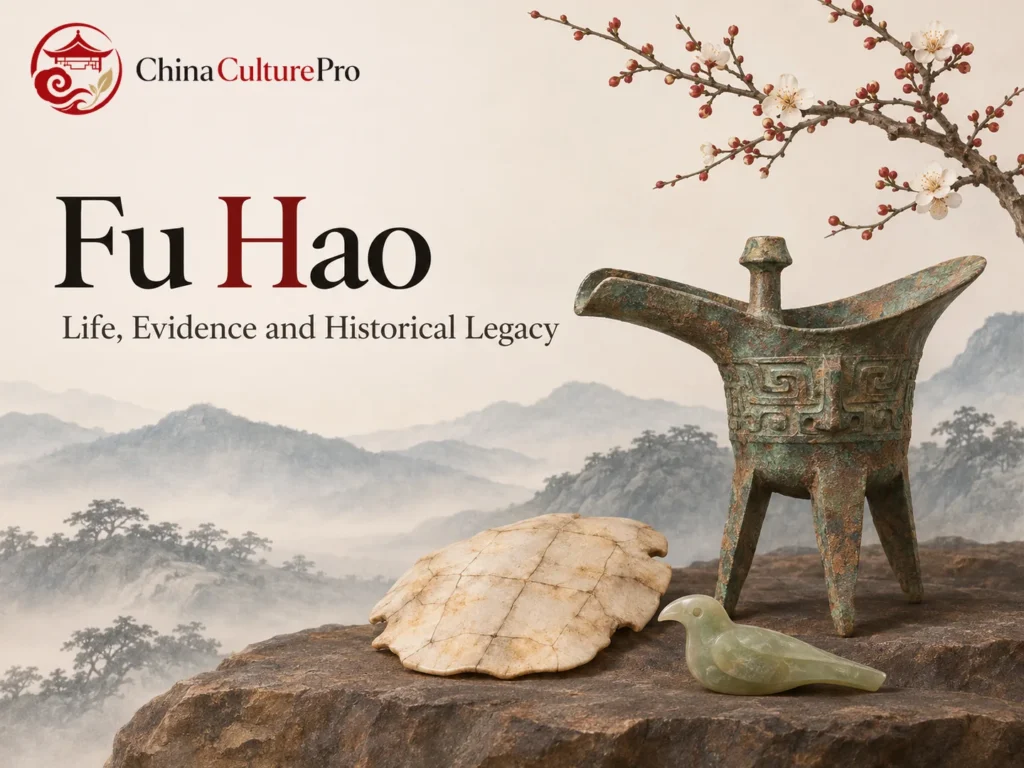

Quick Answer: Who Was Fu Hao?
Fu Hao (妇好, Fù Hǎo) was a royal consort of the Shang king Wu Ding (武丁, Wǔ Dīng), remembered for military and ritual responsibilities. Her history is reconstructed from inscriptions and a richly furnished tomb, rather than a continuous account of her life.[1]
- Setting: Lived in the late Shang royal world centered on Anyang.
- Activities: Appears in records concerning warfare, ritual and royal family life.
- Archaeology: Her tomb, excavated in 1976, preserved an unusually complete group of burial objects.[1][2][4]
“Royal consort” describes her relationship to the king; it does not mean she ruled the entire kingdom as a reigning monarch.

Fu Hao stands out because a named woman in early writing can be connected with a royal burial. The two bodies of evidence illuminate her authority and material world, while leaving gaps that modern portraits, dramatic biographies and romantic stories cannot securely fill.
Fu Hao in the Late Shang Royal World
Fu Hao belonged to the late Shang dynasty, whose royal center lay near modern Anyang in Henan. The archaeological site is known as Yinxu (殷墟, Yīnxū). Palaces, ancestral shrines, tombs and writing place her within a complex Bronze Age state.[4]
Chronological estimates differ: the tomb is sometimes dated around 1250 BCE, while other accounts place Fu Hao around 1200 BCE. Neither is a securely recorded birth year. Her association with Wu Ding’s court is more useful than a falsely precise modern lifespan.[1][2]
Her importance combines family position with responsibilities outside the household. She should not be reduced to a warrior detached from the royal court, or to a consort whose authority was entirely domestic.
What the Oracle Bones Reveal About Her Life
Oracle-bone inscriptions (甲骨文, jiǎgǔwén) record royal divination and related information. Fu Hao appears in questions concerning campaigns, ritual, childbirth, illness and other activities. A military inscription associated with her concerns a campaign against the Tu Fang, providing more concrete evidence than the weapons in her tomb alone.[2]
One surviving turtle plastron, cataloged as Ping 0247, concerns the expected fortune and sex of a child born to Fu Hao. Its recorded findspot is pit YH127 at Xiaotun. This is a specific example of writing about her family life, and also shows that the inscriptions did not all come from her burial.[6]
A divinatory question is not automatically a report that an action occurred. Its wording may concern a proposed campaign or an uncertain outcome. Reading oracle-bone writing therefore requires attention to whether a passage records an inquiry, a prediction or an observed result. A childbirth question alone cannot establish the cause of Fu Hao’s death.[6]
The Tomb Excavated at Anyang in 1976
The tomb excavated in 1976 is known as M5.[2] It lay within the palace-and-ancestral-shrine area, outside the principal royal cemetery. Its survival without ancient looting preserved objects in their burial context, connecting a named royal woman with material remains.[1][4]
The published inventory includes 1,928 objects, among them 468 bronzes and 755 jades. These categories belong within the object total; cowrie shells are reported separately.[2]
The burial also included human and animal sacrifices. These remains belong to the coercive practices of the Shang royal world. An account of the tomb’s craftsmanship should acknowledge that context alongside the richness of its objects.[1]
Weapons, Ritual Vessels and Royal Authority
Large bronze axes known as yue (钺, yuè), including examples bearing Fu Hao’s name, can express military authority. Their ceremonial significance matters: a prestigious weapon in a burial does not prove that its owner personally wielded that exact object in a particular battle.[2]
Ritual vessels show another aspect of court life. A four-legged gong (觥, gōng), a bronze wine vessel excavated from the tomb and held by Henan Museum, combines animal forms and inscriptions. Such vessels belonged to practices of serving, offering and ceremony; they were not simply decorative trophies.[3]
The functions of Chinese bronze vessels help explain why a burial could contain both ritual equipment and weapons. Categories of authority overlapped, while the meaning of an individual object still depends on its form, inscription and archaeological setting.[3]
How Archaeology Shapes Her Historical Legacy
Material analysis can add evidence unavailable from appearance alone. Research on a jade parrot from the tomb identified mineral changes associated with heating in antiquity. The researchers interpreted the result as evidence for jade used in burnt offerings. It does not identify which ceremony Fu Hao personally performed.[5]
Her case is important for the history of women because it preserves a named royal woman with responsibilities in warfare and ritual. One exceptional elite biography, however, does not establish that every Shang woman had the same opportunities or status.
The distinction between historical evidence and later storytelling protects the most interesting part of her legacy: inscriptions and objects can be studied together without inventing her appearance, private conversations or a complete sequence of battles. Her identity can be supported by several kinds of evidence, even though the surviving account of her life remains incomplete.
FAQs About Fu Hao
Was Fu Hao a ruler of China?
She was a royal consort of Wu Ding with military and ritual responsibilities. The evidence does not identify her as a reigning monarch over the Shang kingdom.[1]
Were the oracle bones found inside Fu Hao’s tomb?
They are distinct archaeological evidence sets. For example, the childbirth plastron Ping 0247 came from pit YH127, not tomb M5.[6]
Were all the objects in her tomb weapons?
No. The assemblage included ritual vessels, jades and many other objects. Weapons form one part of a much broader burial group.[3]
Sources
[1] University of Washington, A Visual Sourcebook of Chinese Civilization. Shang Tomb of Fu Hao
[2] Han Ding, Chinese Social Sciences Net. 见器如晤——在考古材料中遇见多面的妇好
[3] Henan Museum. 司母辛四足觥
[4] UNESCO World Heritage Centre. Yin Xu
[5] Rong Wang, Chang-sui Wang and Ji-gen Tang. A jade parrot from the tomb of Fu Hao at Yinxu and Liao sacrifices of the Shang Dynasty
[6] Museum of the Institute of History and Philology, Academia Sinica. Inscribed Plastron Ping 0247