


Quick Answer: Who Was Xugu?
Xugu (虚谷, Xū Gǔ; died 1896), also written Xu Gu, was a nineteenth-century monk-painter from She county, Anhui. Known under the earlier name Zhu Huairen, he became associated with Shanghai’s painting world. [1]
- Subjects: Squirrels, goldfish, flowers, fruit and landscapes gave him varied settings for experimentation.
- Style: Dry, angled brushwork could coexist with delicate color and wet ink.
- Career: He made a living through painting while moving between Yangzhou, Suzhou and Shanghai. [5]
His monastic identity does not make every subject a religious image.
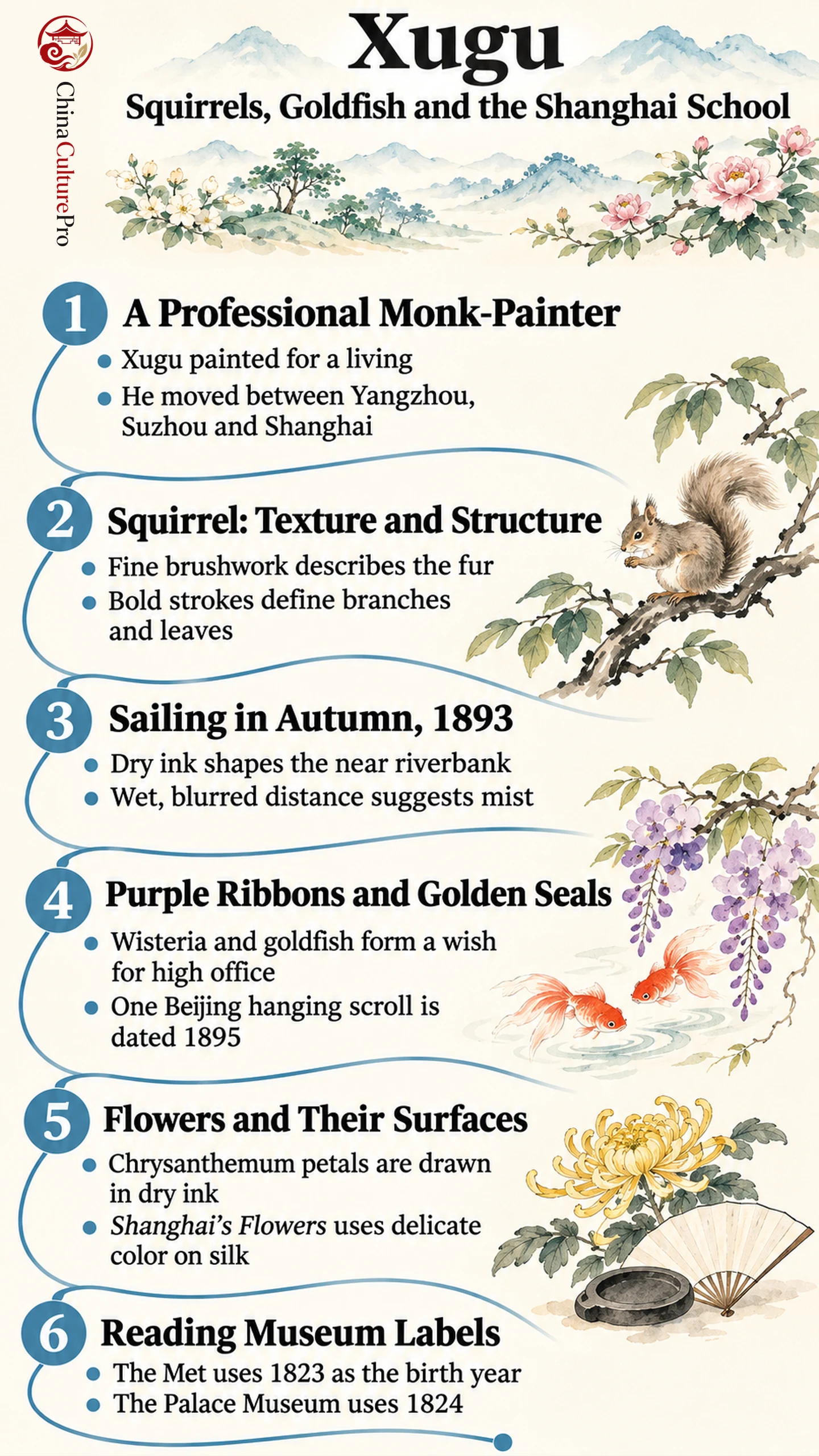
Xugu could make a squirrel’s fur look finely textured, a branch boldly abbreviated and a goldfish unexpectedly angular. His handling changes with the visual task.
A Monastic Name and a Professional Career
During the Qing dynasty, Xugu left a military career amid the Taiping conflict and became an itinerant monk. Painting remained his livelihood, and Shanghai became an important setting for his later career. [6]
The Shanghai School (海上画派, Hǎishàng huàpài) names the artistic milieu in which he developed a distinctive manner. His acquaintances included Ren Bonian, also called Ren Yi, and Hu Gongshou. [9]
The combination of monastic identity, professional work and everyday subjects helps explain his range. Fruit, flowers and animals could address patrons’ interests as well as an artist’s interest in visual form.
Dry Brush, Light Color and Lively Animals
In Beijing’s Wisteria and Goldfish (125 × 66 cm), side-tip brushwork (侧锋, cè fēng) gives the vines broken, rhythmically interrupted marks. [9]
In Squirrel on an Autumn Branch, fine strokes describe fur while broader strokes establish branches and leaves. The contrast joins close observation with simplified forms. [2]
Boneless painting (没骨, mò gǔ), which builds forms without enclosing outlines, provides another approach. Shanghai’s Flowers handscroll uses delicate color on silk with crisp, vigorous handling. [1]
When comparing brush techniques, separate texture from contour. A fuzzy surface, a dry broken edge and a transparent color wash each organize a different part of the image. Such combinations also complicate a rigid opposition between detailed and freehand approaches.
Wisteria and Goldfish: An Auspicious Combination
Purple Ribbons and Golden Seals (紫绶金章, zǐ shòu jīn zhāng) links hanging wisteria and goldfish with emblems of high office. The purple ribbon and golden seal were signs of rank; the painted combination offers a wish for success and distinction. [4]
Xugu’s 1895 version uses three large red goldfish and a small contrasting fish. The goldfish have broad foreheads, ample bellies and exaggerated eyes, with their bodies compressed into angular shapes. This deliberate stylization gives them a distinctive character. [4]
Look at their direction of movement beneath the hanging plant. The contrast between floating animals and descending vines creates activity without needing a fully described pond.
Four Museum Works to Compare
Sizes refer to the image area rather than its mounting. The formats offer different viewing experiences.
| Work | Date and collection | Format, material and size |
|---|---|---|
| Squirrel on an Autumn Branch | Circa 1880s; Metropolitan Museum of Art | Folding fan mounted as an album leaf; ink and color on alum paper; 18.4 × 48.3 cm. [2] |
| Sailing in Autumn | 1893; Metropolitan Museum of Art | Album leaf; ink and color on paper; 35.9 × 91.1 cm. [3] |
| Purple Ribbons and Golden Seals | 1895; Palace Museum, Beijing | Hanging scroll on paper; 115.5 × 47.3 cm. [4] |
| Chrysanthemums | Undated, Qing dynasty; National Palace Museum, Taipei | Hanging scroll on paper; 110.3 × 31.4 cm. [5] |
Landscape, Flowers and a Later Admirer
Sailing in Autumn uses dry ink nearby and wetter, blurred ink in the distance to convey intervening mist. Its loose strokes describe low riverbank vegetation. [3]
This gives a concrete comparison with landscape painting: ask how the same brush changes with distance. Then compare Chrysanthemums, whose dry outlined petals, light and dark leaves and small yellow accents create another balance of wet and dry. [5]
Fruit pictures could also carry wishes for prosperity. Cleveland’s Pipa (Loquats) connects abundant fruit with wealth and abundance, appealing to patrons within the market for paintings. [6]
Xugu’s legacy extended beyond his lifetime. Singapore artist Chen Wen Hsi admired him among earlier ink masters known for individualistic practice. That later engagement carried Xugu’s example into a different twentieth-century artistic setting. [8]
FAQs About Xugu
Was Xugu born in 1823 or 1824?
Museum records differ: the Met uses 1823–1896, while the Palace Museum uses 1824–1896. Both records identify the same nineteenth-century artist. [2][4]
Why do his goldfish sometimes look angular?
He deliberately simplified their bodies into block-like forms while exaggerating features such as the eyes and belly. Shape becomes an expressive choice. [4]
Is every painting bearing Xugu’s name securely attributed?
No. Birmingham’s Wisteria and Goldfish is catalogued as “attributed to Xu Gu.” A name in an inscription and a museum’s attribution are different kinds of evidence. [7]
Sources
[1] Shanghai Museum. Flowers
[2] Metropolitan Museum of Art. Squirrel on an Autumn Branch
[3] Metropolitan Museum of Art. Sailing in Autumn
[4] Palace Museum. Purple Ribbons and Golden Seals
[5] National Palace Museum, Taipei. Chrysanthemums
[6] Cleveland Museum of Art. Pipa (Loquats)
[7] Birmingham Museum of Art. Wisteria and Goldfish, Attributed to Xu Gu
[8] Low Sze Wee, Singapore Chinese Cultural Centre. Pioneer Artist: Chen Wen Hsi
[9] Palace Museum. Wisteria and Goldfish