


Quick Answer: What Is Yangtze River in 1974?
Yangtze River in 1974(一九七四年·长江,Yī jiǔ qī sì nián · Chángjiāng)is an oil panorama by Wu Guanzhong(吴冠中,Wú Guànzhōng), made as a draft for a proposed mural.[1]
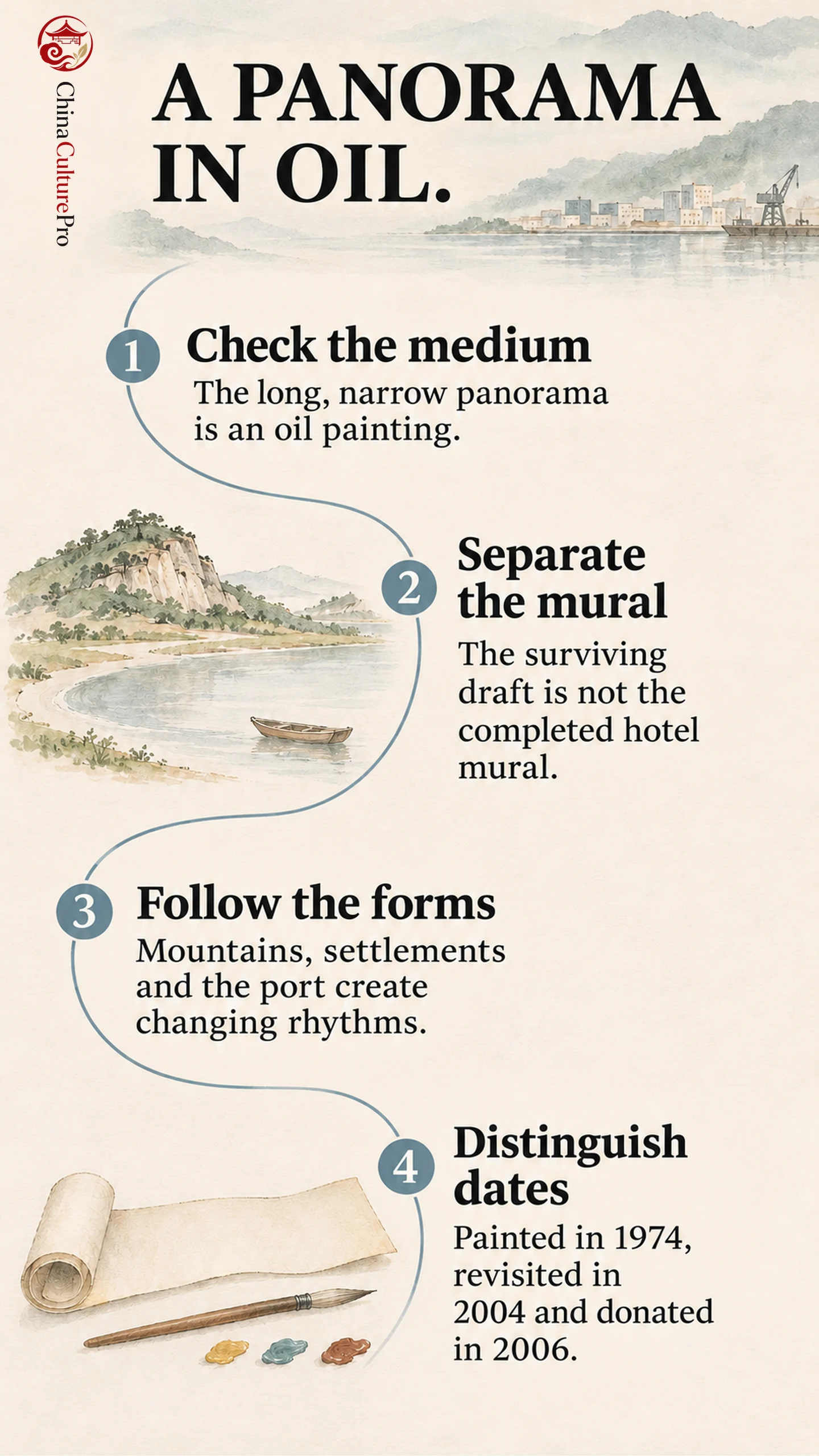
- Format: A very long, shallow painted band.
- Visual range: Snowy mountains, steep cliffs, wooded land, settlements and a port.
- Central distinction: The surviving draft and the intended wall painting are different things.
The work asks viewers to follow a changing landscape sequence, rather than absorb every part from one fixed position.
A narrow painted band carries mountains and towns across an unusually broad field. Pale peaks give way to darker cliffs, then trees, cultivated ground and crowded waterfront structures. Its continuity comes from changing shapes and colours: each passage has a local character while preparing the eye for another stretch of the journey.
An Oil Panorama in a Long Scroll Format
Wu’s own account gives the dimensions as 19.5 × 603.1 cm. The work is an oil painting on paper, later prepared for display.[1][2] At more than six metres long but under twenty centimetres high, it resists the proportions of a conventional framed landscape.
The long-scroll format helps explain how to look. A reduced whole-image photograph establishes the sequence, while closer details reveal transitions between neighbouring passages. Neither view replaces the other: a tiny panorama can hide the brushwork, while an isolated detail can hide its place in the progression.
The Tsinghua University archive supplies a panoramic reproduction for study.[3] In it, the changing heights of the land, the openings of water and the recurrence of dark vegetation keep the eye moving. The format creates duration as well as breadth.
The Beijing Hotel Mural Project
In his later account, Wu connected the draft to a planned collaborative mural for the Beijing Hotel(北京饭店,Běijīng Fàndiàn). The campaign against black paintings(批黑画,pī hēihuà)brought that mural plan to an end.[1]
This context gives the surviving object a precise status. It is a developed pictorial proposal, with a broad arrangement already worked out, but it is not evidence that the planned wall painting was completed.
The scale makes that distinction tangible. A narrow strip can bring many episodes together for comparison, letting the artist test how they belong to a larger whole. Looking at a draft in this way means attending to its decisions about spacing, emphasis and transition, rather than treating it only as an incomplete version of something else.
Following Changes from Mountains to the Port
Begin with the snowy peaks toward the left. Their pale angular faces stand above a darker band of trees. Small warm accents interrupt the cool, grey-white mass. The strong contrast establishes a high, distant terrain without requiring every summit to be individually named.
Farther along, blocks of buildings gather against darker hills. Steep cliffs create a different rhythm: tall faces and deep divisions replace the peaks’ more broken silhouette. The water provides a lower, more continuous passage beside them.
The middle stretch alternates heavy vegetation with misty openings. Slender stems form a dense upright rhythm in one foreground, while distant pale peaks emerge beyond darker tree masses. A small red disc in the sky becomes especially noticeable because the surrounding colours are restrained.
Toward the right, red-pink flowering branches spread across the foreground. Behind them, low fields and water lead toward tightly grouped black-and-white houses. The compact blocks of those houses contrast with the more open arrangement of white buildings farther along.
The final port passage introduces repeated dark diagonals of cranes, small vessels and a wide opening of water. Slopes and engineered structures both contribute to the rising and falling forms.
Comparing these passages makes technique visible: a thin line can separate buildings or describe a stem, while a broader patch establishes a cliff or wooded mass. The recognisable subjects also work as contrasting shapes within the larger panorama.
For a different viewing exercise, compare another painting by Wu. Ask how a compact architectural composition organizes attention compared with this extended journey.
Revisiting the Draft and the Palace Museum Donation
Contemporary reporting describes the draft’s rediscovery in Wu’s home in 2004. Its title and added inscription distinguish the original 1974 painting from his later return to it.[2] These dates belong to different moments in the object’s history.
The Palace Museum records the work’s donation in 2006.[4] It entered the museum as a work in its own right, carrying both its early project history and its later rediscovery.
As landscape painting, the panorama brings a wide territory into one constructed sequence. Following its changes does not require treating every transition as a literal geographical junction.
FAQs About Yangtze River in 1974
Is Yangtze River in 1974 an ink painting?
No. It is an oil painting, despite its scroll-like proportions.[1]
Was this the completed Beijing Hotel mural?
No. It was a draft associated with a mural project that did not proceed.[1]
Does the panorama work as a geographical map?
No. Wu described a broader landscape conception, extending beyond only the river’s banks.[2]
Sources
[1] Wu Guanzhong, statement reproduced in Oriental Outlook. On Yangtze River in 1974: the artist’s account and dimensions
[2] Xiao Yang and Liu Lifeng, Beijing Youth Daily, republished by Sina. Wu Guanzhong’s oil panorama returns to public view
[3] Tsinghua University, Wu Guanzhong Archive. Yangtze River in 1974: panoramic image record
[4] Palace Museum. Opening of the exhibition of works donated by Wu Guanzhong