

Quick Answer: What Is Wuyangzi in Self-Cultivation?
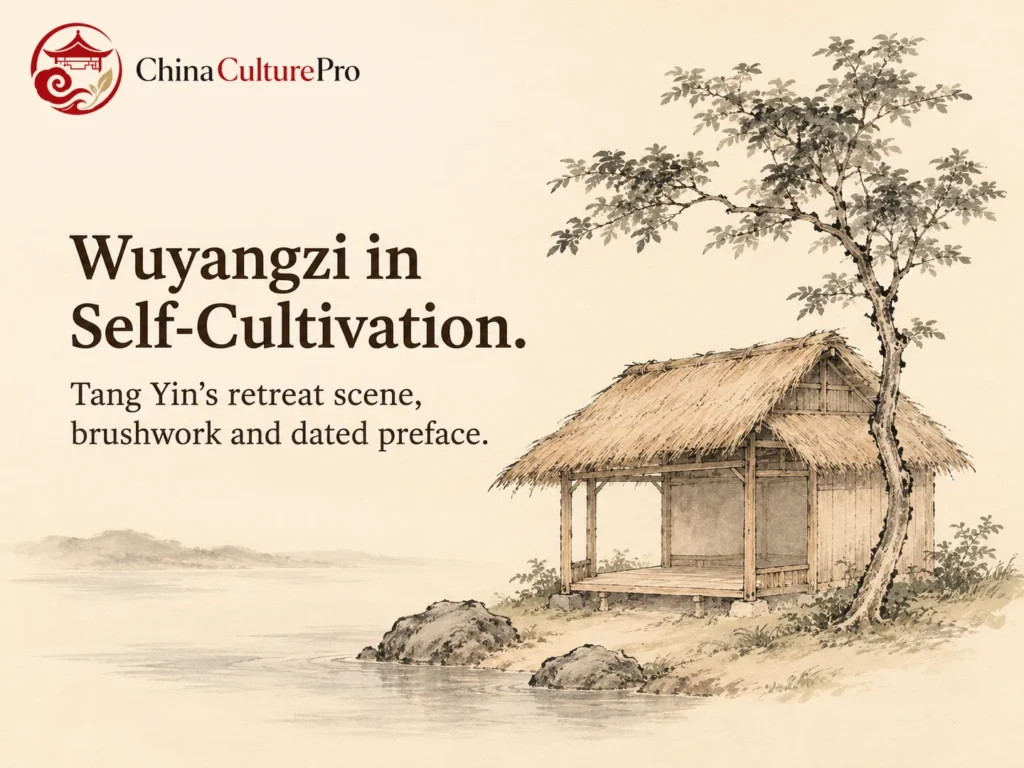
Wuyangzi in Self-Cultivation(悟阳子养性图,Wùyángzǐ yǎngxìng tú)is an ink handscroll by Tang Yin(唐寅,Táng Yín)in the Liaoning Provincial Museum. It presents a seated scholar within a wooded riverside retreat.[1]
- Subject: A retired official known by the name Wuyangzi.
- Composition: An open stretch of water balanced by trees, rocks and a cottage.
- Combined arts: A painting accompanied by literary writing in the scroll.
The title concerns cultivated retirement. Its quiet setting is a constructed pictorial presentation of that ideal, rather than a record of every detail of the sitter’s daily life.
An open expanse of water occupies much of the right side. At the left, trees crowd around a modest building, where a man sits on a circular mat. The contrast makes the small interior unusually absorbing: a restrained figure becomes the still centre of an active landscape of leaning trunks and broken rock edges.
An Ink Handscroll About Gu Mi’s Retirement
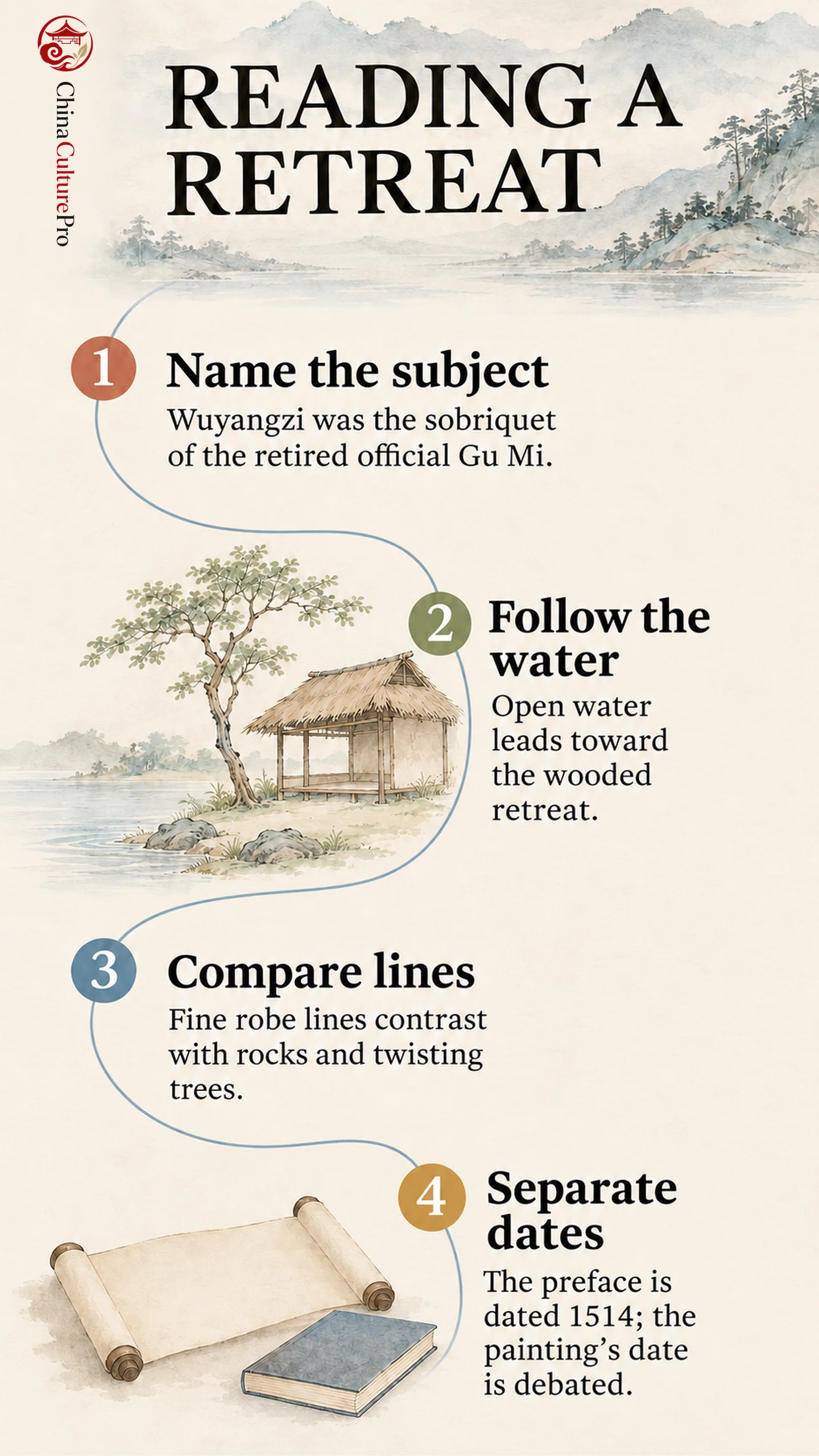
The subject is Gu Mi(顾谧,Gù Mì), a retired official from Chongming who used Wuyangzi as his sobriquet. Chongming’s cultural account associates his withdrawal from office with the work’s presentation of cultivated retirement.[2] This gives the name in the English title a particular human referent; it is not a general label for anyone practising contemplation.
The painting is horizontal and executed in ink on paper. In the handscroll format, the picture can be encountered progressively from right to left. The relatively empty opening and the more densely worked retreat therefore form a sequence, as well as a balance visible in a photograph of the whole image.
Neither its modest architecture nor its solitude makes the scene a portrait of Tang himself. The named subject gives the retreat a specific social purpose: it honors Gu Mi’s retirement.
Looking from Open Water to the Seated Figure
Start at the low bank on the far right. Bare branches rise above its edge, while small dark shapes punctuate the water beyond. Faint horizontal washes suggest distance, leaving the larger pale area comparatively uninterrupted.
The nearer bank enters from the lower edge and builds toward the left. Rocks overlap, and a large twisting trunk rises beside the cottage. Its branching movement points across the roof rather than enclosing the building symmetrically. Other trunks behind it produce a loose, uneven screen.
A short crossing over the narrow channel appears below and to the left of the building. That detail connects the retreat to traversable ground. The scholar is secluded, yet the composition does not present his dwelling as physically inaccessible.
The quiet scene gains tension from these contrasts. The sitter stays within a clear architectural rectangle, while the trees surrounding him bend, split and extend beyond it. The extensive water keeps the compact human setting from filling the entire world of the picture.
Lines, Ink and the Cottage Interior
Inside the cottage, the robe is described with economical, controlled lines. Curves gather around the bent legs, and angular changes articulate the fabric near the knees and sleeves. The circular woven mat separates the figure from the rectangular platform beneath him.
A small table holds books and an incense vessel. These objects introduce cultivated activity without crowding the room. The sitter’s slightly raised face directs attention outward; the photograph does not disclose the content of his thoughts.
Compare that fine drawing with the nearby rocks. Their darker, broader marks interrupt the pale surfaces, while lines along the banks define changes of level. The trees combine outlined trunks with knots, branching shapes and varied touches of ink. These differences in brushwork distinguish the person, the built shelter and the surrounding ground.
The image belongs within the social world of literati painting, where a retreat could honor a particular person and express values associated with withdrawal. Its visual specificity matters as much as that broad cultural category.
Wen Zhengming’s Preface and the Dating Question
The accompanying preface by Wen Zhengming(文徵明,Wén Zhēngmíng)is dated to the ninth lunar month of 1514. A Palace Museum study by Yang Xin argues that the painting may have been added afterward, since the preface does not mention a picture. An earlier study by Wang Zhongxu instead associates the painting with the preface’s year.[3][4]
These are interpretations of the relationship between components. The date attached to Wen’s writing should be distinguished from a date inscribed by Tang on the painting.
A later note by Lu Shidao(陆师道,Lù Shīdào)praises the refined trees and rocks and the figure’s elegance, linking Tang’s manner to the Southern Song painter Li Tang.[4] That historical response adds another voice to the scroll. Reading inscriptions and seals by author and position helps keep the painter, literary contributor and later viewers distinct.
FAQs About Wuyangzi in Self-Cultivation
Is Wuyangzi a portrait of Tang Yin?
No. The named subject is Gu Mi, whose sobriquet was Wuyangzi.[2]
Was the painting certainly made in 1514?
No. Wen’s preface carries that date; the relationship between its date and the painting has been interpreted differently.[3][4]
What does self-cultivation mean in the title?
It refers to the cultivated retirement associated with the subject, expressed through his retreat and contemplative pose.[2]
Sources
[1] Suzhou Museum, published by Museum China. Gusu Prosperity exhibition: Tang Yin’s Liaoning handscroll and its photograph
[2] Chongming Culture and Tourism, republished through Shangguan News. Gu Mi in the painting and calligraphy of Tang Yin and Wen Zhengming
[3] Yang Xin. Questions concerning Tang Yin’s painting and calligraphy, part two: page 134
[4] Wang Zhongxu. Tang Yin’s Fengmu Tu: dating, function and creative context, relevant discussion on pages 66–68