

Quick Answer: What Is Wild Flowers by the Rock?
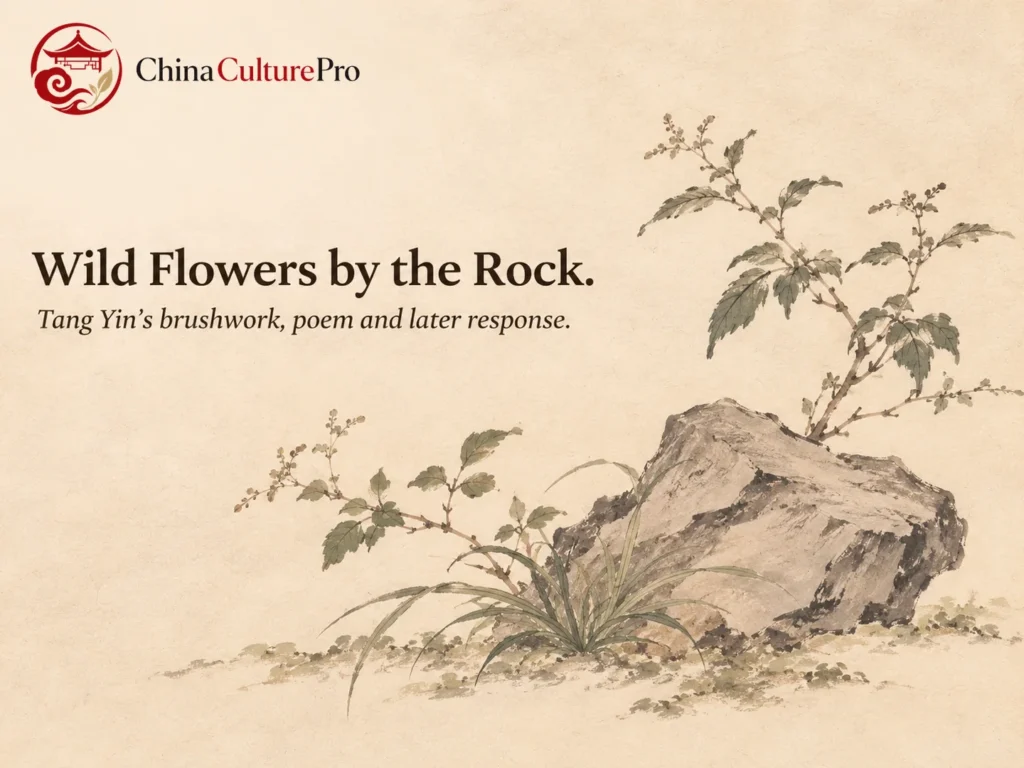
Wild Flowers by the Rock(野芳介石,Yěfāng jièshí)is an ink painting by Tang Yin(唐寅,Táng Yín)in the National Palace Museum, Taipei. Also catalogued in English as Wildflowers Around a Rock, it brings a tall rock and low-growing plants into a compact vertical composition.[1]
- Object: A paper painting catalogued as a leaf in an album.
- Main contrast: A large, angular rock above smaller, branching plants.
- Written meaning: The artist’s poem connects the scene with an upright person’s plain life.
A separate facing leaf carries later imperial poems, not more writing by Tang.

A tall rock bends above a small cluster of plants. Its weight, rough surface and projecting edges contrast with the delicate growth at its foot. The inscription gives these ordinary forms a moral dimension, while the paired mounting invites a second encounter with a later reader’s response.
A Painting Leaf with a Separate Facing Inscription
The painted component measures 52.6 × 28.6 cm and is on paper. The facing calligraphy component is recorded separately at the same dimensions. In the present album arrangement, the painting occupies the right side and the later writing the left; the surrounding mount also contains seals and a narrow identifying label.[1]
This arrangement matters when looking at reproductions. A photograph of the painting alone removes the facing text and much of the mounting. A photograph of the complete pair introduces writing that belongs to another hand. Neither image should be mistaken for a record of a single uninterrupted surface painted and written entirely by Tang.
The distinction also complements the differences between hanging scrolls and handscrolls. Here, the album record is the relevant description of the object’s present format. It does not establish who first assembled every element now surrounding the painting.
Rock, Flowers and the Different Kinds of Brushwork
Start with the rock’s silhouette. Its broad upper projection leans left, while a smaller outcrop pushes to the right farther down. Between them, the body narrows and twists. This uneven profile makes the stone more active than a simple upright pillar.
Inside that silhouette, closely spaced strokes follow the changing surfaces. Darker edges give the projecting parts a sharper presence; lighter passages prevent the central mass from becoming a solid black shape. The rock’s bulk emerges from changes in direction and density.
At the lower left, long leaves spread outward near the ground. Finer stems and smaller leaf marks rise beside the stone, creating a more open structure. Open gaps distinguish the plant marks from the dense rock texture above. Compare these different marks as examples of brushwork in Chinese painting: the same ink medium describes weight, roughness and fragile growth without treating them alike.[1]
The Artist’s Poem and the Ideal of Integrity
Tang’s inscription consists of four five-character lines followed by his name. The opening pair evokes mixed flowers brightening spring and a solitary peak marked by accumulated rain. The closing pair compares the scene to an upright person of antiquity who remains content with the plainest sustenance.[1]
The poem changes the scale of the rock. On the sheet it stands beside small plants; in the verse it becomes a lone peak. This movement between a close-up object and a larger imagined presence gives the modest subject unusual weight. The plants’ seasonal vitality and the stone’s enduring form become companions within the same image.
The ancient upright person in the closing lines makes moral steadfastness a supported reading of the scene. Scholarship has also interpreted the flowers and rock as a vehicle for the artist’s self-comparison, emphasizing an independent, upright character. That is an interpretation of poetic self-expression, not evidence that the stone represents a specific event in Tang’s life.[2] It connects the work with Chinese literati painting, where an ordinary motif can carry a personal stance.
A Later Imperial Response on the Facing Leaf
The Qianlong(乾隆,Qiánlóng)emperor’s facing inscription contains two short poems responding in Tang’s rhymes. Its opening images return to the painted subject: cloud-like atmosphere at the rock’s foot and traces of dew around the flowers. Words concerning wildness, uprightness and roots carry the response beyond a simple inventory of objects.[1]
Seen together, the two leaves create a dialogue across time. Tang’s smaller writing shares the picture with the rock and plants. The emperor’s larger characters occupy their own surface. That difference in placement lets the viewer distinguish the original image-and-poem relationship from a later act of appreciation.
Inscriptions and seals help identify these layers. The artist’s name, the facing poems and the marks in the mounting contribute different kinds of evidence; they should be read in relation to their positions rather than treated as one author’s statement.
FAQs About Wild Flowers by the Rock
When did Tang Yin paint Wild Flowers by the Rock?
The catalogued artist’s inscription gives no year. The work belongs to his Ming-dynasty career, but an exact creation date is not established here.[1]
Why does a monochrome painting have a poem about spring colour?
The verse expands the ink image through seasonal imagination. Its description need not match a literal pigment palette.[1]
Do the flowers identify a specific species?
The catalogue describes wild plants generally. Assigning a precise species from these brush marks would go beyond that evidence.[1]
Sources
[1] National Palace Museum, Taipei. Wildflowers Around a Rock
[2] Zheng Wenhui. Poetry and painting: a study of Tang Yin’s painting inscriptions, relevant discussion on pages 94–95