
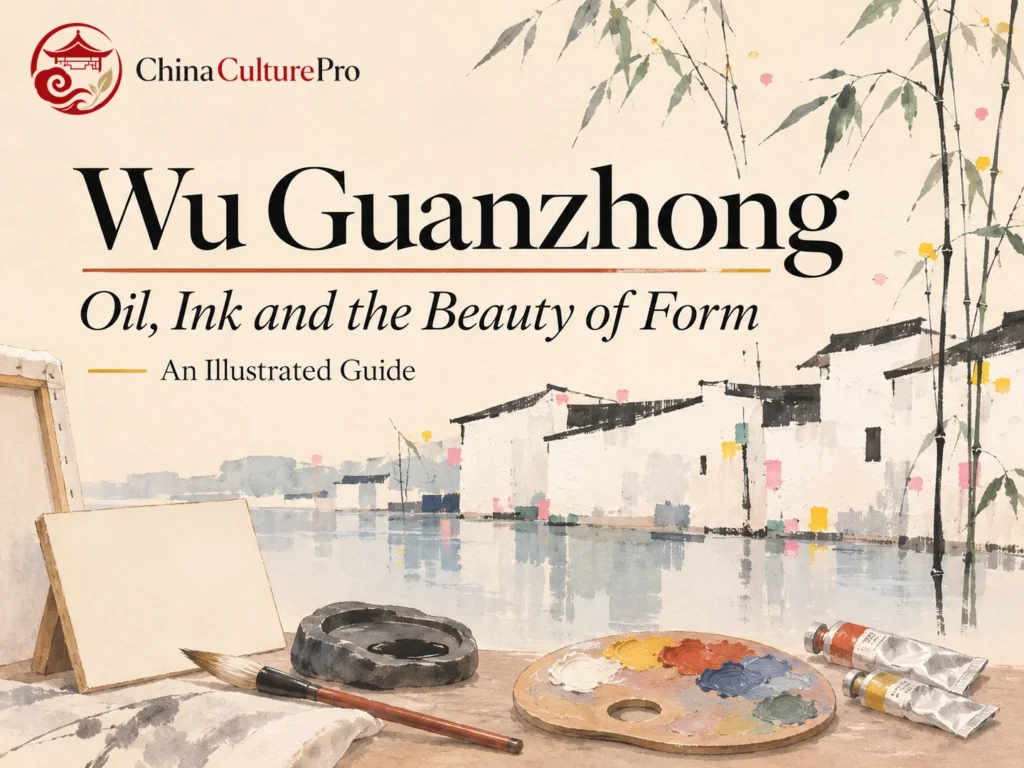

Quick Answer: Who Was Wu Guanzhong?
Wu Guanzhong (吴冠中, Wú Guànzhōng; 1919–2010) was a modern Chinese painter who worked in both oil and ink. He connected Chinese pictorial traditions with Western modern art through rhythmic lines, simplified forms and carefully organized color. [4]
- Media: His career includes oil paintings and works in ink and color on paper.
- Subjects: Villages, trees and familiar places supplied material for formal experimentation.
- Viewing question: Notice how dots, lines and planes change a recognizable scene. [4][7]
This guide compares particular museum works and studies; paintings with similar titles can be different objects.
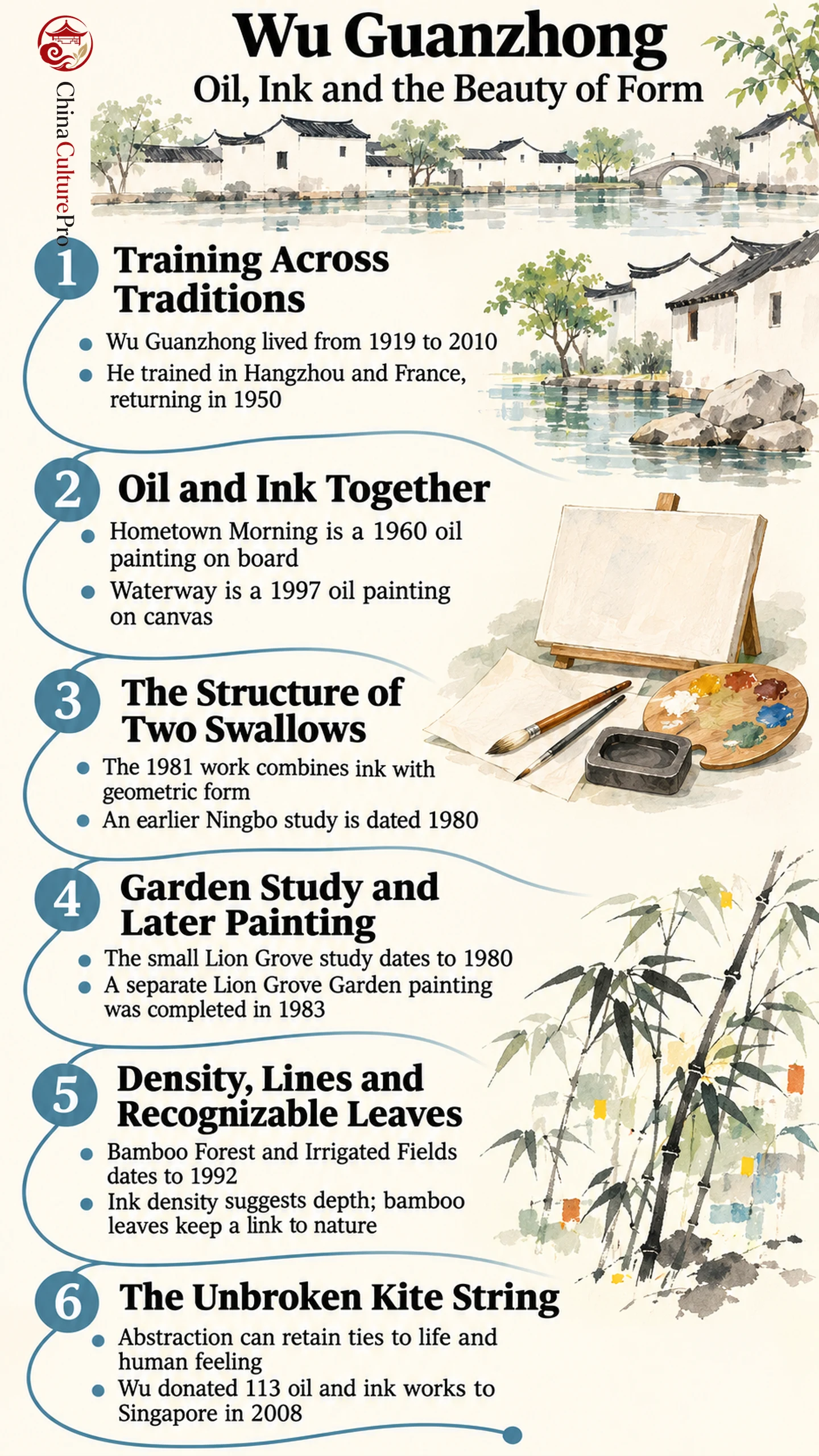
A white wall can become a plane, a roof edge a dark line, and a stand of bamboo a repeated vertical rhythm. Wu’s paintings ask viewers to notice these relationships while retaining a connection to lived experience.
Training in China and France
Born in Yixing, Wu studied with Lin Fengmian and Pan Tianshou in Hangzhou, trained in France from 1947, and returned in 1950. [1]
The crossing of oil and ink, rather than a fixed East–West division, is central to his place in Chinese painting. [4]
Oil and Ink: Shared Questions of Form
Wu’s increasingly abstract compositions retain identifiable features of landscape painting. In Bamboo Forest and Irrigated Fields, dated 1992, the Musée Cernuschi describes overlapping zones differentiated by ink density. Undulating washes suggest water, vertical lines evoke forest, and recognizable bamboo leaves keep the image connected to its subject. Color appears as scattered drops. [5]
His ink handling creates depth through density and rhythm: the same line can describe a stem and organize a larger pattern. [5]
Wu’s own statements, presented by Tsinghua University, emphasize composition, movement, density and the relationship of points, lines and planes. Subject matter alone does not explain a painting’s visual strength. Looking at these relationships provides a clearer route into his art than treating every image as a literal record of a place. [7]
Four Museum Works: Materials, Dates and Scale
The table distinguishes board, canvas, finished ink painting and a small study. Sizes are height × width.
| Work | Date and collection | Medium and size |
|---|---|---|
| Hometown Morning | 1960; National Gallery Singapore | Oil on board; 61.4 × 45.9 cm. [3] |
| Two Swallows | 1981; Hong Kong Museum of Art | Ink and color on paper; 69 × 138 cm. [2] |
| The Lion Grove Garden of Suzhou, study | 1980; Hong Kong Museum of Art | Ink on paper; 23.3 × 33 cm. [1] |
| Waterway | 1997; Hong Kong Museum of Art | Oil on canvas; 73 × 60 cm. [2] |
Two Swallows, Garden Studies and Abstraction
Jiangnan (江南, Jiāngnán), his home region, supplied pale walls and dark roofs. Two Swallows combines ink and geometry; its 1980 Ningbo study precedes the finished 1981 painting. [1]
The Lion Grove study explores interlocking rock forms in Chinese gardens, making observed scenery a source for abstract composition. [1]
A separate Lion Grove Garden painting, completed in 1983, appeared in Orientations in 1984, according to the museum’s timeline. [6]
The Unbroken Kite String and His Legacy
Wu’s unbroken kite string (风筝不断线, fēng zhēng bù duàn xiàn) expresses an enduring connection between artistic invention, life and human feeling. In the statements reproduced by Tsinghua, the kite can travel farther while its link remains. Abstraction need not mean cutting off communication with viewers. [7]
This idea helps explain why a bamboo leaf or recognizable building can remain inside an otherwise highly abstract picture. The motif supplies a point of contact; lines, spacing and color develop an independent visual rhythm around it. [5][7]
His legacy includes teaching, writing and public collections. In 2008 he donated 113 oil and ink works to Singapore’s national collection. The museum’s account also names Shitao among his sources of inspiration, showing that his experiments involved older Chinese art as well as European painting. [4]
FAQs About Wu Guanzhong
Was Wu Guanzhong an oil painter or an ink painter?
Both. The 1997 Waterway is an oil painting, alongside his extensive ink practice. [2][4]
Are the Lion Grove study and the 1983 painting the same work?
No. Hong Kong’s study dates to 1980; 1983 identifies a separate painting. [1][6]
Did his abstract paintings abandon real life?
No. His kite-string metaphor preserves a link to life and viewers’ emotions. The organization of form transforms experience rather than requiring an exact visual transcription. [7]
Sources
[1] Hong Kong Museum of Art. The Paintings and Personal Archives of Wu Guanzhong
[2] Hong Kong Museum of Art. Wu Guanzhong: Between Black and White
[3] National Gallery Singapore. Exhibitions on Chua Ek Kay and Wu Guanzhong
[4] National Gallery Singapore. National Art Gallery Mourns Wu Guanzhong
[5] Musée Cernuschi. Wu Guanzhong, Bamboo Forest and Irrigated Fields
[6] Hong Kong Museum of Art. Wu Guanzhong: Sixty Years of Encounters with Hong Kong
[7] Tsinghua University, Academy of Arts and Design. Art Nurtures Life: Celebrating 100 Years of Wu Guanzhong