


Quick Answer: Who Was Pan Tianshou?
Pan Tianshou (潘天寿, Pān Tiānshòu; 1897–1971) was a modern Chinese painter and teacher known for forceful compositions and freehand painting (写意画, xiěyì huà).[1]
- Forms: Large angular masses work against open areas.[6]
- Methods: Finger painting (指画, zhǐhuà) gave him another way to make lines and broad ink shapes.[6]
- Teaching: He helped organize specialized training in Chinese painting.[5]
Compare the balance of the whole composition before concentrating on a bird, flower or rock.
A small bird can hold its place beside a huge rock when their positions, outlines and surrounding spaces are carefully balanced. Pan Tianshou built much of his art around such relationships, giving familiar natural subjects a strong structural presence.
Learning from Tradition in a Modern Art School
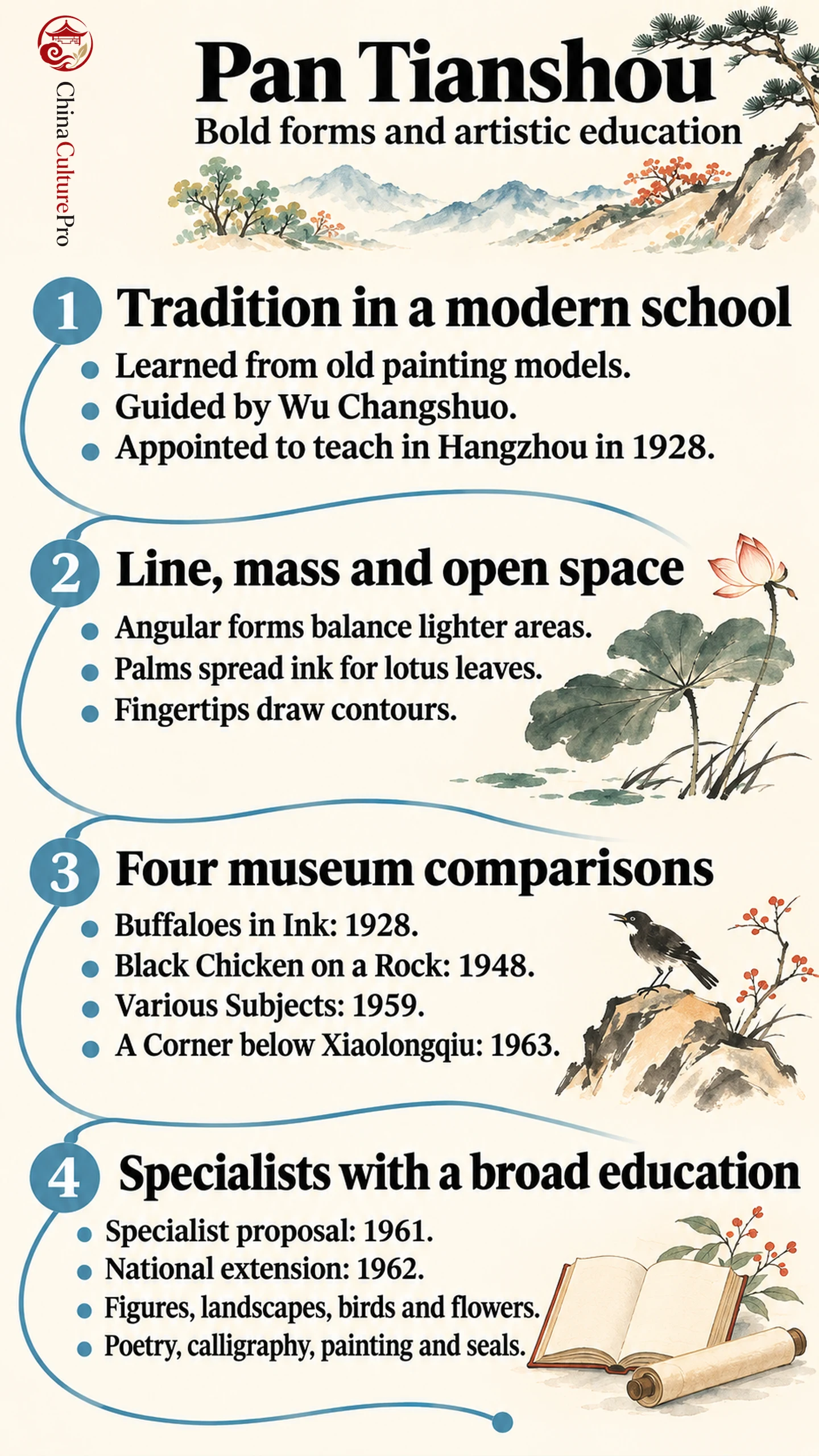
Pan began by studying the Mustard Seed Garden Manual (芥子园画谱, Jièzǐyuán Huàpǔ), then learned from Li Shutong and received guidance from Wu Changshuo. In 1928, Lin Fengmian appointed him to teach traditional painting at the new Hangzhou Art Academy.[2]
Earlier painting, including that of Shitao, supplied further resources for his practice.[1] Tradition became material for a distinct modern language of line, ink and composition.
Pan was persecuted during the Cultural Revolution; he died in 1971.[2]
Line, Large Forms and the Uses of Finger Painting
Pan gave line a central role in shaping a subject’s strength. His later work could combine landscape and bird-and-flower subjects within a single forceful design.[1] This makes brush technique inseparable from the arrangement of the picture.
In finger painting, he could use his palm to spread ink for lotus leaves and his fingertips to draw contours.[6] The method expands the range of marks available to freehand painting.
Look at how a rock’s edge meets the blank paper. Then compare its weight with a thinner stem or a small animal. The tension comes from differences of scale and placement across the whole surface.
Four Museum Works Across His Career
These examples span early finger painting, a mature handscroll and a close view of a mountain setting.
| Work | Date and format | Museum record |
|---|---|---|
| Buffaloes in Ink | 1928; finger-painted hanging scroll | National Museum of China.[1] |
| Black Chicken on a Rock | 1948; ink and color, finger painting on soy-treated paper | Pan Tianshou Memorial Museum; 68 × 136.5 cm.[3] |
| Various Subjects | 1959; handscroll, ink on paper | Metropolitan Museum of Art; image 22.2 × 301.6 cm.[2] |
| A Corner below Xiaolongqiu | 1963; ink and color on paper | Pan Tianshou Memorial Museum; 107.8 × 107.5 cm.[3] |
Buffaloes in Ink places three animals in a line, but turns the central animal toward the right. A branch reaches diagonally across the picture, adding another direction of movement.[1] Compare the animals’ orientation with the much lighter indications of ground.
Various Subjects develops a four-seasons theme through exaggerated forms and angular calligraphy.[2] Follow the handscroll from right to left and consider how the writing participates in the image’s changing rhythm.
A Corner below Xiaolongqiu brings a close view of plants into the field of landscape painting, joining landscape and flower imagery.[4] Its viewpoint makes a small part of nature carry the force of a larger setting.
An Educational Legacy Beyond the Individual Painting
In 1961, Pan proposed separate specialist training in figure painting, landscape, and birds and flowers. The approach was extended nationally in 1962.[5]
He also stressed poetry, calligraphy, painting and seal carving (诗书画印, shī shū huà yìn) as connected abilities.[5] Studying calligraphy and inscriptions and seals therefore belongs alongside looking at his painted subjects.
His legacy joins specialized training with a wider artistic education. It helps explain why an inscription, an ink mass and a carefully placed blank area deserve to be read together.
FAQs About Pan Tianshou
Did Pan Tianshou paint only with his fingers?
No. Finger painting was one part of a practice that also used brushwork.[3]
Why are large rocks so prominent in his paintings?
Their angular forms create visual weight, balanced by other subjects and open areas.[6]
What did he change in Chinese painting education?
He promoted specialist study of figures, landscapes, and birds and flowers within a broader artistic training.[5]
Sources
[1] National Museum of China. Buffaloes in Ink
[2] Metropolitan Museum of Art. Various Subjects
[3] Pan Tianshou Memorial Museum. Selected Major Works
[4] China Academy of Art. A Corner below Xiaolongqiu
[5] China Academy of Art. Pan Tianshou’s Composition and Specialist Teaching
[6] Hangzhou Municipal Archives. Pan Tianshou: Painting and Artistic Practice