

Quick Answer: How Did Women Learn in Imperial China?
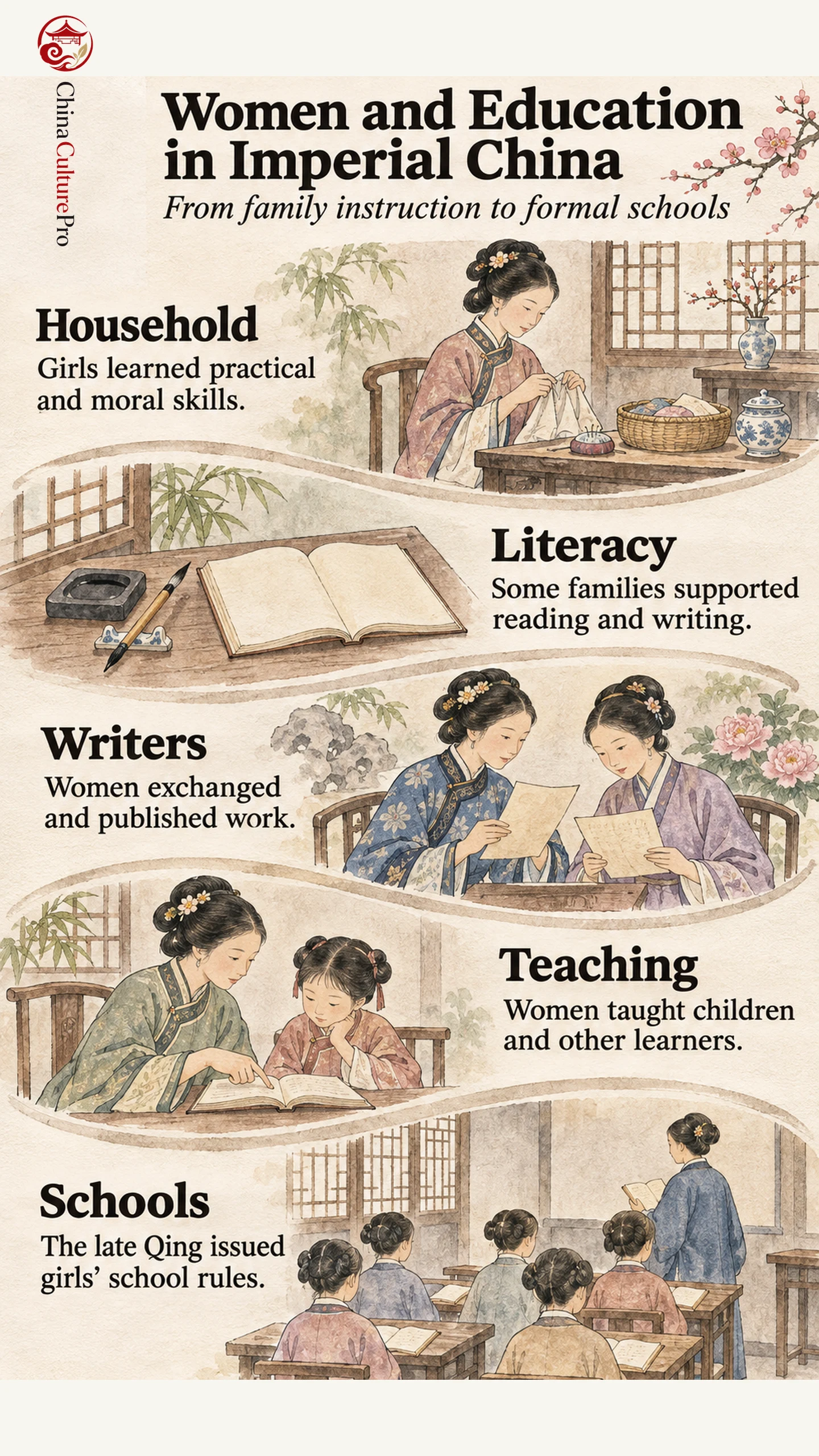
Family instruction, literary circles and schools offered different opportunities, with access shaped by resources and place. In the Ming and Qing, household teaching could include practical skills and moral instruction, and some families also supported reading and writing. Educated women could teach, exchange poems or publish work. Formal schooling for girls expanded in the late Qing.[2][3][4][5][6]
- Home: Family members passed on household skills, values and, in some households, literacy.[2]
- Literary networks: Some women read, wrote, taught and exchanged work through networks of relatives and other writers.[3][4]
- Schools: Reformers and educators founded girls’ schools before the Qing state drew up formal rules in 1907.[2][5][6]
The records are richer for some educated families than for women whose learning left few written traces.[2][3][4]
An instruction book, a woman’s printed poems and a school regulation each preserve a different kind of evidence. Read together, they reveal ways women learned and taught, along with the limits of what survives.[1][2][4][5]
What Girls Learned at Home
Education could include learning how to conduct household tasks, take part in family rituals and behave according to family expectations. In some families it also meant learning to read or write. Mothers might teach daughters these skills and introduce sons to their first characters. The ability to study books depended in part on family resources and access to instruction.[2][3]
An early example comes from the Eastern Han. Ban Zhao (班昭, Bān Zhāo) was a historian and instructed women at court. Her Lessons for Women (女誡, Nǚjiè) made a case for educating girls in the context of expectations about marriage and household duties. The text gives evidence of an argument for education in its own time, while later households learned in many different ways.[1][2]
Women as Readers, Writers and Teachers
Dorothy Ko’s study of seventeenth-century Jiangnan describes educated gentrywomen as readers, writers, editors and teachers. Poetry connected some women across households. Such activity could involve learning from relatives, exchanging work or taking part in a community of readers.[2][3]
The Ming-Qing Women’s Writings collection at Harvard includes rare texts preserved through libraries and digitized in collaboration with McGill. The collection preserves work that reached manuscript or print and survived. The skills of women whose work left few written traces are harder to recover. Surviving writings help recover women’s work, while their uneven preservation shapes the picture historians can reconstruct.[3][4]
How Late Qing Girls’ Schools Changed Access
New-style girls’ schools developed through more than one effort. Missionaries established schools, while Chinese educators and reformers organized schools of their own. An 1898 Chinese-run school was associated with an early women’s journal. Periodicals later published students’ writing and reported on schools, making education a public topic as well as a family concern.[2][6]
The 1907 rules gave girls’ schools a place in the state’s educational framework, while families’ ability to use them still depended on local access. Schooling differed from the civil examination path, which had provided male candidates with credentials for official careers. Some new programs still emphasized household roles and moral instruction even as classes brought learning into a formal institution.[2][5][6]
FAQs About Women and Education in Imperial China
Could women read and write in imperial China?
Some did, especially where families could support literacy. Others learned through practical and oral instruction. Access differed across households, regions and periods.[1][2][3]
What can women’s published writings tell us?
They show how some women used and shared literary knowledge. The works that survive reflect who had access to writing, publication and preservation.[3][4]
Did girls’ education begin with formal schools?
Family teaching and literary study preceded late Qing school reforms. Schools gave girls another setting for education, with courses and enrollment organized by institutions.[1][2][5][6]
Sources
[1] Columbia University, Asia for Educators. Excerpts from Admonitions for Women by Ban Zhao
[2] UBC Press. The Imperial School System and Education Reform
[3] Dorothy Ko, Stanford University Press. Teachers of the Inner Chambers: Women and Culture in Seventeenth-Century China
[4] Harvard-Yenching Library. Ming-Qing Women’s Writings
[5] Wong Yin Lee. Women’s Education in Traditional and Modern China
[6] Cambridge University Press. Women and the Periodical Press in China’s Long Twentieth Century