


Quick Answer: Who Was An Lushan?
An Lushan (安禄山, Ān Lùshān, 703–757) was a frontier commander who rebelled against Emperor Xuanzong (唐玄宗, Táng Xuánzōng) of the Tang dynasty in 755. The conflict, also called the An–Shi Rebellion (安史之乱, Ān Shǐ Zhī Luàn), continued after his death and ended in 763.[1][2]
- His base: An held three military commands and rose in revolt from Fanyang (范阳, Fànyáng).[2]
- The capitals: His forces seized Luoyang (洛阳, Luòyáng), where he set up Yan (燕, Yān), and then took Chang’an (长安, Cháng’ān) in 756.[2]
- The outcome: Tang forces recovered the capitals, but the court emerged with less power over important northern regions.[4]
The fighting and its effects on civilians were severe. Figures for the registered population cannot establish an exact death toll.[1][5]
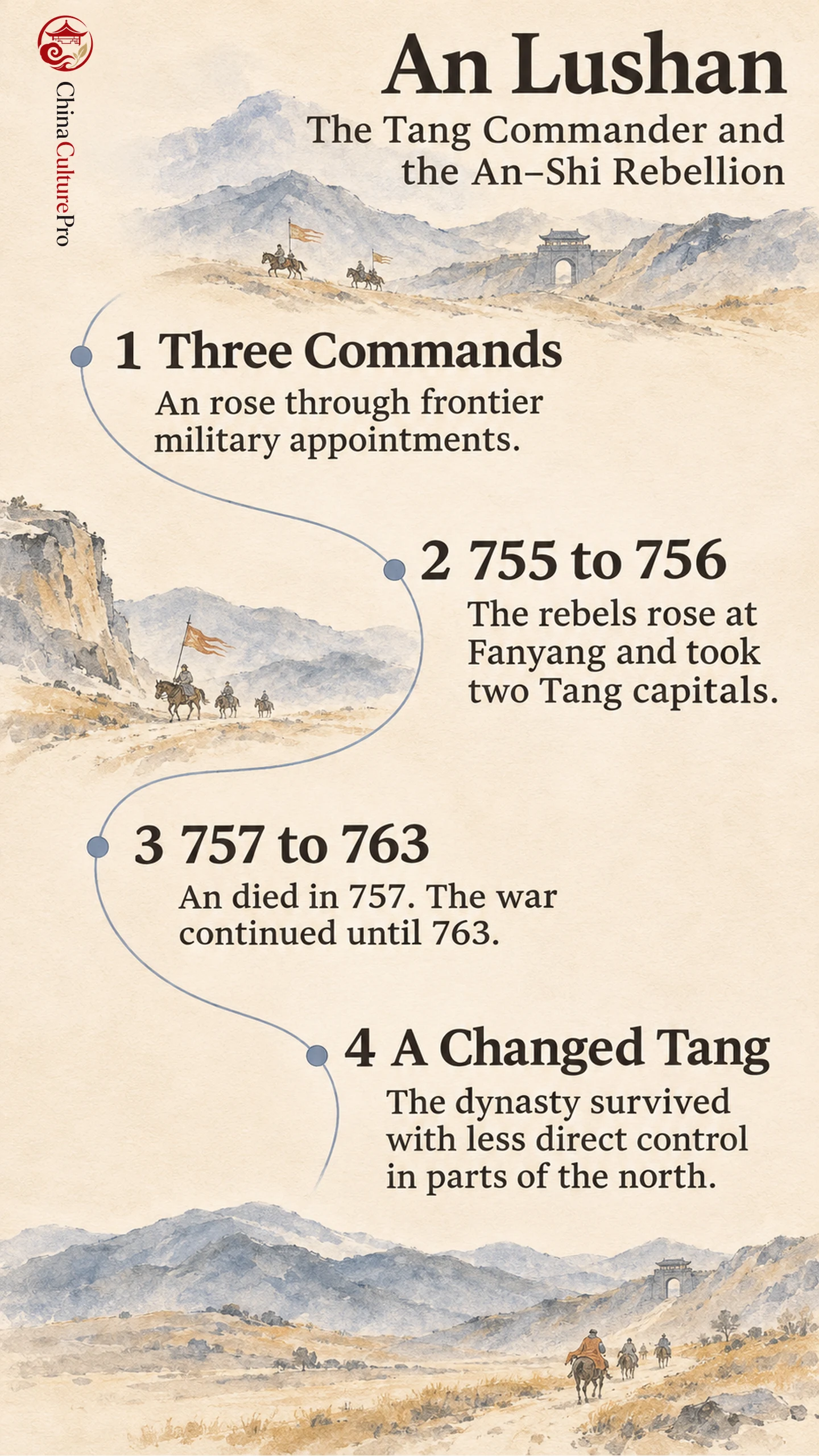
An’s rebellion grew out of appointments he already held. To understand why a general on the frontier could threaten the Tang capitals, start with the offices that put trained soldiers and supplies within his reach.
How An Lushan Built a Frontier Command
An came from a frontier world in which men with Central Asian and steppe ties served the Tang court. Modern histories describe his background as Turco-Sogdian. The broader Silk Road history helps explain why connections across these regions were a feature of imperial life.[6]
A military commissioner (节度使, jiédùshǐ) commanded troops in a designated region. An acquired the Pinglu (平卢, Pínglú) command in 742 and Fanyang in 744. In 751 he added Hedong (河东, Hédōng). The appointments gave one man authority over forces in three strategically important areas.[2][3]
The court supported his rise. The Old Book of Tang (旧唐书, Jiù Tángshū) describes Xuanzong’s confidence in him and records that Yang Guozhong (杨国忠, Yáng Guózhōng), a senior official, repeatedly warned the emperor that An would rebel.[2]
That history was compiled after the events. Read the sequence of promotions separately from the stories that give An intentions at each stage. The appointments explain how he acquired military means. The court rivalry helps explain the crisis around his decision to use them.
The Rebellion in Four Dates
In 756, the fight for Tong Pass (潼关, Tóngguān) helped determine whether the western capital could be defended. After government troops were defeated, Xuanzong fled toward Sichuan. The crown prince took the throne as Emperor Suzong (唐肃宗, Táng Sùzōng) and organized resistance from the northwest.[2][3]
| Year | Turning point | What happened |
|---|---|---|
| 755 | The rising at Fanyang | An turned forces raised in Tang service against the court. |
| 756 | The fall of the Tang capitals | The rebels took Luoyang and Chang’an. An established Yan at Luoyang. |
| 757 | An Lushan’s death and Tang recovery | An Qingxu (安庆绪, Ān Qìngxù) succeeded his father after a palace killing. Tang forces recovered both capitals. |
| 763 | Defeat of the last Yan leader | Shi Chaoyi (史朝义, Shǐ Cháoyì), son of the rebel leader Shi Siming (史思明, Shǐ Sīmíng), lost the last bid to hold Yan together. |
An’s own circle turned against him in 757. His son took power, then lost it to Shi Siming. Shi’s son in turn seized the leadership and remained in charge until Yan’s final defeat. The sequence explains why the date of An’s death and the date at the end of a rebellion named after him are six years apart.[2]
What Changed After the Rebellion
Uyghur military support helped the Tang regain power in the capitals. In parts of the north, commanders retained practical control of territories that the court could no longer administer on its earlier terms. The court could recognize local officials while relying on men it could no longer easily remove.[4]
The Tang dynasty continued until 907.[6] Put 755–763 within a timeline of Chinese dynasties to see how much late Tang history followed it. The rebellion changed the relationship between the center and the provinces for the remainder of the dynasty.[4]
The fighting hit areas including Hebei and Henan particularly hard. A drop in people counted by the government reflects the state’s diminished ability to register households as well as the population’s wartime losses. War could force people from their homes or leave whole areas beyond effective administration.[5]
What the Sources Can Tell Us
The dynastic account reports that members of An’s household and staff killed him. Its vivid account of the attack serves a different purpose from its record of offices and campaigns. When reading the same chapter for both, check the public sequence against other accounts and treat reconstructed private scenes with care.[2]
The crisis also became a subject for poets and artists. In the Song of Everlasting Sorrow (长恨歌, Chánghèn Gē), Bai Juyi (白居易, Bái Jūyì) tells the story of Xuanzong and the consort Yang Guifei (杨贵妃, Yáng Guìfēi). Scenes from that poem appear on Japanese painted screens.[7]
For later Chinese treatments of the same crisis, compare The Romance of the Sui and Tang with The Palace of Eternal Life. The former embeds the court’s crisis in a longer story across dynasties. The latter gives the relationship between the emperor and his consort the center of the stage. Use the historical figures guide to follow other lives with the same distinction between biography and later representation.
FAQs About An Lushan
Why is it called the An–Shi Rebellion?
The name joins An Lushan and Shi Siming, two leaders of the uprising. Shi took charge after An’s son had succeeded him, and the conflict continued under Shi’s son.[1][3]
Did An Lushan end the Tang dynasty?
The Tang survived the rebellion, which ended in 763. The dynasty continued until 907, with reduced control in important regions.[1][4]
Did 36 million people die in the An Lushan Rebellion?
The figure of 36 million is not a reliable count of deaths. The war killed and displaced many people, and changes in government registration make a precise death toll impossible to derive from census comparisons.[1][5]
Sources
[1] Oxford Bibliographies. An Lushan Rebellion, 755–763
[2] Old Book of Tang. Volume 200, An Lushan, An Qingxu and Shi Siming
[3] Longdu Shi, SOAS University of London. Buddhism and the State in Medieval China
[4] Richard von Glahn, Cambridge University Press. Economic Transformation in the Tang-Song Transition
[5] David A. Graff, Journal of Chinese History. The Reach of the Military: Tang
[6] Shao-yun Yang, Cambridge University Press. Late Tang China and the World
[7] Smithsonian National Museum of Asian Art. Scenes From the Life of Ming Huang and Yang Guifei