


Quick Answer: What Was the Two-Tax System?
The Two-Tax System (兩稅法, liǎngshuìfǎ) was a Tang fiscal reform adopted in 780 under Emperor Dezong on the proposal of Yang Yan (楊炎, Yáng Yán). The reform reorganized how officials assessed households and land, and when they collected the levies. It became associated with collection in summer and autumn.[1][2][3]
- Timing: The state prescribed two collection seasons for resident households.[1][2]
- Assessment: Wealth and cultivated land played important roles in setting obligations.[1][2][3]
- Residence: The reform directed officials to register households where they actually lived.[1][2]
Land and household levies describe the bases of the tax. Summer and autumn describe when officials collected it.[1][2][3]
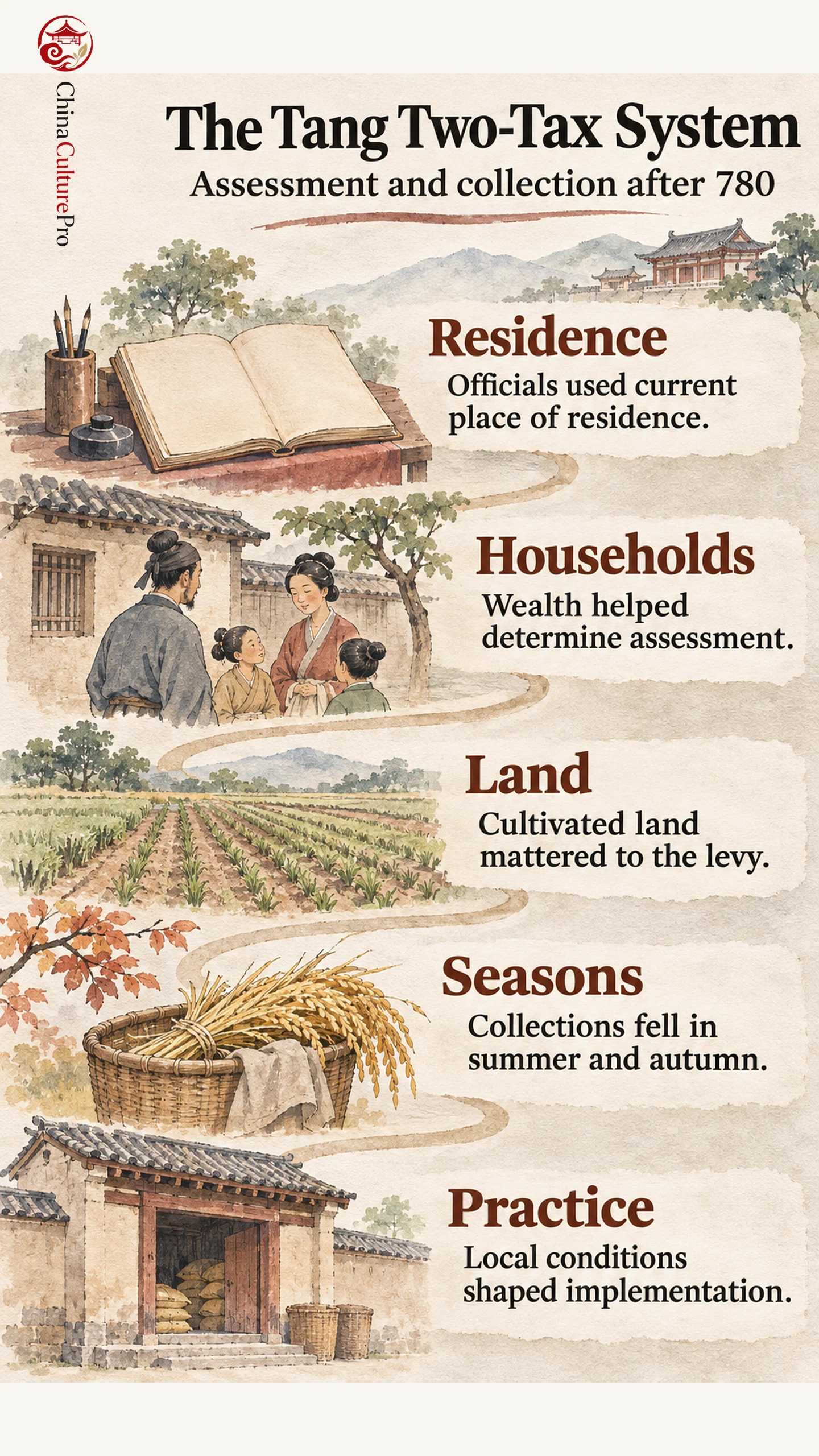
A household might have moved while still appearing in an older register. Yang Yan’s proposal asked officials to count it where it lived and assess its wealth. The change addressed both recordkeeping and revenue collection.[1][2]
What Changed in Household Assessment
Earlier Tang taxes are often discussed under the name zuyongdiao (租庸調, zūyōngdiào), a framework that included taxes in kind and labor obligations tied to registered adult males. It developed alongside institutions such as the equal-field system. By the later Tang, a policy based on outdated registration could miss people and resources that had moved or changed.[1][3][4]
Yang Yan’s proposal used current residence and ranked people by wealth for assessment. It also addressed the levy on cultivated land and included provisions for itinerant merchants. The fiscal decree retained reporting of adult male counts even as the basis for assessment changed. Tax assessment and household registration were connected but served distinct administrative purposes.[1][2][3]
Why the Name Refers to Two Seasons
The proposal provided for collections in summer and autumn. The decree specified deadlines in the sixth and eleventh months of the traditional calendar and allowed attention to local conditions. This schedule does not by itself say how much a household paid or what form a payment took. Different sources discuss cash, grain and other assessments in their own regional and fiscal contexts.[1][2][3][4]
Yang Yan also described starting from what government needed to spend and allocating the necessary revenue. That proposal concerned the amount officials sought. The two collection dates concerned the schedule for raising it.[1][2]
How the Reform Worked in Practice
The Old Tang Book’s fiscal treatise records instructions to officials to consider local conditions and the number of households. The fiscal treatise also records later increases. The original decree and subsequent collection records therefore answer different questions. The reform influenced how later governments approached property and land taxation, as shown in research on Song fiscal records.[2][3]
The Single Whip reform belongs to the Ming, centuries later. It dealt with combining obligations and converting many of them to silver. The Tang reform is best read in its own context of taxation, residence and collection seasons.[1][2][3]
FAQs About the Two-Tax System
Why was it called the Two-Tax System?
The Tang proposal specified collections in summer and autumn. Household wealth and land were separate aspects of assessment.[1][2][3]
Who introduced the Two-Tax System?
Yang Yan proposed the reform and Emperor Dezong adopted it. The decree belongs to the first year of the Jianzhong reign, 780.[1][2][3]
Did the reform end household registration?
It directed officials to record households where they lived. The decree also retained reporting on adult male counts.[1][2]
Sources
[1] Old Tang Book. Biography of Yang Yan and the Two-Tax Proposal
[2] Old Tang Book. Treatise on Food and Money
[3] Journal of the Royal Asiatic Society. Between Coin and Kind: State Revenue and Currency Changes in Song–Yuan Taizhou
[4] Labor History. The Reform of Tax Policies and the Differentiation of Chinese Peasants During the Tang and Song Dynasties