


Quick Answer: What Are the Twenty-Four Filial Exemplars?
The Twenty-Four Filial Exemplars (二十四孝, Èrshísì Xiào) is a popular collection of moral stories traditionally associated with Guo Jujing (郭居敬, Guō Jūjìng) in the Yuan (元, Yuán) period. It presents memorable examples of filial piety, or xiao (孝, xiào): care and devotion directed toward parents and elders.[1][5]
- Form: Short prose accounts accompanied by praising verses, often circulated with pictures.
- Range: Everyday service, sacrifice, extraordinary responses and morally troubling acts.
- Reading approach: Identify the version, distinguish a story’s praise from historical proof, and examine what its demanded conduct costs.[1][3]
The collection is a cultural document to interpret, not a universal description of how Chinese families lived.
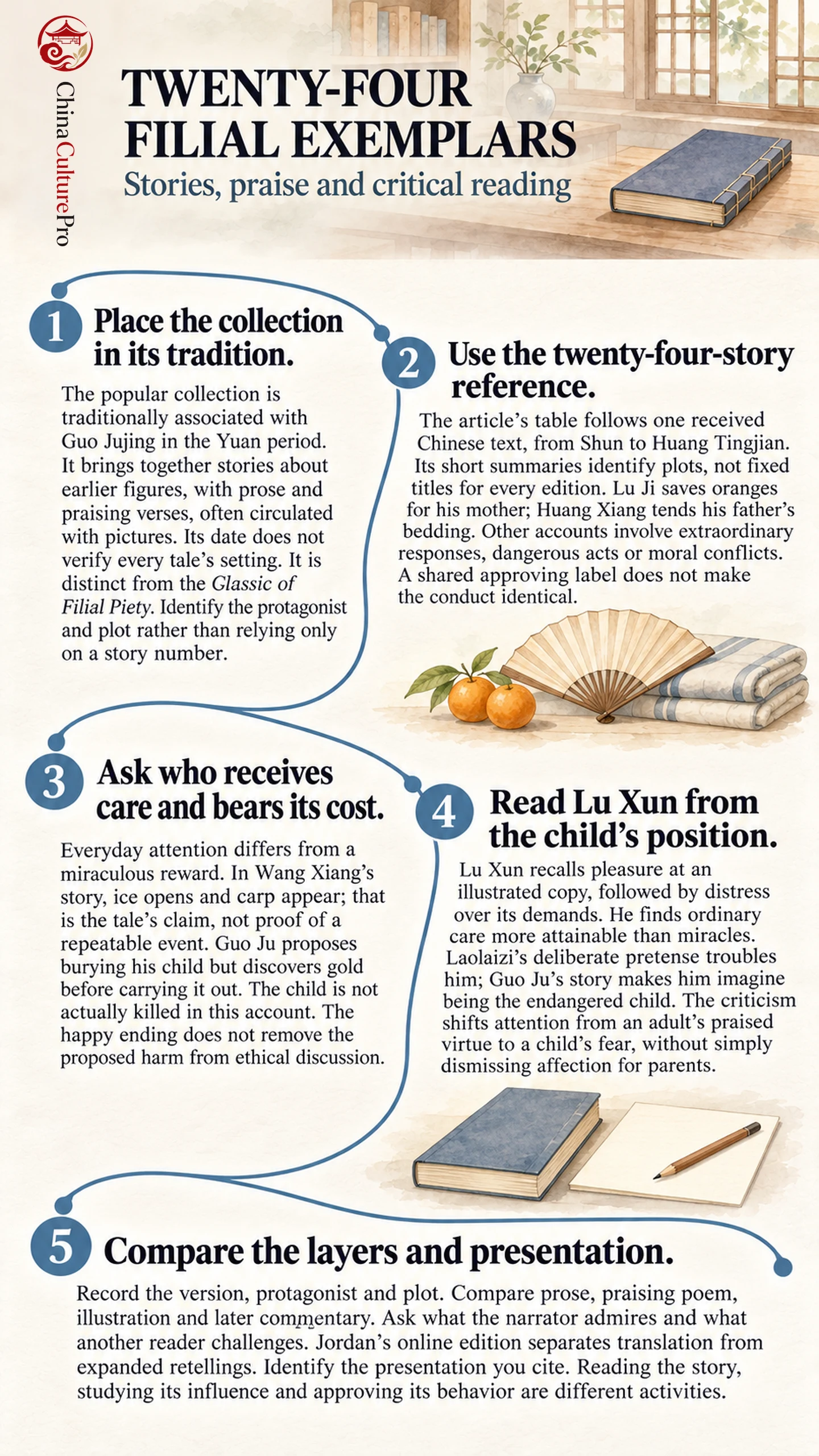
Oranges saved for a mother, bedding cooled for a father, carp emerging from ice: these stories make filial devotion vivid. Yet their forms of devotion differ sharply. Reading the Twenty-Four Filial Exemplars means noticing those differences, including conflicts that later writers found deeply disturbing.
A Popular Collection and Its Changing Forms
The association with a Yuan compiler should not be confused with the age of every tale. The collection gathers stories about figures placed in much earlier periods. Its protagonists range from legendary rulers to named officials and children; the collection’s date does not verify those narrative settings.[3]
It belongs to popular moral teaching related to Confucian traditions, but is not part of the classical canon. The Classic of Filial Piety (孝经, Xiàojīng) is a separate work, distinct from this story anthology.[2]
Order, short titles, wording and pictures vary between editions. Related collections include different tales. Identify an item by its protagonist and plot rather than by its number alone.[1][2]
The Twenty-Four Stories at a Glance
This table follows the received Chinese text cited below. The descriptions are concise summaries, not translations of fixed four-character titles. They identify the stories without presenting supernatural events or dangerous conduct as verified facts.[3][5]
| No. | Protagonist | Story in brief |
|---|---|---|
| 1 | Shun (舜, Shùn) | Filial devotion wins extraordinary help and the throne. |
| 2 | Emperor Wen (汉文帝, Hàn Wéndì) | Personally tastes his sick mother’s medicine. |
| 3 | Zeng Shen (曾参, Zēng Shēn) | Feels pain when his mother bites her finger. |
| 4 | Min Sun (闵损, Mǐn Sǔn) | Pleads for the stepmother who mistreats him. |
| 5 | Zhong You (仲由, Zhòng Yóu) | Carries rice for his parents; later regrets their absence. |
| 6 | Dong Yong (董永, Dǒng Yǒng) | Sells his labor for a burial; receives supernatural help. |
| 7 | Tanzi (郯子, Tánzǐ) | Seeks deer’s milk for his parents. |
| 8 | Jiang Ge (江革, Jiāng Gé) | Carries his mother from danger and works to support her. |
| 9 | Lu Ji (陆绩, Lù Jì) | Saves oranges from a host’s table for his mother. |
| 10 | Lady Tang (唐夫人, Táng Fūrén) | Nurses her elderly mother-in-law. |
| 11 | Wu Meng (吴猛, Wú Měng) | Lets mosquitoes bite him to spare his parents. |
| 12 | Wang Xiang (王祥, Wáng Xiáng) | Lies on ice; carp appear for his stepmother. |
| 13 | Guo Ju (郭巨, Guō Jù) | Plans to bury his child; discovers gold instead. |
| 14 | Yang Xiang (杨香, Yáng Xiāng) | Confronts a tiger to rescue a parent. |
| 15 | Zhu Shouchang (朱寿昌, Zhū Shòuchāng) | Leaves office to search for his mother. |
| 16 | Yu Qianlou (庾黔娄, Yǔ Qiánlóu) | Uses a bodily test and prays for his sick father. |
| 17 | Laolaizi (老莱子, Lǎoláizǐ) | Acts childlike to entertain his elderly parents. |
| 18 | Cai Shun (蔡顺, Cài Shùn) | Separates gathered mulberries to reserve better ones for his mother. |
| 19 | Huang Xiang (黄香, Huáng Xiāng) | Cools and warms his father’s bedding. |
| 20 | Jiang Shi (姜诗, Jiāng Shī) | A spring and carp reward household care for his mother. |
| 21 | Wang Pou (王裒, Wáng Póu) | Visits his mother’s grave when thunder sounds. |
| 22 | Ding Lan (丁兰, Dīng Lán) | Serves wooden images of his deceased parents. |
| 23 | Meng Zong (孟宗, Mèng Zōng) | Cries beside bamboo; shoots appear for his mother. |
| 24 | Huang Tingjian (黄庭坚, Huáng Tíngjiān) | Personally cleans his mother’s chamber pot. |
Everyday Care, Miracles and Moral Conflict
Lu Ji’s oranges and Huang Xiang’s bedding connect affection with material attention: remembering what a parent likes, or responding to discomfort. Their stories can be understood without an extraordinary change in the natural world.[3]
Wang Xiang’s account works differently. His stepmother wants fresh fish in freezing weather; he lies on the ice, which opens and produces carp. The miraculous response makes devotion visibly effective within the tale. It is not evidence that exposure to ice will provide food or demonstrate moral worth.
Guo Ju’s story raises a sharper conflict. Poverty is framed as competition between his mother’s needs and his child’s food. He proposes burying the child; while digging, he discovers gold, and the narrative praises heavenly reward. The child is not actually killed in this account. Even so, the proposed harm is central to the problem: a miraculous ending does not remove the danger the child faces.
Ask who receives care, who bears the cost and how the poem directs judgment. “Filial” is the collection’s approving category; it does not settle every ethical question a reader can ask of the conduct.
Lu Xun’s Criticism: Reading from the Child’s Position
In Twenty-Four Filial Piety Pictures (二十四孝图, Èrshísì Xiào Tú), Lu Xun (鲁迅, Lǔ Xùn) recalls his childhood excitement at receiving an illustrated copy. That pleasure changes when he learns what the stories seem to require. He distinguishes relatively attainable acts, such as carrying rice or saving oranges, from miracles and frightening demands.[4]
Laolaizi’s childlike performance troubles him because of its artificiality, particularly the deliberate pretense of falling. Guo Ju’s tale changes the child reader’s position even more dramatically: instead of identifying with the praised son, he imagines himself as the child a father might sacrifice.
The discovery of gold brings relief within the story, but it offers no dependable protection outside it. Lu Xun’s recollection turns attention from the adult’s reputation for virtue to the child’s fear. His response is more specific than simply rejecting affection for parents: it challenges the moral authority of these particular examples and the way they are taught.
How to Compare a Story, Picture and Translation
- Identify the version: Record its title, protagonist and plot; do not rely on the story number alone.
- Separate the layers: Compare the prose action, praising poem, illustration and any later commentary.
- Compare the response: Ask what the narrator admires, what another reader criticizes and whose interests are represented.
Images circulated through illustrated books and other forms of moral teaching. In a printed illustrated edition, compare what the picture emphasizes with what the prose states. An image may make a gesture memorable without establishing that the event took place.[1]
David K. Jordan’s university-hosted edition provides a translation with Chinese text and separate expanded retellings, using different illustrations. Choose the translation for close reading of a passage, and identify the presentation you cite.[2]
Keep those modern explanatory layers distinct from the older text. Reading an account, studying its historical influence and approving its behavior are three different activities.
FAQs About the Twenty-Four Filial Exemplars
Did Confucius write the Twenty-Four Filial Exemplars?
No. The familiar collection is associated with the Yuan-period compiler Guo Jujing, not with Confucius as its author. Individual tales draw on older material.[1][3]
Are all twenty-four stories historical facts?
No. Some figures are historical, but the collection includes legendary settings and miraculous events. Treat each account’s claims as evidence requiring interpretation rather than as independently verified biography.
Is it the same book as the Classic of Filial Piety?
No. The Classic of Filial Piety is a separate classical text, while this is a popular collection of moral stories.[2]
Sources
[1] Chinese Temples Committee, Hong Kong. The Twenty-Four Filial Exemplars: collection and contemporary illustration project
[2] David K. Jordan, University of California San Diego. The 24 Filial Exemplars: introduction and notes on translation and retelling
[3] Public-domain Chinese text. Twenty-Four Filial Exemplars: received prose tales and poems
[4] Public-domain Chinese text. Lu Xun: Twenty-Four Filial Piety Pictures
[5] Ministry of Education, Taiwan. Revised Mandarin Chinese Dictionary: Twenty-Four Filial Exemplars