

Quick Answer: What Is The Classic of Tea?
The Classic of Tea (茶经, Chájīng), also written Chajing, is an eighth-century treatise by Lu Yu (陆羽, Lù Yǔ) on the plant, production, preparation and culture of tea. Written in the Tang (唐, Táng) period, it joins practical expertise with judgments about quality and appropriate conduct.[1]
- Structure: Three juan (卷, juàn), or traditional divisions, containing ten numbered parts.
- Central method: Tea cakes are prepared, ground and cooked in water before serving in bowls.
- Wider scope: Tools, utensils, earlier writings, producing regions and adjustments to the equipment.[2][3][4][5]
Read it as a historical work with its own preferences. Its method is not a universal instruction for every tea or every period.
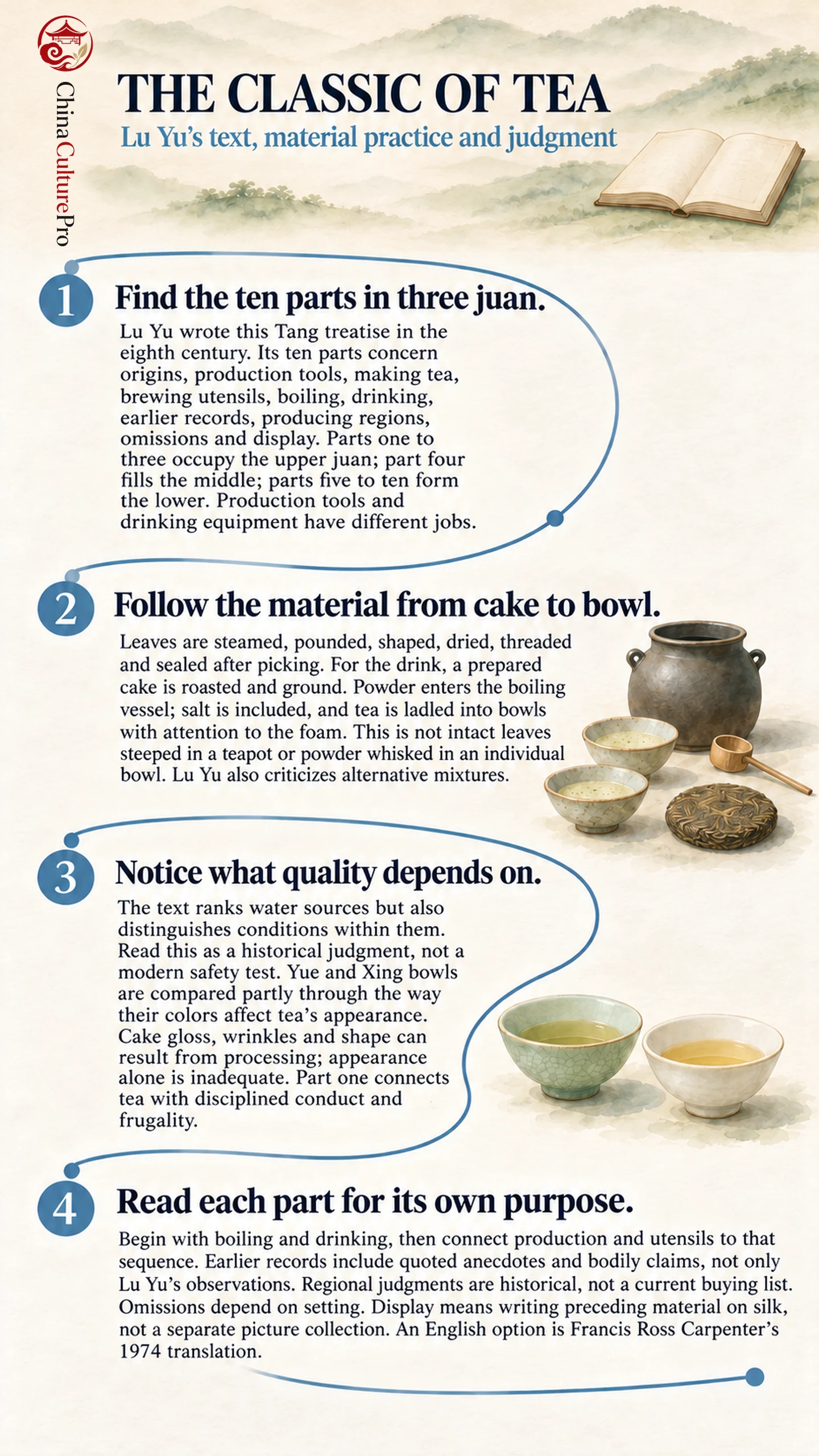
A reader expecting today’s teapot instructions may be surprised by roasted cakes, ground tea, salt and a boiling vessel. The Classic of Tea explains a different material world. Its ten parts connect that practice with tools, taste, earlier writings and regional knowledge.
Lu Yu’s Tang Treatise and Its Ten Parts
The National Museum of China places the work’s completion around the 770s and identifies it as the first book devoted to tea. Use that as an approximate historical setting, rather than assigning every passage to one securely established year. The received text’s organization is more useful to a first reader than an elaborate biography built from later anecdotes.[1]
| Part | Reading focus |
|---|---|
| One: Origins (一之源, Yī zhī yuán) | The plant, names, growing conditions and qualities. |
| Two: Production tools (二之具, Èr zhī jù) | Equipment for gathering and processing tea. |
| Three: Making tea (三之造, Sān zhī zào) | Processing and judging the finished tea. |
| Four: Brewing utensils (四之器, Sì zhī qì) | Equipment for preparing, serving and cleaning. |
| Five: Boiling (五之煮, Wǔ zhī zhǔ) | Fire, water, powdered tea and serving. |
| Six: Drinking (六之饮, Liù zhī yǐn) | Drinking practices, preferences and difficulties. |
| Seven: Records (七之事, Qī zhī shì) | Earlier texts and accounts concerning tea. |
| Eight: Producing regions (八之出, Bā zhī chū) | Places of production and comparative judgments. |
| Nine: Omissions (九之略, Jiǔ zhī lüè) | Equipment that circumstances allow one to leave out. |
| Ten: Display (十之图, Shí zhī tú) | Writing out the preceding material for visible reference. |
Parts two and four are easy to confuse in English: both concern equipment, but the former serves production and the latter preparation and drinking. The upper juan contains parts one to three, the middle contains part four, and the lower contains parts five to ten.[2]
From Tea Cake to the Serving Bowls
Part three describes leaves being steamed, pounded, shaped, dried, threaded and sealed after picking. The resulting cakes belong to a production sequence; they are not simply loose leaves pressed together at the table. That historical form is one point of comparison within the wider subject of compressed tea.[3]
Part five then moves from the prepared cake to the drink. The cake is roasted and ground; the powder goes into the boiling vessel. Water, fire and the developing surface are observed closely. Salt is included, and the tea is ladled into bowls with attention to distributing the foam.[5]
This is different from pouring hot water over intact leaves in a teapot, and it should not automatically be pictured as whisking powder in an individual bowl. Read the sequence through its particular utensils: roasting implements, grinder, sieve, vessel, ladle and bowls.[4]
Part six also mentions mixtures using ingredients such as ginger, scallion, dates and citrus peel, then sharply criticizes them. That criticism is revealing: Lu Yu’s preferred practice existed alongside alternatives. A prescription for excellent tea is not a census of what everyone actually drank.[5]
Water, Bowls and the Judgment of Quality
Water receives a hierarchy in part five: mountain water is preferred to river water, and river water to well water. Yet the passage goes on to distinguish sources and conditions within those broad groups. Read that ranking as a historical judgment in this text, not a modern test of drinking-water safety.[5]
Part four’s bowls make the relationship between material and perception unusually concrete. Lu Yu prefers Yue (越, Yuè) ware to Xing (邢, Xíng) ware, comparing their appearance to jade and silver, or ice and snow. His argument includes how their different colors affect the perceived color of tea. The choice of tea vessel is part of his account of tasting, not a neutral container decision.[4]
Part three likewise resists judging tea cakes only by a handsome surface. Gloss, wrinkles and shape can result from processing, and appearance alone is an inadequate guide. The text connects discernment with knowledge of how the tea was made.[3]
Its values extend beyond equipment. Part one associates tea with disciplined conduct and frugality. Practical precision and an ethical ideal coexist here; neither requires treating the work’s historical medical statements as present-day health guidance.[3]
How to Read the Text and Choose an English Edition
- Establish the sequence: Read parts five and six to understand the drink being prepared and the alternatives Lu Yu criticizes.
- Return to the material: Use parts two to four to connect each tool and utensil with production or preparation.
- Change reading modes: Treat records, regional judgments, omissions and display as distinct tasks in parts seven to ten.
Part seven quotes earlier writings rather than offering only Lu Yu’s observations. Its anecdotes and inherited bodily claims require different handling from a description of a grinder. Part eight offers regional comparisons while also acknowledging incomplete knowledge of some producing places; it is not a current buying list.[5]
Part nine permits omissions in outdoor or otherwise adapted settings, while insisting on complete equipment in an urban princely setting. Part ten asks for the preceding material to be written on plain silk and displayed. Its title does not mean a separate collection of surviving illustrations.[2][5]
An established English option is Francis Ross Carpenter’s The Classic of Tea, published by Little, Brown in 1974, with illustrations by Demi Hitz. The catalogue records an introduction and translation. Compare its explanatory material with the Chinese text, and identify the edition when citing a passage.[6]
For Chinese ceremonial tea practices, keep the historical question separate: this particular treatise does not by itself define every later hospitality or ceremonial form.
FAQs About The Classic of Tea
Did Lu Yu invent tea drinking?
No. The text itself discusses earlier tea drinkers and cites earlier writings. Lu Yu’s contribution is the systematic treatment and evaluation of tea practices, not the invention of drinking tea.[5]
Is The Classic of Tea only a recipe book?
No. Production and preparation are important, but the work also concerns names, equipment, earlier accounts, regional knowledge, taste and conduct. Read those parts according to their different purposes.
Does its method describe every Tang tea drinker?
No. Lu Yu criticizes alternative preparations and adapts equipment to different settings. His preferred method should be distinguished from a claim that everyone in the Tang period followed it.[5]
Sources
[1] National Museum of China. Liang Feng: Lu Yu and The Classic of Tea
[2] Public-domain Chinese text. Chajing: later bibliographical notice and received contents
[3] Public-domain Chinese text. Chajing, upper juan: origins, production tools and making tea
[4] Public-domain Chinese text. Chajing, middle juan: utensils for preparing and drinking tea
[5] Public-domain Chinese text. Chajing, lower juan: boiling, drinking, records, regions, omissions and display
[6] FAO AGRIS, National Agricultural Library record. The Classic of Tea: Francis Ross Carpenter translation (1974)