


Quick Answer: What Is Tao Yao About?
Tao Yao (桃夭, Táo Yāo) is a wedding ode in the Book of Songs (诗经, Shījīng). It pairs a flourishing peach tree with a young woman going to her new household.[1][2]
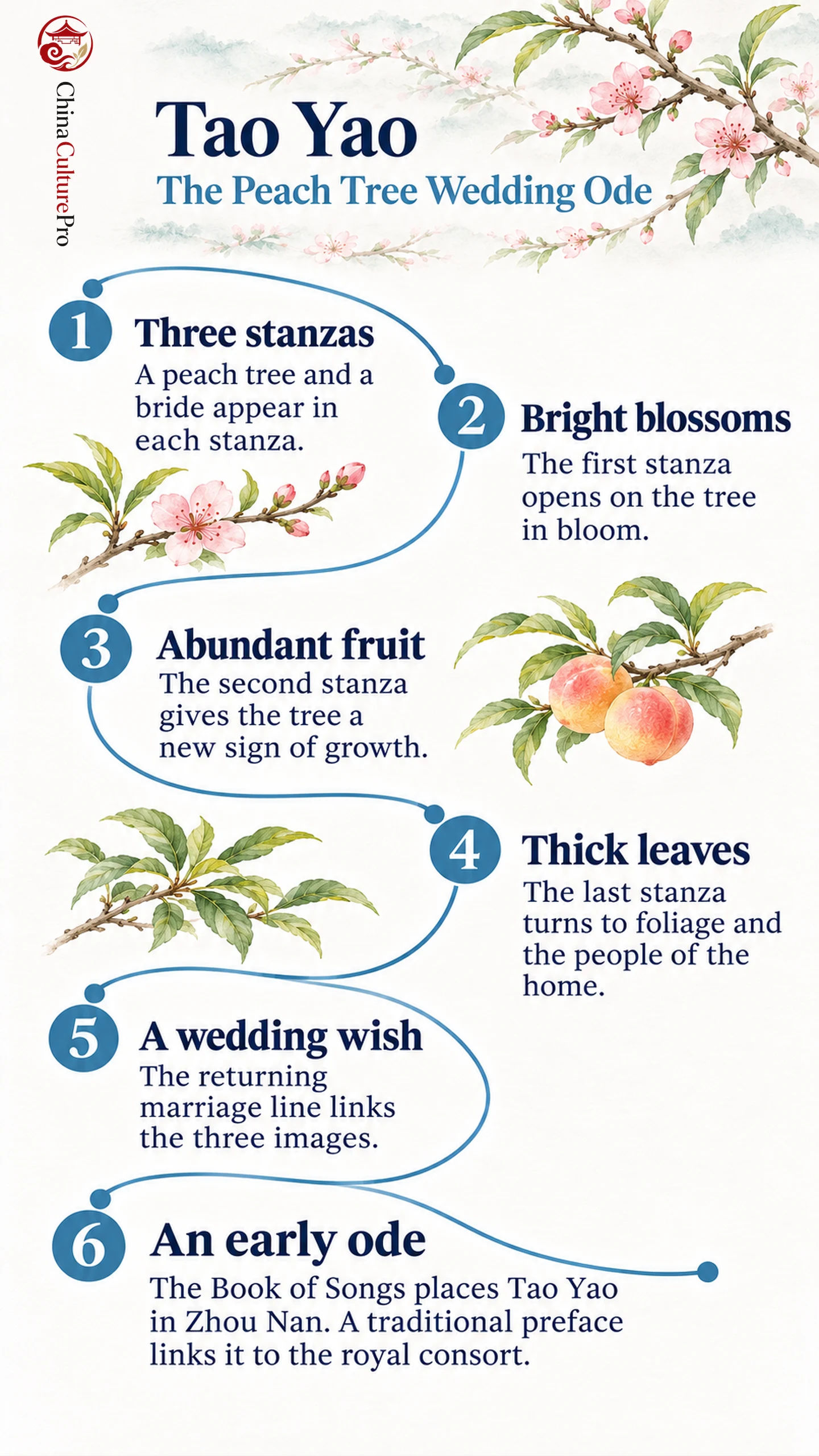
- Blossoms: The first stanza opens on the bright display of the flowers.
- Fruit: The second stanza turns to the tree’s abundant peaches.
- Leaves: The last stanza sets the wish for family harmony beside dense foliage.[1]
The words for the bride’s arrival return in every stanza. What the tree shows and how the new household is named keep changing.[1]
It is easy to meet this ode through its first four lines and remember it as a picture of a bride beside a peach tree in bloom. Read through the last stanza and notice how each return to the tree changes the wish offered to the bride.
The Complete Tao Yao in Chinese, Pinyin and English
The ode has three stanzas of four lines, with four characters per line. The text here uses simplified characters, preserving 华 and the unusual fruit word 蕡. The pinyin represents a modern Mandarin reading, with no claim about how the ode sounded when it was first sung.[1]
| Stanza | Chinese | Pinyin | English sense |
|---|---|---|---|
| 1 | 桃之夭夭 | táo zhī yāoyāo | The young peach tree flourishes. |
| 1 | 灼灼其华 | zhuózhuó qí huá | Bright, bright are its blossoms. |
| 1 | 之子于归 | zhī zǐ yú guī | This young woman goes to be married. |
| 1 | 宜其室家 | yí qí shìjiā | May there be harmony in her new home. |
| 2 | 桃之夭夭 | táo zhī yāoyāo | The young peach tree flourishes. |
| 2 | 有蕡其实 | yǒu fén qí shí | Its peaches grow in plenty. |
| 2 | 之子于归 | zhī zǐ yú guī | This young woman goes to be married. |
| 2 | 宜其家室 | yí qí jiāshì | May there be harmony in her new household. |
| 3 | 桃之夭夭 | táo zhī yāoyāo | The young peach tree flourishes. |
| 3 | 其叶蓁蓁 | qí yè zhēnzhēn | Thick, thick are its leaves. |
| 3 | 之子于归 | zhī zǐ yú guī | This young woman goes to be married. |
| 3 | 宜其家人 | yí qí jiārén | May the people of her new home live in harmony. |
In the translation, “may” gives each closing line the sound of a wish. An English rendering can also make the bride the subject of the final line, with the sense that she will fit well into or bring harmony to the household. Both approaches keep the last line’s attention on relationships inside the home.[1]
What the Blossoms, Fruit and Leaves Do
The repeated opening describes a peach tree at its most vigorous. Within the next line, the focus shifts each time. The first stanza draws the eye to blossom colour and brightness. The second gives the tree weight through the abundance of fruit. The third looks across thick foliage. In each stanza, the marriage line follows that fresh glimpse of growth.[1]
The sequence makes more room for the idea of flourishing than the first blossom image could carry alone. Beauty at the beginning of married life is one possible association. Fruit can suggest hopes for continuity and abundance, while foliage lets the poem end with an image of fullness around the household. These are implications of the juxtaposition. The poem leaves the woman’s appearance, her future children and the details of her married life unspoken.
The peach tree does a different job in Peach Blossom Spring, where flowering trees lead a traveller into an unexpected settlement. In Tao Yao the tree stays in view through all three wishes for the household.
How the Ode Welcomes the Bride
The phrase 于归 (yú guī) marks the woman’s marriage and departure for her marital home. “Goes home” on its own can sound as though she were returning to the family she grew up with. The ode sees the arrival through the expectation that the new household will thrive.[1][2]
The last lines vary the address. The first two alternate 室家 and 家室, closely related expressions for a home or household. The last names 家人, the members of the family. English can suggest that widening of attention by ending on the people who have to live together. It would take more than the words provide to assign a separate institution or room to each expression.[1]
The household is an ideal presented through a song. Evidence about arrangements such as Chinese marriage contracts comes from other records and periods. This ode can illuminate an expectation about harmony, while leaving the particulars of the bride’s situation open.
Where Tao Yao Sits in the Book of Songs
Tao Yao appears in Zhou Nan (周南, Zhōu Nán), the same section of the anthology as Guan Ju. Its short, repeating stanzas make it a useful counterpart to Jian Jia, another ode in which small changes to a natural setting carry meaning across repeated lines.[1][3]
The traditional preface associated with the Mao reading links Tao Yao to the influence of the royal consort. That interpretation gives a courtly frame to a marriage song that names no ruler. Readers can distinguish the commentary’s interest in exemplary influence from the text’s visible movement between the tree and the bride.[2]
FAQs About Tao Yao
Who wrote Tao Yao?
There is no named author in the transmitted ode. It appears in the Book of Songs among the airs of Zhou Nan.[1][3]
Is the blossom stanza the whole poem?
The blossom stanza is the first of three. The next two keep the bride’s arrival and turn to the fruit and leaves, respectively.[1]
Sources
[1] Chinese Text Project. Tao Yao
[2] Ministry of Education, Taiwan. 桃夭
[3] Chinese Text Project. Odes of Zhou and the South