


Quick Answer: What Is Tuning the Lute About?
Tuning the Lute (听弹琴, Tīng Tán Qín) is a four-line Tang poem by Liu Changqing (刘长卿, Liú Chángqīng). A listener hears an old melody on a qin (琴, qín) and thinks about how few people play it in his day.[1]
- Instrument: The opening counts seven strings.
- Sound: The notes suggest the chill of wind through pines.
- Contrast: One person loves the tune while few others play it.[1][4]
The Chinese title describes listening to the instrument being played.[1]
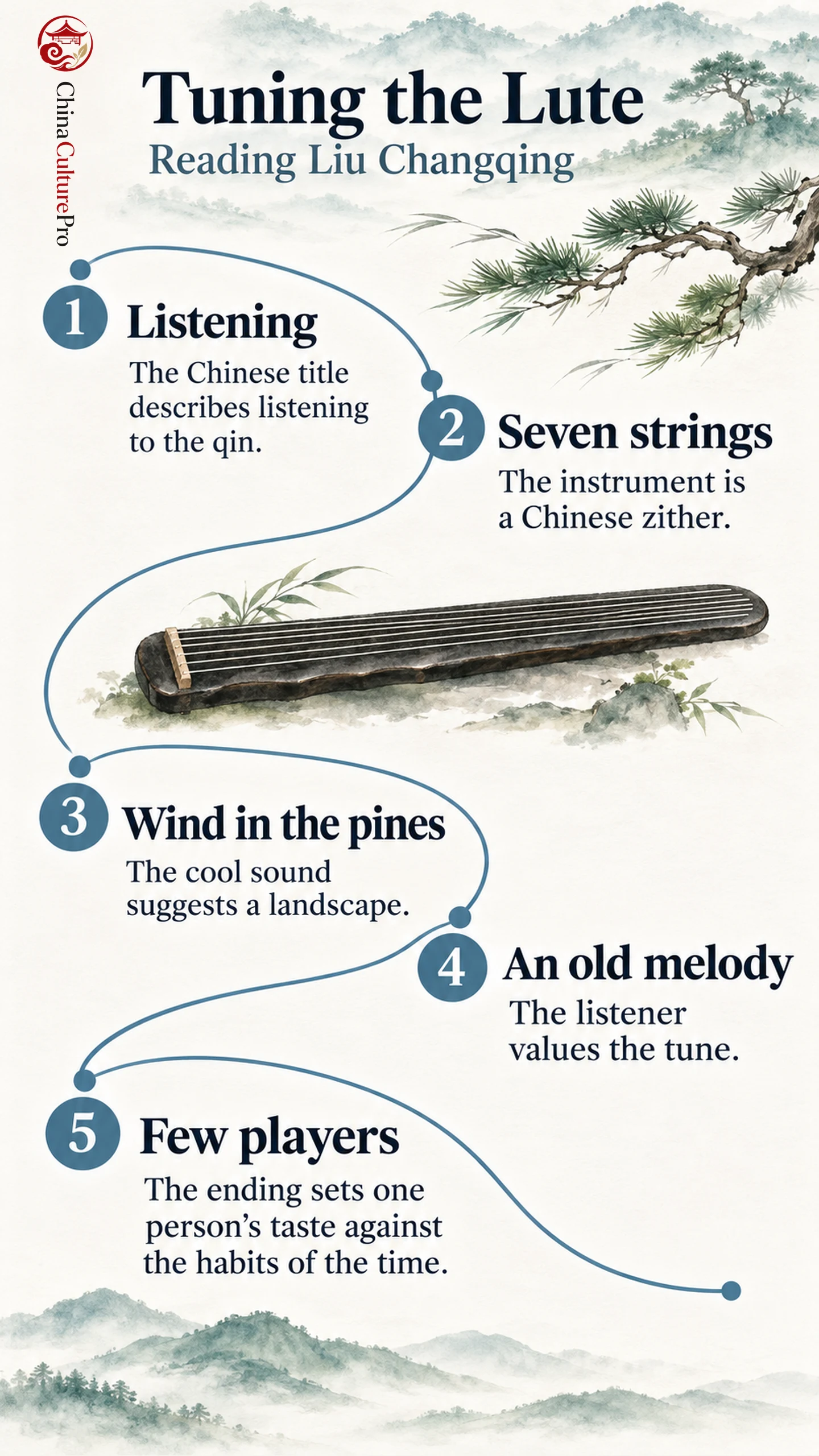
The first two lines ask a reader to listen closely. The last two ask what happens when a sound someone values falls out of favour. Liu Changqing moves between the two with one small concession. The speaker loves the tune, though most people around him no longer play it.
The Quatrain in Chinese, Pinyin and English
The received text has four lines of five characters. This version uses 七弦, “seven strings,” in the first line. Another reading gives 七丝, “seven silk strings.” The sense translation keeps the contrast between personal taste and wider practice.[1]
| Chinese | Pinyin | English sense |
|---|---|---|
| 泠泠七弦上 | Línglíng qī xián shàng | A clear, ringing sound on the seven strings. |
| 静听松风寒 | Jìng tīng sōngfēng hán | I listen quietly to the chill of wind in the pines. |
| 古调虽自爱 | Gǔ diào suī zì ài | I myself love this old tune. |
| 今人多不弹 | Jīnrén duō bù tán | Most people today do not play it. |
How the Poem Makes a Sound Feel Cold
The doubled opening 泠泠 describes a clear, cool sound. The next line moves from what the instrument gives to what the listener hears in it. The line can be read as the wind in pines imagined through the notes, an impression that joins sound and cold. The phrase moves naturally between something the ear hears and a landscape the mind supplies.[1][4]
The quietness belongs to the act of listening. It lets the sound stand out before the reader learns what kind of tune it is. In Wang Wei’s Bamboo Lodge, a qin is part of a solitary scene. Liu’s quatrain spends its short space on hearing an old tune and considering how much it is still played.[1]
What the Seven Strings Tell Us
The instrument belongs to the tradition now commonly called the guqin (古琴, gǔqín), a Chinese zither. Its strings lie along a long body. In The Song of the Pipa, Bai Juyi describes a four-string instrument of the lute family. “Lute” in this poem’s English title can therefore be misleading if it makes the reader picture a pipa.[1][2][3]
The qin has a long tradition of solo playing and attentive listening. Readers interested in how finger actions and string positions were recorded can turn to guqin notation. The poem itself supplies no notation or complete description of the melody.[1][3]
Why the Old Tune Has Few Players
The last couplet places “old tune” against “people today,” and the speaker’s liking against the habits of most people. The word “most” matters. The tune can still be heard. What the listener notices is how little room his own time seems to make for this old melody.[1]
That difference in taste is enough to make the ending feel lonely. It can also suggest a person valuing something that no longer earns much attention. The poem leaves that wider reading implicit, without naming an event in Liu Changqing’s life that settles it.[1][4]
In Visiting an Absent Hermit, a pine marks the place where a visitor stops to listen to a boy. Reading the two short poems together shows how a similar landscape cue can orient a listener and then leave something beyond reach.
FAQs About Tuning the Lute
Is the speaker tuning the instrument?
The Chinese title means listening to someone play the qin. The poem describes the sound of its seven strings and the speaker’s response.[1]
Does ‘wind in the pines’ name a particular tune?
It can evoke the sound of wind through pine trees. It may also recall a musical title associated with that sound, though the poem leaves the exact melody unstated.[1][4]
Sources
[1] Liu Changqing. Listening to the Qin
[2] Metropolitan Museum of Art. The Qin
[3] UNESCO Intangible Cultural Heritage. Guqin and Its Music
[4] Gushiwen. 听弹琴