
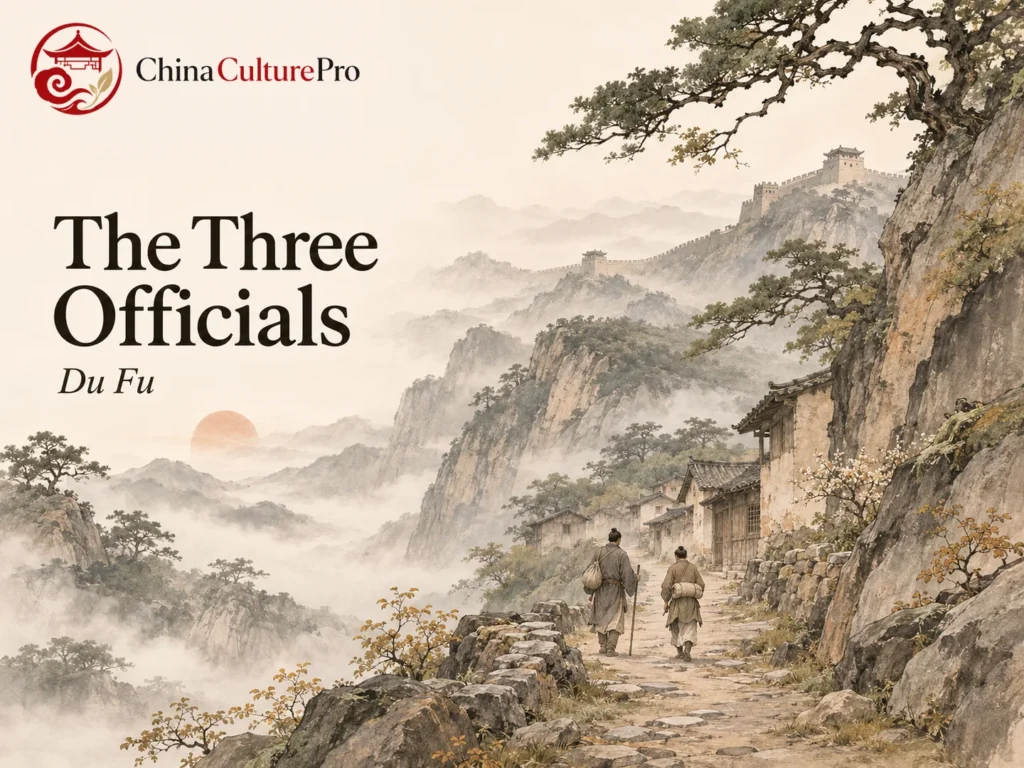

Quick Answer: What Are Du Fu’s Three Officials?
The Three Officials (三吏, Sān Lì) are three Tang poems by Du Fu (杜甫, Dù Fǔ), generally dated to 759 during the An Lushan Rebellion. Each brings a wartime institution into view through a small encounter.[1][2][3][4]
- Xin’an: The Officer at Xin’an (新安吏, Xīn’ān Lì) calls up youths when adult men are scarce.[1]
- Shihao: The Officer at Shihao (石壕吏, Shíháo Lì) comes at night to a household that has already lost sons.[2]
- Tong Pass: The Officer at Tong Pass (潼关吏, Tóngguān Lì) shows off new defences, prompting a warning about the conduct of commanders.[3]
The poems share a war, but they show different kinds of encounter with its demands.[4]

An order issued the night before sends boys away from home. An officer’s visit to a village house turns a woman’s family history into a plea. At a mountain pass, an official points to walls that should be impossible to take. The three scenes let readers see how an ongoing war looks from a road, a doorstep and a fortification.
The Three Poems at a Glance
The An Lushan Rebellion was still under way in 759. These poems locate its demands in three separate situations. The labels below are English renderings of the received titles.[1][2][3][4]
| Poem | What the speaker encounters | What the scene makes visible |
|---|---|---|
| The Officer at Xin’an | A roll call draws younger men into service. | The difference between a number on the levy and a person leaving home. |
| The Officer at Shihao | A woman speaks to an officer taking people from the village. | The losses concealed by the demand for another recruit. |
| The Officer at Tong Pass | An officer shows the speaker the defences. | The difference between a strong position and wise command. |
The Officer at Xin’an
The first thing the traveller hears is the clamour of men being called up. He asks why a small county has no adult men left. The officer cites an order received the night before. The youths are next on the list. Du Fu then asks how boys so small can guard the royal city. It is a different kind of question from the one an official can answer with an order.[1][4]
One boy has a mother to see him off. Another is alone. The poem follows the water east and lets the cries carry across the landscape. The line 白水暮东流,青山犹哭声 can be read as “White water flows east at dusk. The sound of weeping lingers in the green hills.” The line lets sound outlast the people the traveller can see.[1]
The poem also tries to give the families reasons to hope, including lighter tasks and a commander who might act like a father or brother. Those assurances follow a description of the imperial army scattering after the fighting at Xiangzhou, associated with Yecheng. The movement between grief and reassurance allows the final words to be both an act of care and a sign of how little comfort is available.[1][4]
The Officer at Shihao
The speaker lodges at Shihao as night falls. An officer comes to seize people for service. An old man climbs over a wall, and his wife goes to the door. Two of her three sons have died, she says. A nursing grandchild and the child’s mother are still in the house. The officer’s anger is reported, but the words the poem lets us hear in detail are hers.[2]
The woman asks to go with the officer and says she can prepare the morning meal at Heyang. The offer names the one task she may still be able to perform. By morning the narrator takes leave only of the old man. Du Fu leaves the actual departure out of view. The missing farewell suggests what happened. Before dawn, the narrator thinks he hears someone sobbing. The uncertainty matters because it puts us at a distance from events the woman herself is forced to face.[2][4]
The Officer at Tong Pass
At Tong Pass, soldiers are building walls and the officer speaks at length. The pass narrows to a place where only one cart can fit. One man with a long weapon, the officer claims, can hold such ground. The scenery here is tactical evidence, something the official points out to explain his confidence.[3]
The speaker remembers a much earlier loss. Geshu Han (哥舒翰, Gēshū Hàn) had defended the pass before being ordered to take the army out to fight in 756. The last line asks the officer to warn the commander against repeating Geshu’s example. The warning reads differently once the pass has been shown to be so strong. The terrain may be an advantage, yet a command decision can forfeit it.[3][4]
How to Read the Three Officials with the Three Partings
The Three Partings (三别, Sān Bié) take the same wartime pressures into the lives of a newly married woman, a man who returns to a ruined home and an elderly man leaving his wife. The groups are often read together. The titles of the Three Officials name figures of authority. The Partings name forms of separation.[4]
The contrast between one person’s history and the record of a war also explains why the poems remain readable beyond their events. They turn encounters into carefully shaped scenes, with choices about whose words are heard and where a story cuts off. In Spring View, a cityscape and the wish for news from home give another view of the same war.[1][2][3][4]
FAQs About Du Fu’s Three Officials
When did Du Fu write the Three Officials?
They are generally dated to 759, when the rebellion continued and the imperial army had suffered a defeat at Yecheng. The earlier disaster recalled at Tong Pass belongs to 756.[3][4]
Do all three poems criticise the same kind of official?
The Xin’an and Shihao poems show recruitment in different settings. At Tong Pass the officer is supervising defences, and the speaker’s last warning is directed at a commander.[1][2][3]
Sources
[1] Du Fu. The Officer at Xin’an
[2] Du Fu. The Officer at Shihao
[3] Du Fu. The Officer at Tong Pass
[4] Columbia University Press. How to Read Chinese Poetry in Context: Book Excerpt