


Quick Answer: What Is Welcome Rain on a Spring Night About?
In *Welcome Rain on a Spring Night* (春夜喜雨, Chūnyè Xǐ Yǔ), Du Fu (杜甫, Dù Fǔ) welcomes rain that arrives just when spring growth needs it. It comes quietly with the wind. In the darkness a riverboat’s light stands out, and the speaker pictures the city’s wet flowers at dawn.[1]
- The rain: Its timing matters as much as its gentleness.
- The night: The sky and paths are dark, with one light visible on the river.
- The morning: Wet red flowers will make the rain’s work visible.
The poem moves from something the speaker can scarcely hear to something he expects to see clearly.
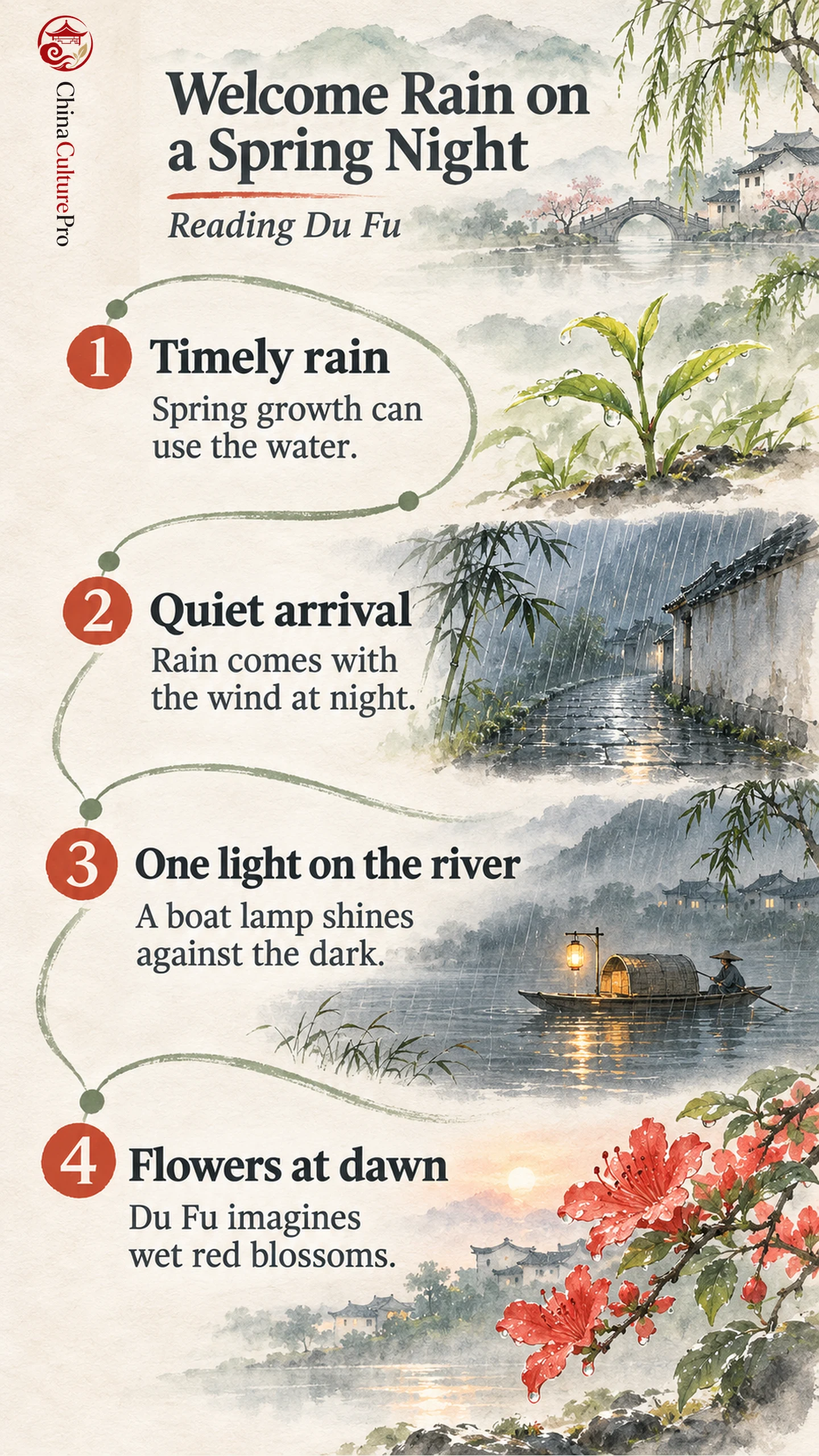
A boat’s light is the one bright point in Du Fu’s dark landscape. The poem uses it to show how little the speaker can see before he imagines the color that morning will bring.
Welcome Rain on a Spring Night in Chinese, Pinyin and English
The four couplets below follow the received text in simplified Chinese. The pinyin gives a modern Mandarin reading. Brocade City (锦官城, Jǐnguānchéng) is an old name for Chengdu, where Du Fu lived for part of his life. The English rendering is original.[1][2][3]
| Chinese | Pinyin | English |
|---|---|---|
| 好雨知时节,当春乃发生。 | Hǎo yǔ zhī shíjié, dāng chūn nǎi fāshēng. | Good rain knows the season. When spring comes, the rain brings things to life. |
| 随风潜入夜,润物细无声。 | Suí fēng qián rù yè, rùn wù xì wú shēng. | It slips in with the wind at night, gently wetting things without a sound. |
| 野径云俱黑,江船火独明。 | Yě jìng yún jù hēi, jiāng chuán huǒ dú míng. | Field paths and clouds are dark. A light on a riverboat shines alone. |
| 晓看红湿处,花重锦官城。 | Xiǎo kàn hóng shī chù, huā zhòng Jǐnguānchéng. | At dawn, look where the red is wet. Flowers hang heavy in Brocade City. |
What Makes the Rain Good
The first line gives the rain a human ability. It knows when to come. The next line names spring, when new growth can use the water. “Good” is a judgment about the rain’s timing, and the quiet second couplet adds the manner of its arrival. It slips in without needing to announce itself.[1]
The poem makes the rain’s softness perceptible through a detail that is almost an absence. The line asks you to imagine the wetting without the sound of rainfall. The line about wetting things registers an effect even while the rain is almost imperceptible. The following two couplets give the effect of the rain a visible form.
Why the Boat’s Light Stands Out
The third couplet places dark against bright. The paths belong to the ground, and clouds cover the sky. The boat’s light picks out the river between them. The word “alone” does as much work as “bright.” In that stretch of the poem, a single visible detail tells you how much of the scene has disappeared into shadow.[1]
By the last couplet the light will spread across the city. The boat’s flame makes the darkness distinct enough that the imagined morning will feel like a change, in the scale of what can be seen.
What Du Fu Imagines at Dawn
The final line reads the flowers’ weight as a sign of what happened in the dark. The last couplet starts with wet red and then gives the color a shape. It belongs to flowers holding water, their color visible across the city. The speaker can already picture what the rain will look like once daylight returns.[1][2]
In Du Fu’s Spring View, spring flowers are bound up with grief in a city damaged by war. Here rain on flowers prompts pleasure. Su Shi’s On the Road to Xincheng offers a later picture of how passing weather changes what a traveler notices on the ground.
Li Bai’s Waking from Drunkenness on a Spring Day likewise asks what spring feels like before a speaker has a full view of it. There a bird and the wind tell him what season he has woken into.
FAQs About Welcome Rain on a Spring Night
Where is Brocade City in the poem?
Brocade City is Chengdu, in present-day Sichuan. Du Fu wrote poems about the area while he lived there, and the closing line uses its historical name.[3]
What does moistening things without a sound mean?
In the poem it describes soft rain watering things quietly. Quoted apart from the poem, the phrase can also describe a gentle influence that works without drawing attention to itself.[1]
Sources
[1] Du Fu. Welcome Rain on a Spring Night in the received text
[2] Lingnan University. The Chinese poem, pinyin and a recording
[3] Stephen Owen. An Anthology of Chinese Literature