
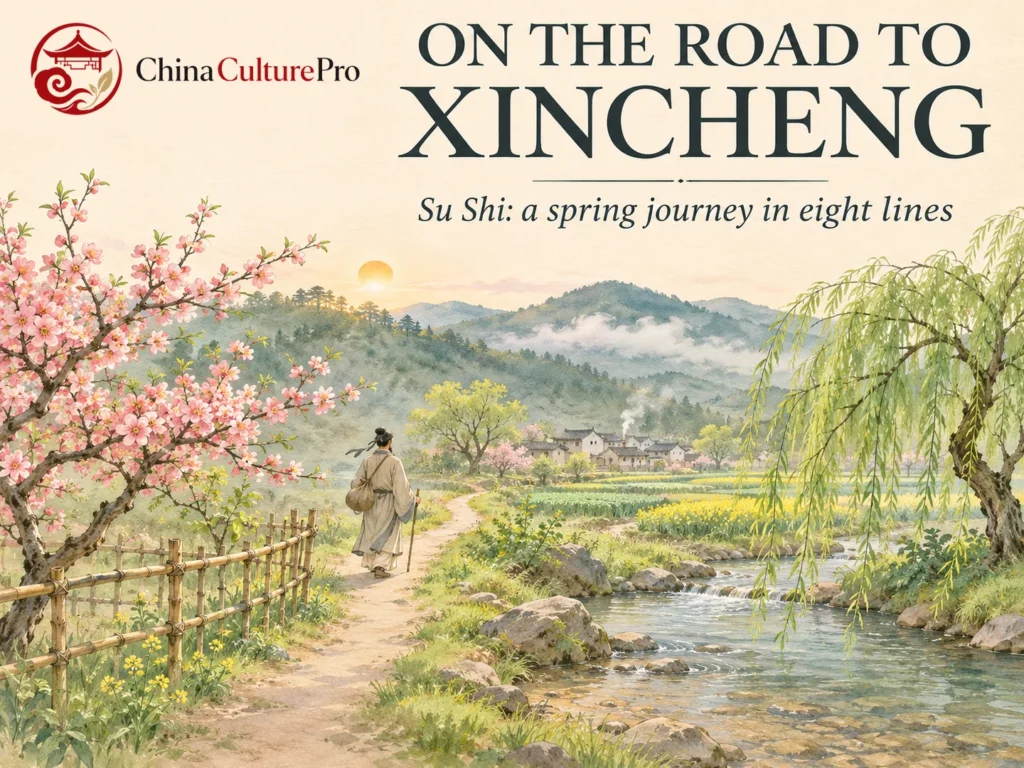

Quick Answer: What Is On the Road to Xincheng About?
On the Road to Xincheng (新城道中, Xīnchéng Dàozhōng), by Su Shi (蘇軾, Sū Shì), follows a spring journey through clearing weather and lively countryside. The poem translated here is the first of two works under that shared title.[1]
- Form: Seven-character regulated verse (七言律詩, qīyán lǜshī), with eight lines of seven Chinese characters.
- Central technique: Wind seems to understand the traveler, clouds become a soft cap, and the early sun resembles a bronze gong.
- Ending: The speaker imagines nearby households enjoying seasonal food as they provide for spring farm work.
The whole first poem contains eight lines, not just the familiar opening four; its rural happiness is the traveler’s inference rather than a factual survey.
The journey begins when a familiar annoyance stops: rain is no longer sounding beneath the eaves. The traveler treats this clearing weather as a personal favor, then looks outward to cloud, sunlight, flowers and a stream. By the end, the poem’s attention has moved from the conditions of his own journey to the work and meals of country households.
The Complete First Poem and an English Sense Translation
This is the full first poem. The original English rendering keeps all eight lines, including the last pair’s shift toward household life. The selected Chinese text reads 芹, a leafy vegetable, in its final line.[1]
| Chinese text | English sense |
|---|---|
| 東風知我欲山行 | The east wind knows I wish to journey in the hills; |
| 吹斷檐間積雨聲 | It blows away the sound of persistent rain beneath the eaves. |
| 嶺上晴雲披絮帽 | Bright clouds on the ridge spread like a softly padded cap; |
| 樹頭初日掛銅鉦 | Above the treetops, the early sun hangs like a bronze gong. |
| 野桃含笑竹籬短 | Wild peach blossoms smile beside a low bamboo fence; |
| 溪柳自搖沙水清 | Streamside willows sway by themselves; sand and water are clear. |
| 西崦人家應最樂 | Households in the western hills must be happiest of all, |
| 煮芹燒筍餉春耕 | Boiling greens and cooking shoots to feed the spring fieldwork. |
The gong belongs to the visual comparison with the sun. The poem does not say that the traveler hears an actual instrument. Likewise, the cap is an image for the clouds, not evidence that the summit is covered in snow.[1]
A Spring Journey in the Hangzhou Region
The title’s place is the historical county of Xincheng (新城, Xīnchéng), identified with present-day Xindeng (新登, Xīndēng) in the Fuyang (富陽, Fùyáng) area of Hangzhou (杭州, Hángzhōu). The journey belongs to Su Shi’s service as an official inspecting counties in that region, rather than an unspecified trip to a “new city.”[2]
A premodern critical account places the journey in the second traditional month of 1073. That month should not automatically be converted to Gregorian February. The poem’s peaches, willows and fieldwork supply its own spring setting.[1][4]
The second poem under the same title begins instead with thoughts about the traveler’s life and a horse’s loosened reins beside a stream. It also introduces anxiety about public service. Those lines can complicate an entirely carefree reading of the pair, but they are a separate poem and are not part of the eight-line translation above.[1]
A Wind That Knows the Traveler
The opening gives the wind knowledge of a human wish. It does more than state that the weather improved: it makes the improvement seem considerate. The interruption of rain’s sound becomes the first event in a landscape that appears responsive to the traveler.[1][3]
This is personification, not a claim that weather deliberately serves an individual. The effect depends on the playful gap between an ordinary change in conditions and the traveler’s sense of being helped. The later “smile” of the peach blossoms continues that friendly animation of the scene.[1]
The Cloud Cap and the Bronze Gong
The next pair looks upward. The cloud-cap comparison gives the ridge a soft, pale covering; the early sun supplies a bright metal-like form above the trees. The two objects translate a distant view into things that can be pictured at human scale. Their parallel placement also lets the eye move from ridge to treetop without leaving the same morning.[1]
Not every historical reader admired this pair equally. Fang Hui (方回, Fāng Huí), in the Yingkui Lüsui (瀛奎律髓, Yíngkuí Lǜsuǐ), praised the opening and the peach-and-willow pair while finding the third and fourth lines comparatively clumsy. His response offers a useful question: do the conspicuous comparisons make the scenery immediate, or make the poet’s construction too visible? Both are critical judgments to test against the words.[4]
From Peach Blossoms to Food for Spring Work
After the high view, the poem moves closer: a low fence, blossoms and willows beside clear water. The setting is inhabited before a person enters the closing thought. This change in scale prepares the move from pleasing scenery to the households that live within it.[1]
The final verb about feeding connects food with agricultural labor. Greens and bamboo shoots are not merely a picturesque menu: they provision people working in the fields. The cheerful scene includes the practical business of spring cultivation.[1]
Yet the speaker says the households “must” be especially happy. He imagines their contentment from outside; he does not interview them or prove that rural life lacks hardship. Keeping that small qualification preserves both the poem’s warmth and the distance between a passing official and the lives he pictures.[1]
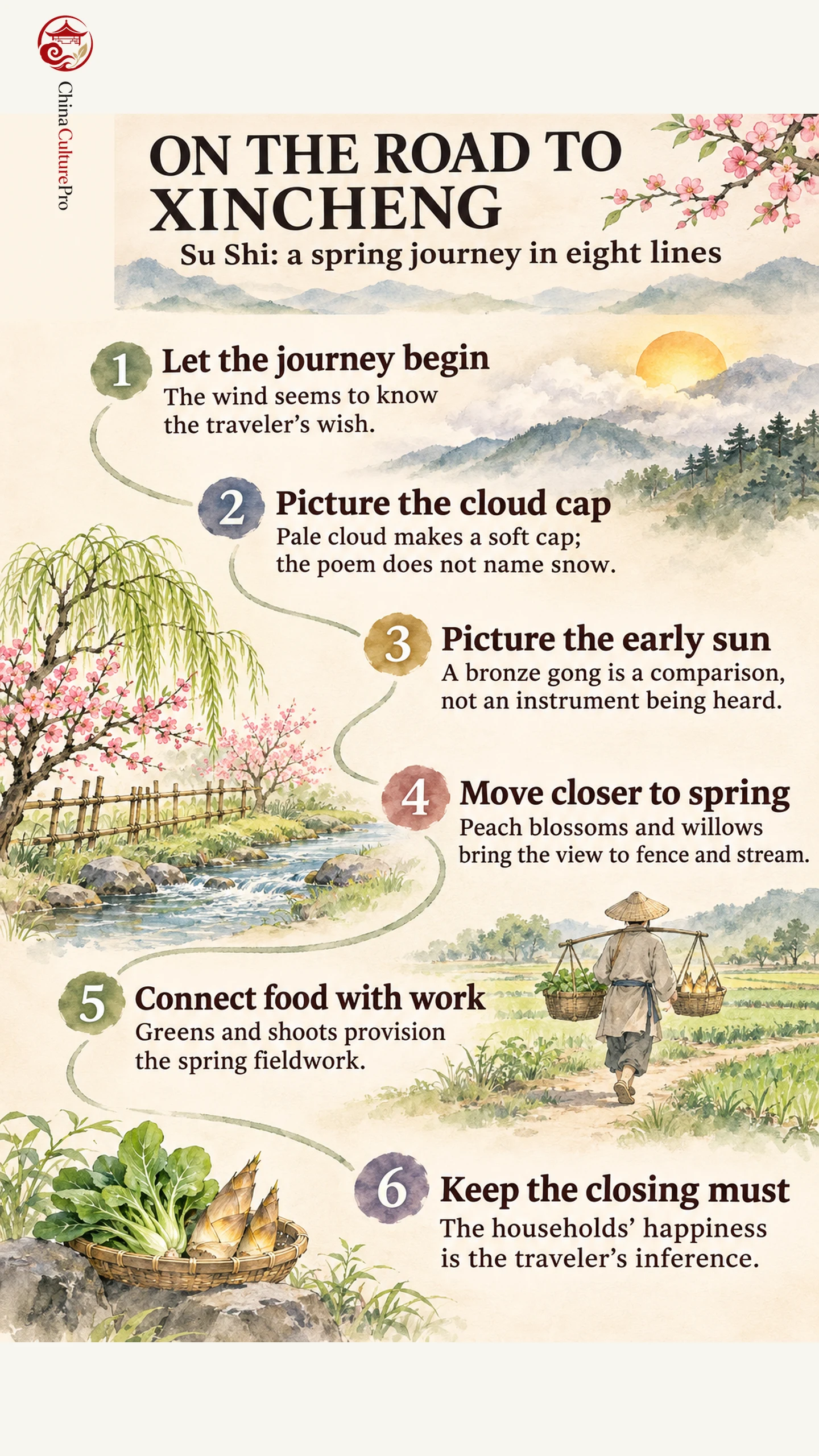
How to Read the Journey in Four Couplet Moves
- Listen at the eaves: Start with the sound that stops, and notice how the wind receives a helpful intention.
- Look above the ridge: Hold the cloud cap and sun gong together as paired visual comparisons.
- Move to fence and stream: Follow the shift from the high view to nearby signs of spring and habitation.
- Hear the closing inference: Keep “must” in the thought about household happiness, then connect the meal with fieldwork.
For a wider reading path, explore Chinese nature poetry. Another of the poet’s journeys through wind and rain offers a different relation between weather and the traveling self.
FAQs About On the Road to Xincheng
Are the opening four lines the whole poem?
No. They are half of the first eight-line poem. The remaining four lines bring peach blossoms, willows and households preparing food for spring farm work into view.[1]
Is the white cap snow on the mountain?
The line names clouds in clearing weather and compares their appearance to a padded cap. It does not explicitly describe snow, so the comparison should not become a separate snowfall report.[1]
Does the ending prove that rural life is easy?
No. The speaker imagines the households’ happiness, and the last line still includes agricultural work. Read the ending as a traveler’s hopeful picture rather than a conclusion established about every villager.[1]
Sources
[1] Su Shi. 新城道中二首: received text of both poems
[2] Taoyuan Museum of Fine Arts, National Cultural Memory Bank. 東坡居士新城道中詩: collection record and geographical context
[3] Asami Yoji. On Personified Nature in Poems of Su Shi and Yang Wan-Li
[4] Fang Hui. 瀛奎律髓, volume 14: poem and commentary