


Quick Answer: What Are Du Fu’s Three Partings?
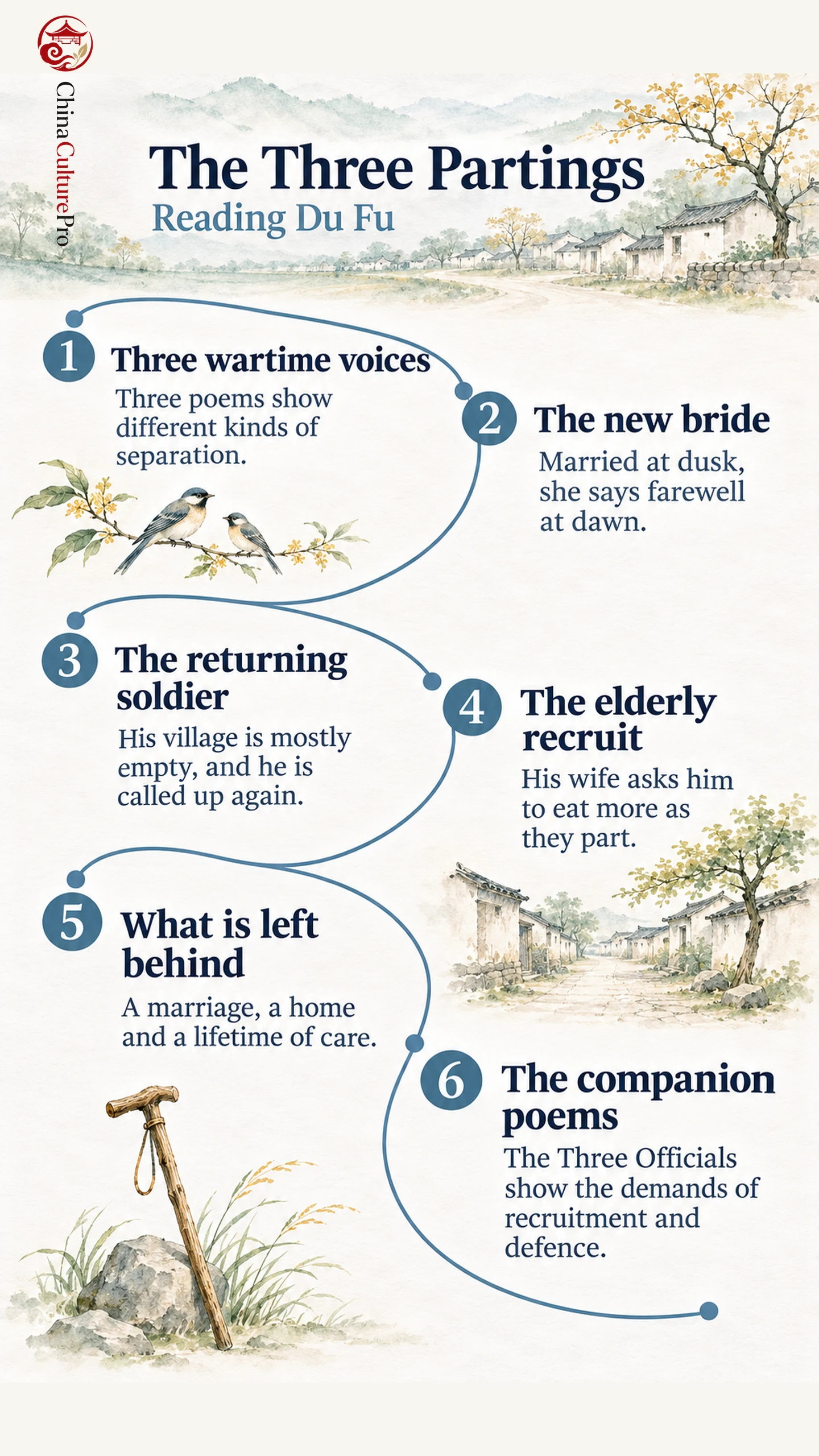
The Three Partings (三别, Sān Bié) are three poems by Du Fu (杜甫, Dù Fǔ), usually dated to 759 during the An Lushan Rebellion. Each gives the speech of someone facing a different kind of separation.[1][2][3][4]
- Newlyweds: Parting of the Newlyweds (新婚别, Xīnhūn Bié) gives the bride’s words as her husband leaves the morning after their marriage.[1]
- No home: Parting with No Home (无家别, Wújiā Bié) follows a soldier who returns to a deserted village and is called up again.[2]
- Old age: Parting in Old Age (垂老别, Chuílǎo Bié) gives an elderly recruit’s farewell to his wife.[3]
The poems can be read together by asking what each speaker still has to leave behind.
A wedding bed has barely grown warm. A path home leads to empty lanes. An elderly wife who fears she will never see her husband again still tells him to eat more. These are three different losses. Du Fu gives each one a person able to speak about it.
The Three Voices at a Glance
The An Lushan Rebellion forms the setting. The poems bring its pressure into three households at different stages of life.[1][2][3][4]
| Poem | Who speaks | What the war interrupts |
|---|---|---|
| Parting of the Newlyweds | A bride | The beginning of a marriage and her place in a new household |
| Parting with No Home | A returning soldier | His attempt to resume life in the village he remembers |
| Parting in Old Age | An elderly man | The care he and his wife can still give each other |
Parting of the Newlyweds
The bride gives the duration of the marriage in two times of day. 暮婚晨告别 can be read as “Married at dusk, saying farewell at dawn.” She also says the bedding has yet to warm. Both images measure how little time the household has had to become a place she knows.[1]
The husband is going to defend Heyang. She worries about how she can approach her parents-in-law when her status in the family has barely begun. For a moment she wants to go with him. She then urges him to attend to military service and sets aside the clothing and makeup she prepared. The words of encouragement come from the same woman who asks how she can bear the separation.[1]
At the end, she looks up at birds flying in pairs. The birds make companionship visible at the moment it is taken from her. The last lines leave her looking and waiting.[1]
Parting with No Home
This speaker has already been in battle. After a defeat he looks for the tracks he used to know. The village once had more than a hundred households. He now finds empty lanes, wild animals and only one or two elderly widows nearby. The remembered village gives the empty lanes their scale.[2][5]
He tries to stay. In spring he takes up a hoe and waters the plots in the evening. When the local official learns he has returned, he is told to train for service again. The order is especially bitter because he has just begun to do the work that makes a place habitable.[2]
The final question changes the meaning of parting. A farewell normally has someone or somewhere on the other side of the separation. Here the man can travel nearby or far away and still have nowhere to turn back to. He remembers his mother, whose body, he says, was left in a ditch, as part of the loss of a place in the world.[2][5]
Parting in Old Age
The old man says his children and grandchildren have died in battle. He casts away his walking stick and goes out. He still has teeth, he remarks, while he feels strength failing inside his bones. He describes his fitness for service in terms that leave his remaining strength open to question.[3]
His wife lies crying by the road, thinly dressed in the cold at the end of the year. The man expects no return, yet he still hears her telling him to eat more. That familiar advice does something a speech about military duty could not. It preserves an ordinary kind of care when they may have no chance to repeat it.[3]
He can tell himself that the defences are stronger than those of a previous battle. He can also ask where there is a safe place to stay in a world at war. The poem ends on the pain of leaving the thatched home. His reasons for going have not made the departure easier.[3]
How the Three Partings Relate to the Three Officials
The Three Officials (三吏, Sān Lì) put a traveller in contact with people charged with recruitment or defence. The Three Partings give longer stretches of speech to those whose lives are divided by those duties. Read together, the groups let an order look different when heard from the doorway or the road outside the home.[4]
The monologues are carefully shaped poems. They can tell us how Du Fu imagines war entering family life while leaving the speakers’ historical identities open. A useful comparison is Bai Juyi’s The Elderly Man of Xinfeng, which uses one man’s account of recruitment to look back at a different Tang campaign.[4]
FAQs About Du Fu’s Three Partings
When were the Three Partings written?
They are usually dated to 759, while the An Lushan Rebellion continued. The military defeat at Yecheng forms part of the context for the renewed calls to service.[4][5]
Who speaks in the Three Partings?
The speakers are a newly married woman, a soldier who returns to a largely deserted village and an elderly man called to leave home. The poems centre the farewells they experience.[1][2][3]
Sources
[1] Du Fu. Parting of the Newlyweds
[2] Du Fu. Parting with No Home
[3] Du Fu. Parting in Old Age
[4] Columbia University Press. How to Read Chinese Poetry in Context: Book Excerpt
[5] China Confucius Network. 无家别