


Quick Answer: What Is Wang Wei’s Double Ninth Poem About?
Thinking of My Brothers on Double Ninth (九月九日忆山东兄弟, Jiǔ Yuè Jiǔ Rì Yì Shāndōng Xiōngdì) is a quatrain by Wang Wei (王维, Wáng Wéi). Away from home on Double Ninth (重阳, Chóngyáng), he pictures his brothers climbing a height without him.[1][2]
- Date: The festival falls on the ninth day of the ninth lunar month.
- Custom: The brothers wear sprigs of zhuyu (茱萸, zhūyú), a plant associated with the festival.
- Ending: The last line imagines the family group from its own side and notices the gap.[1][3]
The holiday gives homesickness a concrete scene.[1]
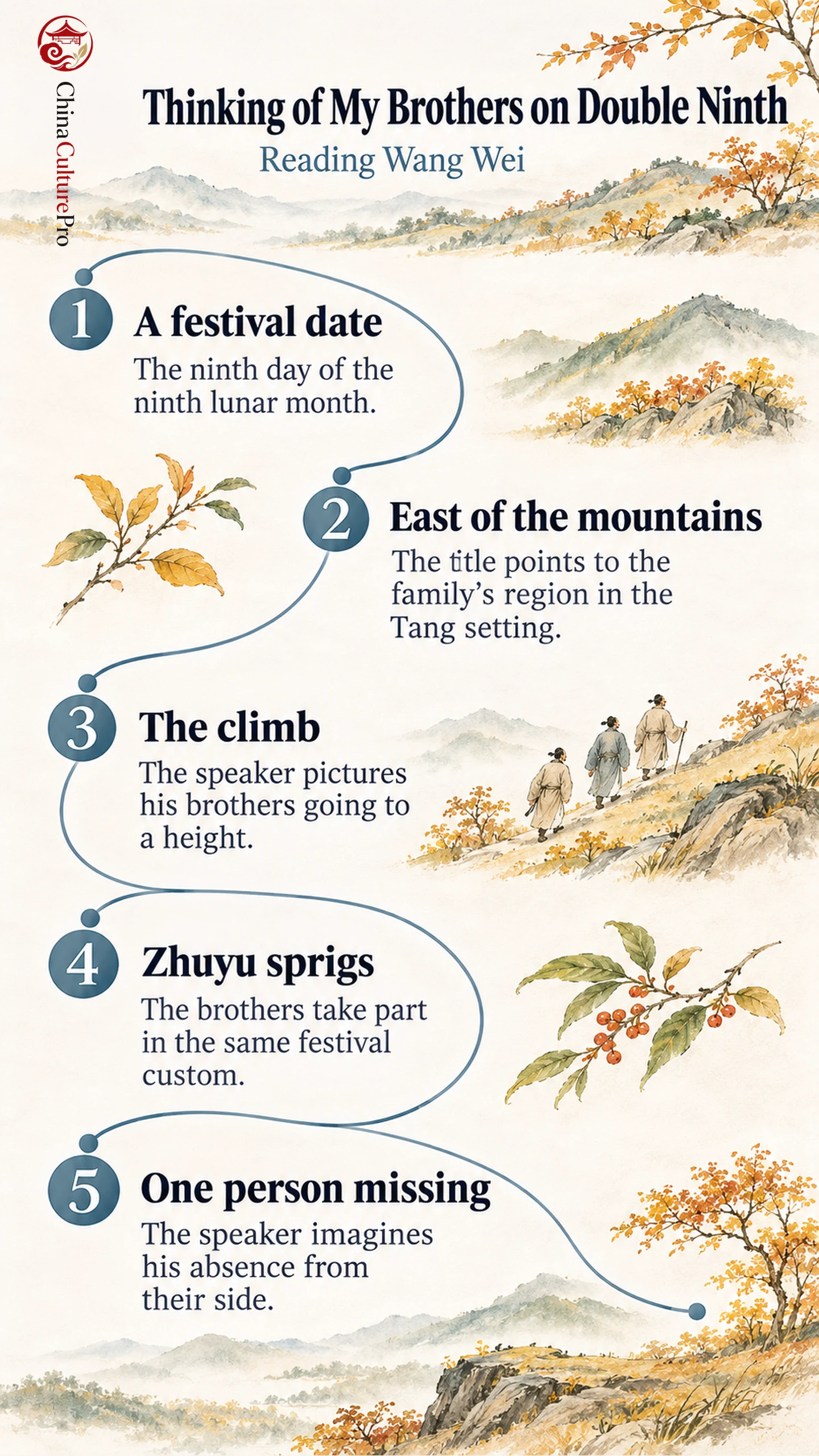
The speaker starts by saying he is alone. The poem ends by counting a group he cannot see. Between those two moments, a festival custom supplies the action that makes absence visible. Someone should be there to put on a sprig with the rest of the family.
The Poem in Chinese, Pinyin and English
The poem has four lines of seven characters. The English gives the sense of the received text, including the repeated 异 in the first line. The pinyin shows a modern Mandarin reading.[1]
| Chinese | Pinyin | English sense |
|---|---|---|
| 独在异乡为异客 | Dú zài yìxiāng wéi yìkè | Alone in an unfamiliar place, I am a stranger. |
| 每逢佳节倍思亲 | Měi féng jiājié bèi sī qīn | Each festival makes me miss my family twice as much. |
| 遥知兄弟登高处 | Yáo zhī xiōngdì dēng gāo chù | From afar, I picture my brothers up on the heights. |
| 遍插茱萸少一人 | Biàn chā zhūyú shǎo yī rén | They put on their zhuyu sprigs. There is one person fewer. |
The phrase 遥知 can also suggest knowing from afar in the sense of imagining with confidence. It lets the speaker describe a scene without claiming he has seen it.[1][2]
What the Title Tells Us About Time and Place
The doubled ninth gives the festival’s date in the traditional calendar. In the poem’s second line, 佳节, a festive occasion, broadens that date into a recurring experience. Each return of a festival makes the separation felt again. The first line uses 异 twice, for both the unfamiliar place and the visitor who feels out of place there. Even before the date enters the verse, the place and the traveller’s relation to it are linked. “Twice as much” gives the increase an immediate expression without asking the reader to measure it.[1][2][3]
Shandong (山东, Shāndōng) in the full title means “east of the mountains.” The traditional geographical explanation associates the family with Pu, near present-day Yongji in Shanxi, east of the Mount Hua and Hangu Pass area. The title locates the brothers in relation to the speaker. It does not place them in the modern province called Shandong.[2][4]
Why the Brothers Climb and Wear Zhuyu
Ascending a height and wearing zhuyu were two customary Double Ninth activities. The plant is often called cornel or dogwood in translations. Wearing it was traditionally associated with keeping misfortune away. Wang Wei uses it in a specific social scene. The speaker imagines the brothers putting it on together, and the repeated action makes an absent participant easier to notice.[1][2][3]
Another poem linked to the festival, Li Qingzhao’s Drunken Flower Shade, makes solitude perceptible through chrysanthemums, weather and the passing day. Wang uses the ritual action to put his own loneliness into a scene at home.
How the Last Line Changes the Point of View
The first two lines look outward from the lone traveller. The last two imagine a family looking around and finding that its number has changed. “One person fewer” names no emotion. It trusts a missing place in a familiar group to carry the emotion of the whole poem.[1][2]
Du Fu also imagines the far side of a separation in Moonlit Night, where his speaker pictures a family member seeing the night. The two poems use different details to make that change of perspective. Du Fu follows the moon and the person looking at it. Wang Wei follows a custom that the brothers can continue, even though he is missing from it.
FAQs About Thinking of My Brothers on Double Ninth
How old was Wang Wei when he wrote the poem?
A note in the transmitted collection gives his age as seventeen. The poem itself does not name an age.[1][2]
What does the line about missing family twice as much mean?
A familiar festival sharpens the speaker’s sense of being away. The first half states that feeling. The ending shows it from the imagined viewpoint of the people at home.[1]
Sources
[1] Wang Wei. Thinking of My Brothers East of the Mountains on the Ninth Day of the Ninth Month
[2] Pauline Yu. The Poetry of Wang Wei
[3] Getty Research Institute. Double Ninth Festival
[4] Chaoxing Learning. 九月九日忆山东兄弟