

Quick Answer: What Is The Hard Road to Shu About?
The Hard Road to Shu (蜀道难, Shǔdào Nán) is a Tang poem by Li Bai (李白, Lǐ Bái). It follows an imagined westward journey into Shu, the region centred on present-day Sichuan, and repeatedly calls the road harder than climbing to the sky.[1][2]
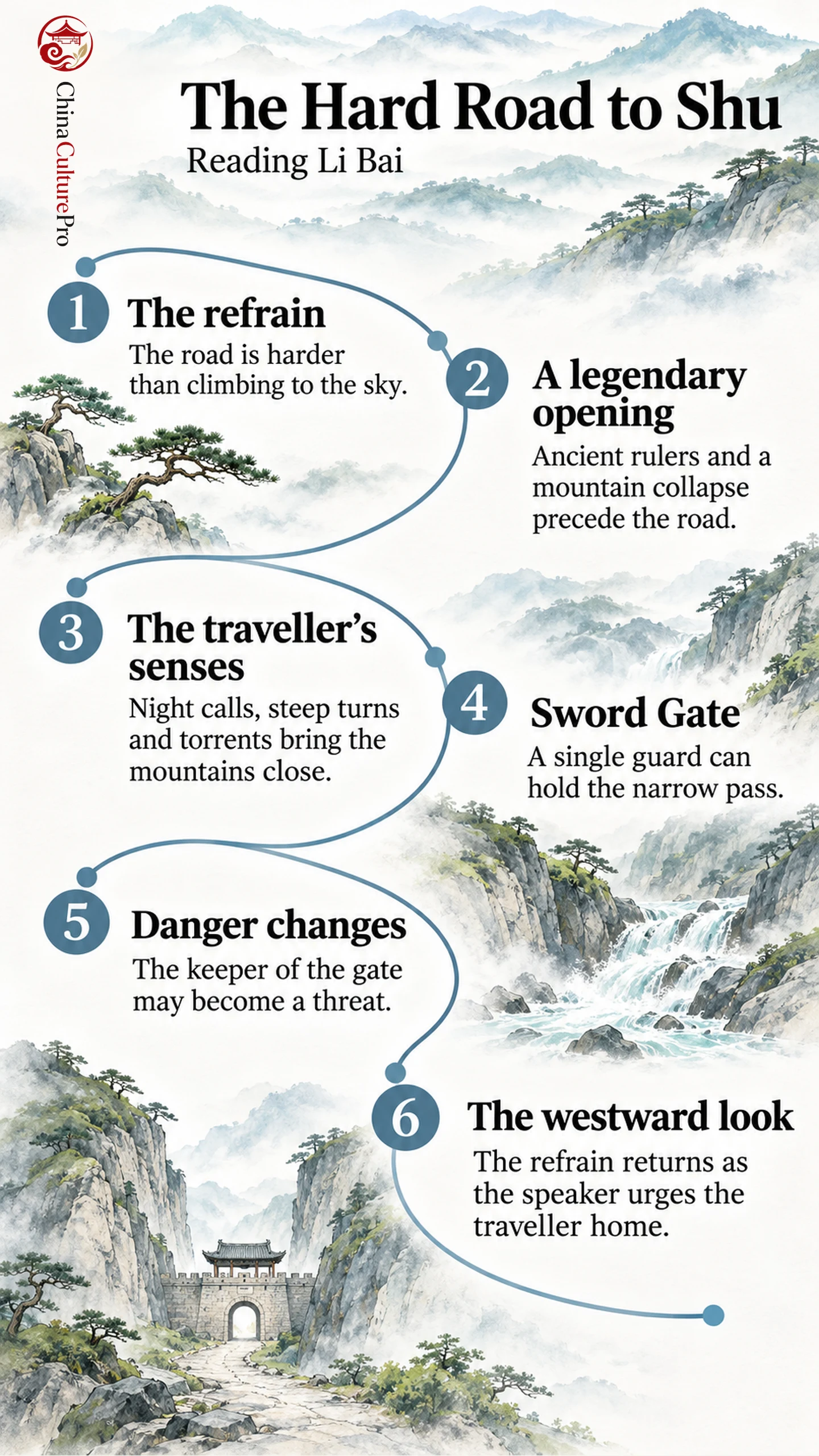
- Beginnings: Legendary rulers and a mountain collapse set the road apart from ordinary human passage.
- Experience: Steep turns, night cries and thundering torrents make the difficulty felt.
- Warning: At Sword Gate (剑阁, Jiàngé), the traveller’s safety depends on who controls the pass.[1][2]
The route belongs to the poem’s imagination.
The first sound is an exclamation. Before anyone takes a step, the road has already defeated the speaker’s ordinary ways of describing height. Later the same refrain comes back when the traveller can hear the mountains, and again when the speaker looks west. Where it returns is a way to hear the poem’s changing argument.
The Hard Road to Shu in Chinese and English
Short exclamations and long verse lines share the same poem. The Chinese below follows the main text of the Complete Tang Poems edition. The English groups the lines for reading and keeps the refrain stable. The edition records variants, including a shorter ending in a Dunhuang fragment.[1]
| Chinese | English sense |
|---|---|
| 噫吁嚱!危乎高哉!蜀道之难,难于上青天! | Ah! How steep, how high! The road to Shu is hard, harder than climbing to the blue sky. |
| 蚕丛及鱼凫,开国何茫然!尔来四万八千岁,不与秦塞通人烟。 | Cancong (蚕丛, Cáncóng) and Yufu (鱼凫, Yúfú) founded their land in the dim past. For forty-eight thousand years, the smoke of human homes did not connect it with Qin beyond the passes. |
| 西当太白有鸟道,可以横绝峨眉巅。地崩山摧壮士死,然后天梯石栈相钩连。 | Westward at Taibai, a bird’s path could cross the crest of Emei. The earth gave way and brave men died. Then ladders and cliffside plankways joined up. |
| 上有六龙回日之高标,下有冲波逆折之回川。黄鹤之飞尚不得过,猿猱欲度愁攀援。 | Above are peaks that turn back the sun’s six dragons. Below is a river whose surging waves turn back on themselves. Even a flying crane cannot pass. The apes struggle for a hold. |
| 青泥何盘盘!百步九折萦岩峦。扪参历井仰胁息,以手抚膺坐长叹。 | How Qingni winds! In a hundred steps, nine turns coil around the crags. You reach for the stars Shen and Jing, gasp as you look up, then sit with a hand to your chest and sigh. |
| 问君西游何时还?畏途巉岩不可攀。 | When will you return from the west? The rocks along that fearful way are too steep to climb. |
| 但见悲鸟号古木,雄飞雌从绕林间。又闻子规啼夜月,愁空山。 | You see grieving birds crying in old trees, the hen following the male through the woods. A cuckoo calls under the moon and makes the empty mountain sad. |
| 蜀道之难,难于上青天,使人听此凋朱颜! | The road to Shu is hard, harder than climbing to the blue sky. The very hearing of it drains the colour from a face. |
| 连峰去天不盈尺,枯松倒挂倚绝壁。飞湍瀑流争喧豗,砯崖转石万壑雷。 | Peak after peak comes within a foot of heaven. Dead pines hang upside down on sheer walls. Rapids and falls roar over one another. Water strikes rock, stones roll, and ten thousand ravines thunder. |
| 其险也若此,嗟尔远道之人胡为乎来哉? | With danger like this, why have you come from so far away? |
| 剑阁峥嵘而崔嵬,一夫当关,万夫莫开。所守或匪亲,化为狼与豺。 | Sword Gate towers. One man can hold it and ten thousand cannot force it open. If its keeper cannot be trusted, he may turn wolf or jackal. |
| 朝避猛虎,夕避长蛇。磨牙吮血,杀人如麻。 | In the morning, avoid fierce tigers. At dusk, avoid long snakes. They sharpen their teeth, suck blood and kill people like stalks of hemp. |
| 锦城虽云乐,不如早还家。蜀道之难,难于上青天,侧身西望长咨嗟! | For all they say of the delights of Brocade Town (锦城, Jǐnchéng), better to return home soon. The road to Shu is hard, harder than climbing to the blue sky. I turn, look west and give a long sigh. |
Why the Road Begins in Legend
Cancong and Yufu belong to stories of the ancient founding of Shu. The vast span after them makes the time before human passage seem almost beyond memory. Li follows it with a path only birds might use and a story of mountain collapse. In a traditional explanation, five strong men encounter a great snake and die when the mountain falls. The poem keeps the collapse and the deaths, and lets the footways appear in their aftermath.[1][2]
The opening makes the road hard before it gives the reader a traveller to follow. Even the sun’s team of dragons must turn back at the peaks. That scale is a poetic way to imagine the sublime. Compare The Waterfall on Mount Lu, where Li also brings the sky into a landscape but uses it to make a falling stream appear astonishing.[2][3]
How the Refrain Changes Across the Poem
On its first appearance, the refrain measures height against a human impossibility. The middle return has a different subject. Hearing the account can drain colour from the listener’s face, even without an actual climb. Before that line, the soundscape moves from birds in old trees to a solitary night call. After it, the rapids and rocks produce something like thunder.[1]
The night bird has a traditional association with a former ruler of Shu, the same association that makes the cuckoo in The Brocade Zither more than a sound in a landscape. Li can leave the old story in the background and still make the call unsettling to a traveller hearing it at night.[1][2]
As the refrain returns at the close, the speaker looks west and sighs. The listener has already been urged home. The ending keeps the road at a distance, unlike Early Departure from Baidi City, where Li’s river traveller passes quickly through a landscape of cliffs and calls.[1]
What Changes at Sword Gate
Up to the gate, much of the danger comes from trying to pass through steep terrain. The narrow pass makes that same terrain a source of military power. A single guard can block a vastly larger force. That raises a question about loyalty. Who holds the gate, and what might he do with the advantage it gives him?[1][2]
The next lines make beasts a language for violence. The passage moves from a keeper becoming a wolf or jackal to threats that wait morning and evening. A political reading can start with that change in agency. A guard can create a danger no skill at climbing will answer. The text names no official as its target.[1]
FAQs About The Hard Road to Shu
Where is Shu in the poem?
Shu is the southwestern region centred on what is now Sichuan. Brocade Town is Chengdu. The poem names places but also incorporates legends, extreme numbers and imagined scenes.[1][2]
Who is the traveller Li Bai addresses?
The poem asks a westbound traveller when he will come home, but it does not name him. That address gives the warning an immediate audience.[1]
Sources
[1] Li Bai. The Hard Road to Shu in the Complete Tang Poems
[2] Stephen Owen. An Anthology of Chinese Literature: Beginnings to 1911
[3] Journal of Beijing University of Technology. Li Bai and High Tang Landscape Poetry: Rereading The Hard Road to Shu