

Quick Answer: What Is The Brocade Zither About?
The Brocade Zither (锦瑟, Jǐn Sè) is an eight-line poem by Li Shangyin (李商隐, Lǐ Shāngyǐn). A many-stringed instrument prompts a look back at the years of youth, and four images give that memory an elusive shape.[1][2]
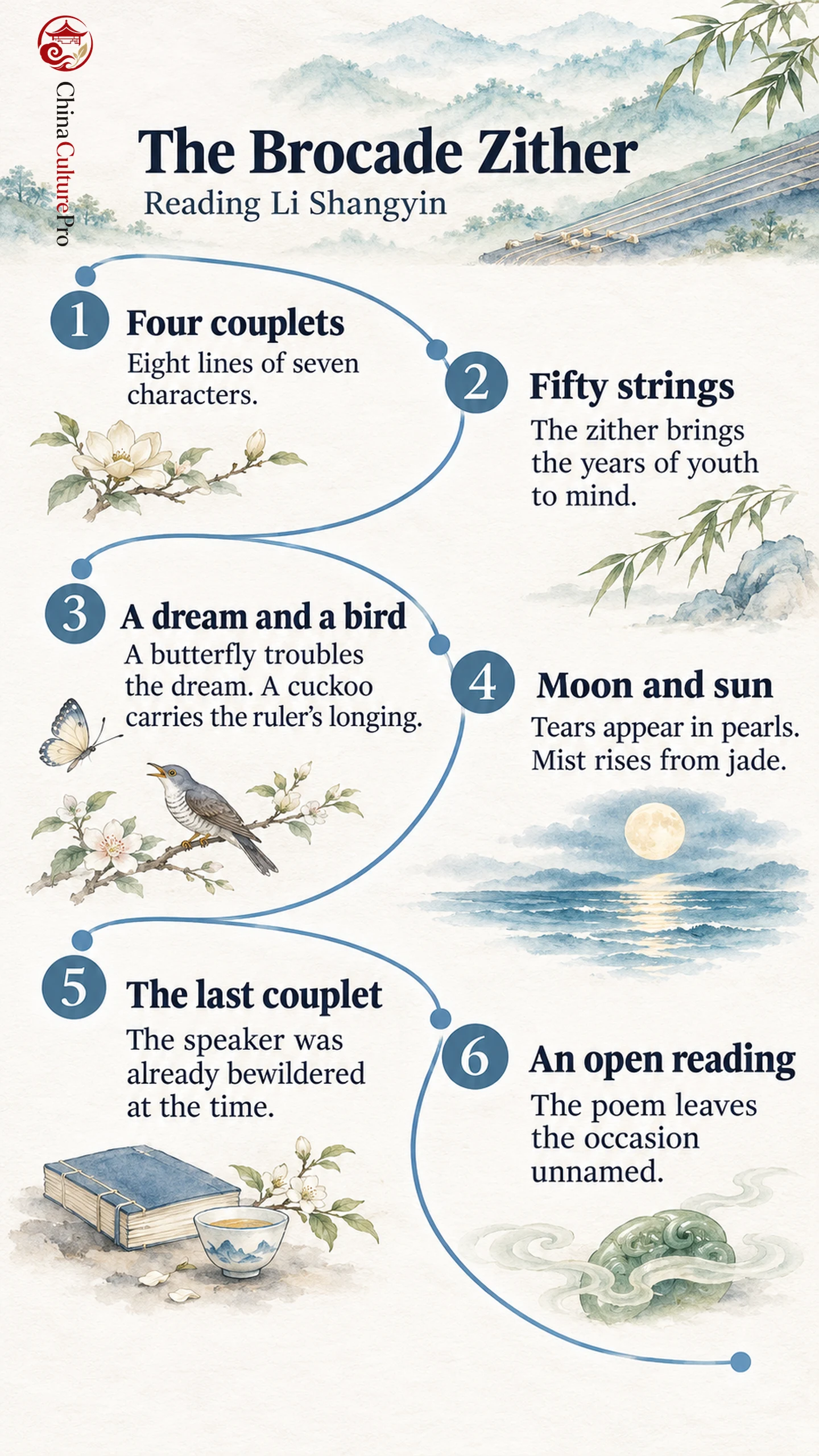
- Opening: Each string and bridge brings the earlier years to mind.
- Middle: A butterfly dream, a cuckoo, pearls with tears and jade with mist give feeling different forms.
- Ending: The speaker remembers having felt bewildered even at the time.[1]
The poem leaves the occasion for that bewilderment open. Grief, love and poetry are all possible readings.[2]
Start with the last couplet. The speaker finds that looking back brings an old feeling into view without making it easier to name. Then go back to the instrument in the first line. It seems able to call up the past string by string, yet what returns is a series of images instead of a story.
The Brocade Zither in Chinese, Pinyin and English
This is seven-character regulated verse (七言律诗, qīyán lǜshī), with eight lines arranged in four couplets. The table pairs the received text with modern Mandarin pinyin and an English sense translation.[1][2]
| Chinese | Pinyin | English sense |
|---|---|---|
| 锦瑟无端五十弦 | Jǐn sè wúduān wǔshí xián | The brocade zither has fifty strings, for no apparent reason. |
| 一弦一柱思华年 | Yī xián yī zhù sī huánián | Each string, each bridge brings back the years in bloom. |
| 庄生晓梦迷蝴蝶 | Zhuāng shēng xiǎomèng mí húdié | Master Zhuang, in bewildered by a butterfly in his dawn dream. |
| 望帝春心托杜鹃 | Wàngdì chūnxīn tuō dùjuān | Emperor Wang (望帝, Wàngdì) entrusts his spring longing to a cuckoo. |
| 沧海月明珠有泪 | Cānghǎi yuè míng zhū yǒu lèi | Over the blue sea, the moon shines and pearls have tears. |
| 蓝田日暖玉生烟 | Lántián rì nuǎn yù shēng yān | At Lantian (蓝田, Lántián), the sun is warm and mist rises from jade. |
| 此情可待成追忆 | Cǐ qíng kě dài chéng zhuīyì | Did this feeling have to wait to become a memory? |
| 只是当时已惘然 | Zhǐshì dāngshí yǐ wǎngrán | Even at the time, I was already at a loss. |
The question in line seven is an interpretive choice. The Chinese allows other readings of 可, including “might” or “should.” The final couplet can be read with either a question or a statement leading into its last line.[2]
What the Fifty Strings Set in Motion
A se (瑟, sè) is a Chinese zither with multiple strings and movable bridges. In a story associated with the unusual number, a player draws such sorrowful music from a fifty-string se that the instrument is broken into two of twenty-five strings. The poem can evoke that association without telling the reader to count one string for every year of the poet’s life.[2]
“一弦一柱,” one string and one bridge at a time, sounds like a plan to review the past in order. But the first thing that follows is a dream in which the dreamer has trouble identifying himself. The gap between the precise count and the strange memory is part of the effect. A more direct encounter with strings as a sound is Tuning the Lute by Liu Changqing, where hearing and its audience are central.
The Butterfly, Cuckoo, Pearls and Jade
Zhuang Zhou (庄周, Zhuāng Zhōu) dreams he is a butterfly and wakes unable to settle which identity dreamed the other. Li leaves only the dawn dream and its bewildering butterfly. Next to it stands a ruler of ancient Shu, also called Du Yu (杜宇, Dù Yǔ). Traditions associate Emperor Wang with the cuckoo after his reign. Li makes the link active by giving him a feeling to entrust to the bird. The juxtaposition lets a butterfly carry uncertainty about the self and a cuckoo carry something the ruler can no longer express directly.[1][2][3]
Then come two scenes with a tighter visual correspondence. The sea has a bright moon and pearls with tears. Lantian has warm sun and jade with mist. The first looks out over cool water, the second toward a place associated with jade. Tears and mist put a fleeting trace beside something precious and durable.[1][2]
There are stories behind the images, but the poem does not tell the reader which story explains the speaker’s life. Take the fifth line. Traditions about tears and pearls help make sense of the connection, while the line itself gives the tears to the pearls. The object takes on a sign of feeling. In Untitled: It Is Hard to Meet, Li gives a candle tears as its wax runs out. The tears there have a visible material counterpart. In The Brocade Zither, the pearls seem to contain tears of their own. Reading the image that way preserves the strangeness of its wording without making it stand for a single event.[1][2]
Why the Ending Leaves the Past Open
In the last line, “already” is important. It places the speaker’s bewilderment in the moment being remembered, before the act of looking back. On the question reading of line seven, the speaker did not have to wait for time to pass to feel at a loss. Even if line seven is read as a statement, the final line complicates the idea that memory alone caused the uncertainty.[1][2]
Readers have treated the poem as an elegy, a record of love or loss, and a reflection on the poet’s own writing. Each reading can account for a portion of the evidence. The music and the tears lend themselves to mourning, while the counted strings can suggest reviewing a body of work. None identifies the occasion from words the poem actually supplies.[2]
The writing of Li Shangyin offers other ways to see how a poem handles something its speaker cannot yet explain. In Night Rain Sent North, the speaker imagines telling the story of the present rain in a future conversation. The Brocade Zither looks back and finds that the uncertainty was present all along.
FAQs About The Brocade Zither
What kind of poem is The Brocade Zither?
It is a Tang regulated poem of eight seven-character lines. The two middle couplets pair images across corresponding lines.[1][2]
Is The Brocade Zither an elegy for Li Shangyin’s wife?
That is one established reading. The poem names neither a wife nor a death, so the identification remains an interpretation.[1][2]
Sources
[1] Li Shangyin. Jin Se in the Complete Tang Poems
[2] Stephen Owen. The Late Tang: Chinese Poetry of the Mid-Ninth Century
[3] Zhuangzi. The Adjustment of Controversies