
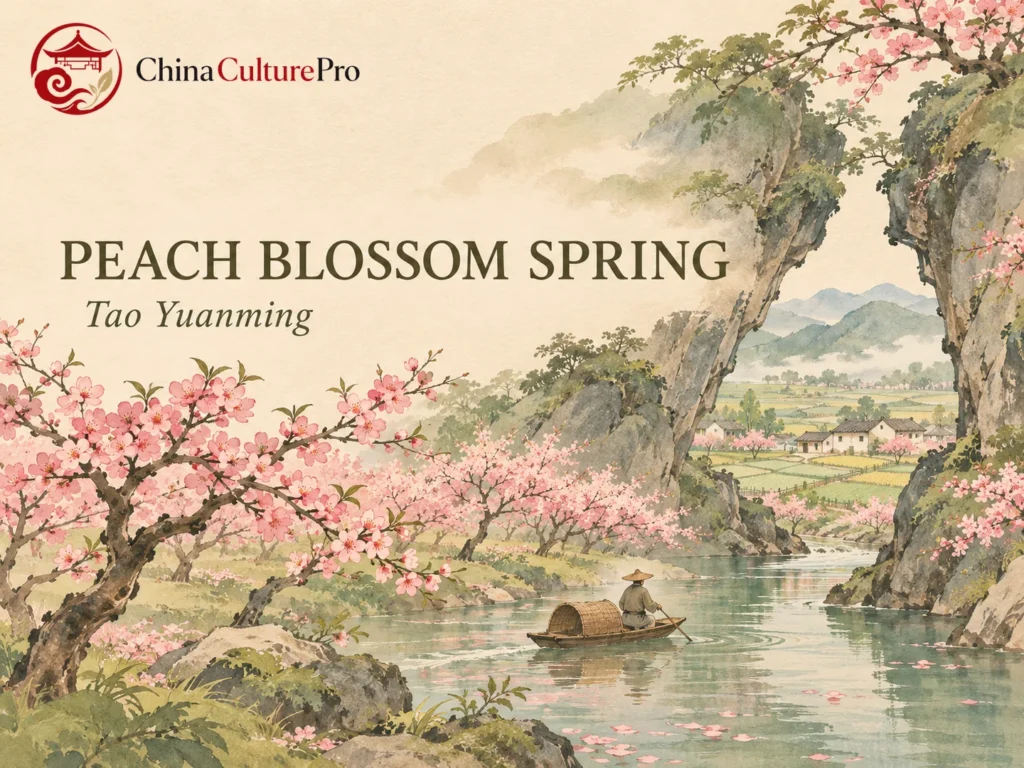

Quick Answer: What Is Peach Blossom Spring About?
Peach Blossom Spring (桃花源, Táohuā Yuán), by Tao Yuanming (陶淵明, Táo Yuānmíng), imagines a peaceful farming community discovered by chance and never found again. Read its two connected parts separately:[1]
- The narrative: The Account of Peach Blossom Spring (桃花源記, Táohuā Yuán Jì) follows a fisherman’s arrival, welcome, departure and unsuccessful attempt to return.
- The verse: The Poem of Peach Blossom Spring (桃花源詩, Táohuā Yuán Shī) has 32 five-character lines describing the inhabitants’ origins, work, customs and seclusion.
- The central tension: The village offers a desirable alternative to political disorder, yet deliberate searching cannot recover it.
The full texts below are literary works, not evidence that a hidden settlement or a route to it has been authenticated.
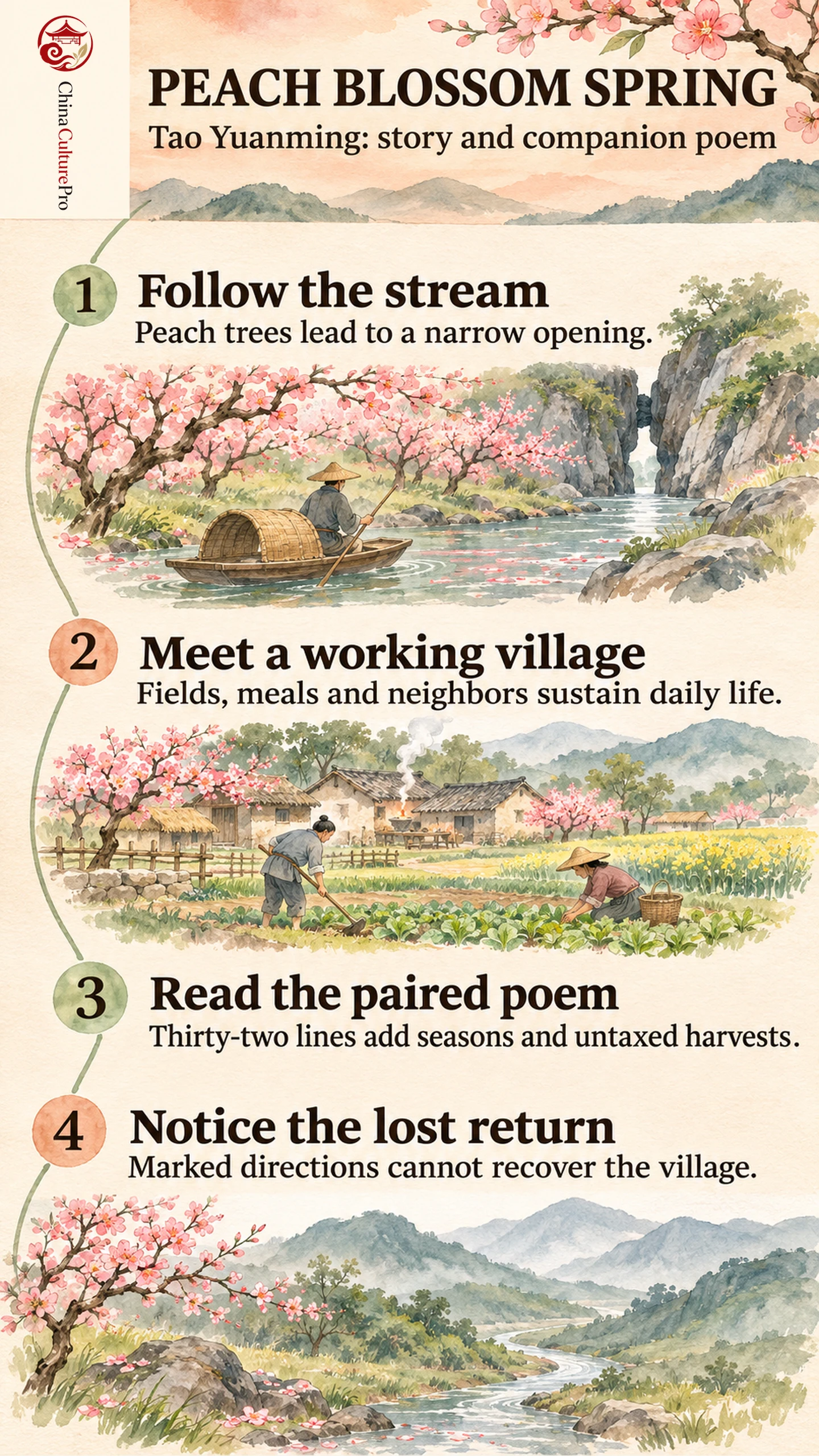
A fisherman follows a stream into a village that has slipped out of imperial history. The famous discovery is told in prose, but its companion poem makes the community’s appeal more explicit: shared cultivation, familiar seasons and harvests beyond the tax collector’s reach.
The Prose Account: Complete Text and English Translation
The story opens during the Taiyuan era (太元, Tàiyuán; 376–396) of the Jin dynasty (晉, Jìn). This dates the narrative setting, not automatically its composition. The following original English translation follows the received Chinese text; paragraph divisions aid reading.[1][2]
| Chinese text | English sense translation |
|---|---|
| 晉太元中,武陵人捕魚為業。緣溪行,忘路之遠近。忽逢桃花林,夾岸數百步,中無雜樹,芳草鮮美,落英繽紛。漁人甚異之。復前行,欲窮其林。 | During the Jin’s Taiyuan era, a man of Wuling (武陵, Wǔlíng) made his living by fishing. Following a stream, he lost track of how far he had traveled. Suddenly he encountered a grove of peach trees extending along both banks for several hundred paces. No other trees grew among them; fragrant grasses were fresh and lovely, and fallen blossoms lay scattered everywhere. Astonished, the fisherman continued, wanting to reach the grove’s end. |
| 林盡水源,便得一山,山有小口,髣髴若有光。便捨船,從口入。初極狹,纔通人。復行數十步,豁然開朗。 | The grove ended at the stream’s source, where he found a mountain with a small opening that seemed to admit light. Leaving his boat, he entered. At first it was so narrow that a person could barely pass. After several dozen more steps, the space suddenly opened into light. |
| 土地平曠,屋舍儼然。有良田、美池、桑竹之屬。阡陌交通,鷄犬相聞。其中往來種作,男女衣著,悉如外人。黃髮垂髫,並怡然自樂。 | The land was level and spacious, with houses neatly arranged. There were fertile fields, pleasant ponds, mulberries and bamboo. Paths crossed between the fields; chickens and dogs could be heard from neighboring homes. People went about planting and farming. Men and women dressed like people outside. Elders with yellowing hair and children with hanging locks were alike content and happy. |
| 見漁人,乃大驚,問所從來,具答之。便要還家,為設酒殺鷄作食。村中聞有此人,咸來問訊。 | Seeing the fisherman, they were greatly surprised and asked where he had come from. He answered fully. They invited him home, served wine and killed a chicken for a meal. Hearing of this visitor, the villagers all came to ask questions. |
| 自云先世避秦時亂,率妻子邑人來此絶境,不復出焉,遂與外人間隔。問今是何世,乃不知有漢,無論魏晉。此人一一為具言所聞,皆歎惋。餘人各復延至其家,皆出酒食。停數日,辭去。此中人語云:「不足為外人道也。」 | They said their ancestors, escaping the turmoil of the Qin (秦, Qín), had brought their wives, children and fellow villagers to this isolated place. They never left again and became cut off from outsiders. They asked what dynasty now ruled: they had not even heard of the Han (漢, Hàn), much less the Wei (魏, Wèi) and Jin. The fisherman related everything he had heard, item by item, and they all sighed with regret. Other households also invited him in, offering wine and food. After several days he took his leave. The people told him, “There is no need to tell outsiders about this.” |
| 既出,得其船,便扶向路,處處誌之。及郡下,詣太守,說如此。太守即遣人隨其往,尋向所誌,遂迷,不復得路。 | Once outside, he found his boat and retraced his route, making marks along the way. Reaching the commandery seat, he visited the prefect and reported what had happened. The prefect immediately sent men back with him. They searched for his earlier marks, but became lost and could no longer find the way. |
| 南陽劉子驥,高尚士也。聞之,欣然規往。未果,尋病終。後遂無問津者。 | Liu Ziji (劉子驥, Liú Zǐjì), a man of lofty character from Nanyang (南陽, Nányáng), heard the account and eagerly planned to go. His plan came to nothing; soon afterward he fell ill and died. After that, no one inquired about the crossing. |
The final “crossing” extends the language of seeking a passage. Liu plans a visit; the text does not describe him entering the village or dying during an expedition.
The Companion Poem: All 32 Lines in English
Each row below contains two five-character lines. The opening calls the Qin rulers the Ying clan (嬴氏, Yíng shì) and invokes Huang and Qi (黃綺, Huáng Qǐ), recluses linked with Mount Shang (商山, Shāng Shān). These names place the villagers’ departure beside the tradition of refusing a troubled world.[1]
| Chinese couplet | English sense translation |
|---|---|
| 嬴氏亂天紀, 賢者避其世。 | The Ying clan threw heaven’s order into chaos; worthy people withdrew from their age. |
| 黃綺之商山, 伊人亦云逝。 | Huang and Qi went to Mount Shang; these people too departed. |
| 往跡寖復湮, 來逕遂蕪廢。 | Their former traces gradually disappeared; the path by which they came grew over and fell unused. |
| 相命肆農耕, 日入從所憩。 | Calling to one another, they devoted themselves to farming; at sunset they went to rest. |
| 桑竹垂餘蔭, 菽稷隨時藝。 | Mulberries and bamboo spread abundant shade; beans and millet were sown in their seasons. |
| 春蠶收長絲, 秋熟靡王稅。 | Spring silkworms yielded long threads; autumn harvests owed no royal tax. |
| 荒路曖交通, 鷄犬互鳴吠。 | Overgrown paths faintly joined one another; chickens crowed and dogs barked in reply. |
| 俎豆猶古法, 衣裳無新製。 | Ritual offerings still followed ancient practice; clothing had no new styles. |
| 童孺縱行歌, 斑白歡遊詣。 | Children wandered freely, singing as they went; gray-haired people happily visited one another. |
| 草榮識節和, 木衰知風厲。 | Flourishing grasses told them the season was mild; declining trees told them the winds were harsh. |
| 雖無紀曆誌, 四時自成歲。 | Though no calendar recorded the passing dates, the four seasons formed a year of themselves. |
| 怡然有餘樂, 於何勞智慧。 | Contentment left them joy to spare; why trouble themselves with clever calculations? |
| 奇蹤隱五百, 一朝敞神界。 | This wondrous place lay hidden five hundred years; one day its marvelous realm opened. |
| 淳薄既異源, 旋復還幽蔽。 | Simplicity and worldliness sprang from different sources; soon it returned to hidden darkness. |
| 借問游方士, 焉測塵囂外? | Let me ask you who roam the world: how can you fathom what lies beyond its dust and clamor? |
| 願言躡輕風, 高舉尋吾契。 | I wish to tread the light wind, rise high and seek those whose spirit accords with mine. |
The poem ends with the speaker’s longing, rather than the prose’s report that inquiries ceased. Its five hundred years give seclusion a vast duration; they are not a precise population chronology.
A Working Community beyond Dynastic History
The village is attractive because ordinary life works. Fields produce food, households share meals, children sing and elders visit. The poem names silk production and seasonal sowing: peace includes labor. Its explicit absence of royal taxation sharpens the contrast with the political world the ancestors fled.[1]
The Qin dynasty belongs to the inhabitants’ ancestral memory, but later dynasties do not. Against an outside history measured by rulers, the poem offers time recognized through growing grass, declining trees and recurring seasons. This is an alternative rhythm of life, not a claim that time has literally stopped.
Read the two descriptions without erasing their differences. The prose says clothing resembles outsiders’ clothing; the poem says there are no new styles. Both make a recognizable rural community, but their wording does not supply one consistent costume reconstruction. Tao’s Drinking Wine Number Five also explores distance from worldly disturbance, through a different speaker and scene.
Why the Return Journey Fails
Discovery happens accidentally; recovery becomes an organized project involving marks and official authority. That change makes the ending unsettling. The fisherman has apparently collected usable directions, yet the route cannot be recovered.[1]
One reading is that the ideal loses its character when outsiders try to bring it within the outside world’s reach. The poem supports a boundary between incompatible ways of life. But neither part explicitly says a magical curse punishes the fisherman for talking. The failed search leaves the cause unresolved.
The marvelous entrance and disappearance invite supernatural associations, while the villagers’ farming, ancestry and meals remain human. Scholarship distinguishes this tension from later versions that more explicitly turn the settlement into an abode of immortals.[3] Keeping the uncertainty matters: a practical map or a single moral explanation would close what the work leaves open.
How to Read the Prose and Poem Together
- Follow the threshold: Trace stream, grove, narrow opening and open fields before interpreting the village.
- Compare the daily details: Put the prose’s meals and cultivation beside the poem’s silk, harvests and absence of royal tax.
- Separate attempts to return: The fisherman accompanies an unsuccessful official search; Liu hears the story and plans a visit that never happens.
- Compare the endings: The prose closes down further inquiry, while the poem voices a continuing wish for spiritual companionship.
FAQs About Peach Blossom Spring
Is Peach Blossom Spring a poem or a story?
The received work pairs a prose account with a 32-line poem. The fisherman’s discovery and failed return are narrated in the prose; the verse expands the community’s life and the speaker’s longing.
Are the villagers immortal?
The prose identifies their ancestors as refugees and describes ordinary human activities. The companion poem uses elevated, marvelous language, but the paired work does not simply state that the original refugees have lived forever.
Does the story identify a place to visit?
It names the fisherman’s historical home district, but its own return journey fails. A modern place associated with the tale is not thereby authenticated as the settlement inside the story.
Sources
[1] Tao Yuanming. Account and Poem of Peach Blossom Spring, received Chinese text
[2] Ministry of Education, Taiwan. Revised Mandarin Chinese Dictionary: Taiyuan
[3] Zhiyi Yang. Return to an Inner Utopia: Su Shi’s Transformation of Tao Qian in His Exile Poetry, T’oung Pao 99 (2013), especially pp. 359–363