
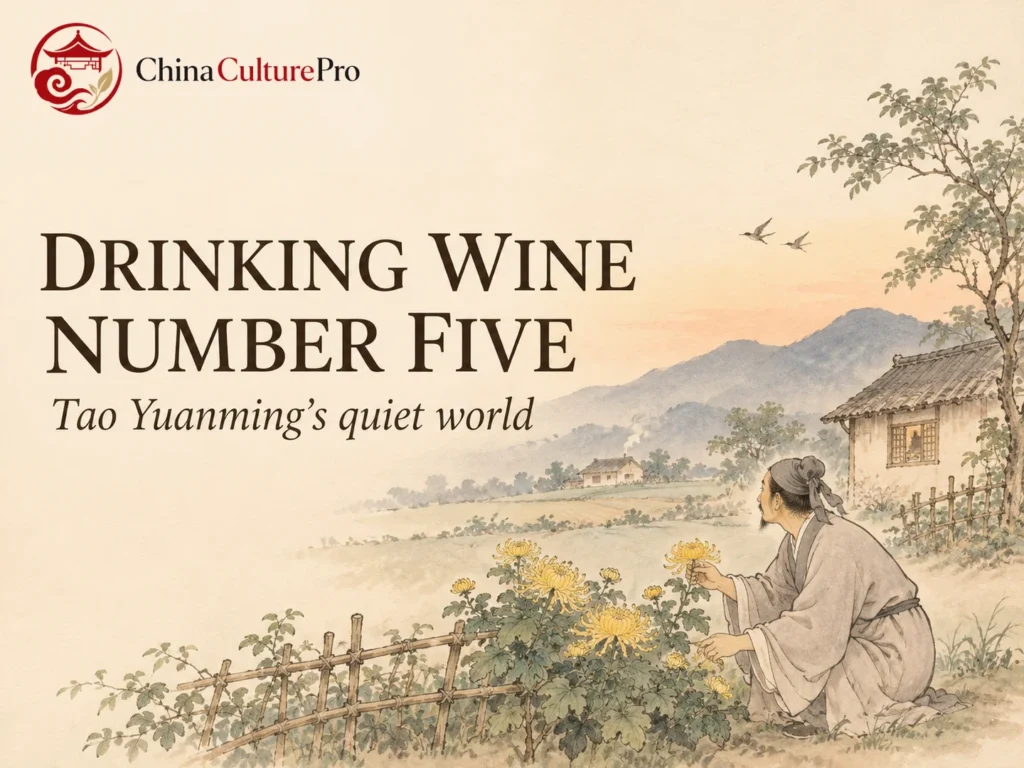

Quick Answer: What Does Drinking Wine Number Five Mean?
Drinking Wine Number Five (飲酒·其五, Yǐnjiǔ · Qíwǔ), by Tao Yuanming (陶淵明, Táo Yuānmíng), explores a life in which freedom from worldly distractions allows ordinary surroundings to become deeply satisfying.[1]
- Inner distance: The speaker’s attitude makes a settled place feel secluded.
- Unforced attention: Gathering flowers leads into an encounter with the mountain view.
- An elusive insight: The evening scene offers meaning that a final explanation cannot capture.
This is a poem about reclusion within human life, not a promise that moving away will automatically bring peace.

The chrysanthemums and distant mountain are the best-known images here, but the poem begins with a home among other people. That opening matters: its quiet comes from a way of inhabiting the world, not simply from finding somewhere empty.
The Complete Poem and an English Sense Translation
The author is also known as Tao Qian (陶潛, Táo Qián). This is the fifth of twenty drinking poems written after his withdrawal from office.[2] Its ten lines are five-character ancient-style verse (五言古詩, wǔyán gǔshī), rather than an eight-line regulated poem.[1]
Below is the full Chinese text, grouped into five couplets, with an original English sense translation. The wording keeps the sequence of thought and images rather than attempting an English rhyme.[1]
| Chinese original | English sense translation |
|---|---|
| 結廬在人境, 而無車馬喧。 | I have made a modest home amid human dwellings, yet no clamour of carts and horses reaches it. |
| 問君何能爾? 心遠地自偏。 | You ask how this can be: with the heart turned away, the place grows quiet of itself. |
| 採菊東籬下, 悠然見南山。 | I gather chrysanthemum blooms beneath the eastern hedge, and, unhurried, catch sight of the hills to the south. |
| 山氣日夕佳, 飛鳥相與還。 | Toward dusk the mountain air is at its loveliest; birds in flight are making their way home together. |
| 此中有真意, 欲辯已忘言。 | Within this lies something true, but before I can explain it, words slip away. |
Why the Hut Can Be Quiet among Other People
The first couplet sets a small puzzle. A home stands in the human world, yet the traffic associated with that world seems absent. The question in the next couplet brings the reader directly into the puzzle before the speaker answers it.
The answer locates the decisive distance in the heart. The noise of carts and horses suggests the bustle of worldly dealings, rather than every possible sound around the house.[2] A secluded feeling and a populated setting can therefore coexist.
Notice the sequence of cause and effect. The speaker does not first measure how many miles separate him from other people. He starts from what holds his attention. The flowers, mountain air and returning birds then show the kind of experience that becomes available.
For a related account of choosing rural life, read Returning to Dwell in Gardens and Fields. That comparison helps keep this poem’s quiet grounded in a lived setting rather than an empty wilderness.
Chrysanthemums and the Difference between Seeing and Looking
The flower gathering is an ordinary action close at hand. From the eastern hedge, attention opens toward South Mountain (南山, Nánshān), commonly identified with Mount Lu (廬山, Lúshān) in the poet’s home region.[4] The movement connects the near and the far without announcing a grand expedition.
The verb 見 (jiàn), “see,” became important to later readers. Su Shi (蘇軾, Sū Shì) preferred it to the variant 望 (wàng), “look toward” or “gaze at.” In his account, the mountain comes into view while the poet is gathering flowers, allowing scene and feeling to meet without deliberate pursuit.[3]
Su Shi’s judgment draws attention to how a small verbal choice shapes the scene. In this reading, the encounter feels discovered rather than arranged for display.
The chrysanthemum’s cultural meanings add another layer to the famous scene. Within the poem itself, however, the flowers first belong to a concrete act: someone is gathering them beside a hedge.
Returning Birds and a Meaning That Resists Explanation
The view continues into dusk. Mountain air, fading light and birds returning together give the scene its own rhythm. Homecoming is no longer only the speaker’s condition; it also belongs to the movement he notices around him.
The final “this” directs attention back to that experience. The verse offers no separate list of doctrines that would exhaust its true meaning. Instead, it brings the reader to the point where an explanation is attempted and words fall away.
A related idea in Zhuangzi (莊子, Zhuāngzǐ) treats words as a means of reaching meaning, which can be left behind once meaning is grasped.[2] This connection makes the ending richer than simple absent-mindedness or drunken forgetfulness.
The poem has nevertheless used words with great care to arrive there. Its ending asks readers to hold the scene in mind, including the speaker’s relation to it, rather than exchange it for a single slogan.
How to Read the Movement from Human Life to Silence
- Locate the home: Keep the opening’s human setting in view before calling the speaker isolated.
- Follow the answer: Ask how the heart’s distance changes the experience of a place.
- Move from near to far: Track the flowers, the mountain and the birds instead of treating the famous couplet as a detached quotation.
- Pause at the unfinished explanation: Consider what the preceding scene has made felt before deciding what its “true meaning” must be.
The introduction to Chinese poetry places this compact work beside other forms and periods without reducing its distinctive pace to a general rule.
FAQs About Drinking Wine Number Five
Why is the poem called Drinking Wine when no wine appears?
The title belongs to the twenty-poem group. Its preface describes writing verses after drinking; each individual poem need not depict a cup or a drinking scene.[1]
Are Tao Yuanming and Tao Qian the same poet?
Yes. Both names refer to the author of this poem; editions may identify him by either name.[2]
Does the poem describe a home far from everyone?
Its opening places the dwelling among other people. The following answer makes inner distance central to its feeling of seclusion.[1]
Sources
[1] Tao Yuanming. 飲酒二十首: classical text and preface
[2] Hong Kong Education Bureau. 飲酒(其五): text and teaching notes
[3] Su Shi. 慎改竄: 東坡全集, volume 100
[4] Kominami Ichirō. What Did T‘ao Yüan-ming See on South Mountain?