


Quick Answer: What Is the Poem About?
Returning to Dwell in Gardens and Fields (歸園田居, Guī Yuántián Jū) by Tao Yuanming (陶淵明, Táo Yuānmíng) presents rural return as a recovery of a way of living suited to the speaker’s character.
- Constraint: Worldly life becomes a dusty net; a confined bird and pond fish express longing for an earlier home.
- Place: Fields, a thatched house, trees, distant village smoke and familiar animal sounds make the alternative concrete.
- Release: The received ending answers the opening confinement with a return to living in accord with what is natural.
This guide covers the complete first poem: twenty five-character lines, or 100 Chinese characters. It is the opening of the familiar five-poem sequence, whose later pieces also consider agricultural anxiety, labor, mortality and companionship.[1][2]
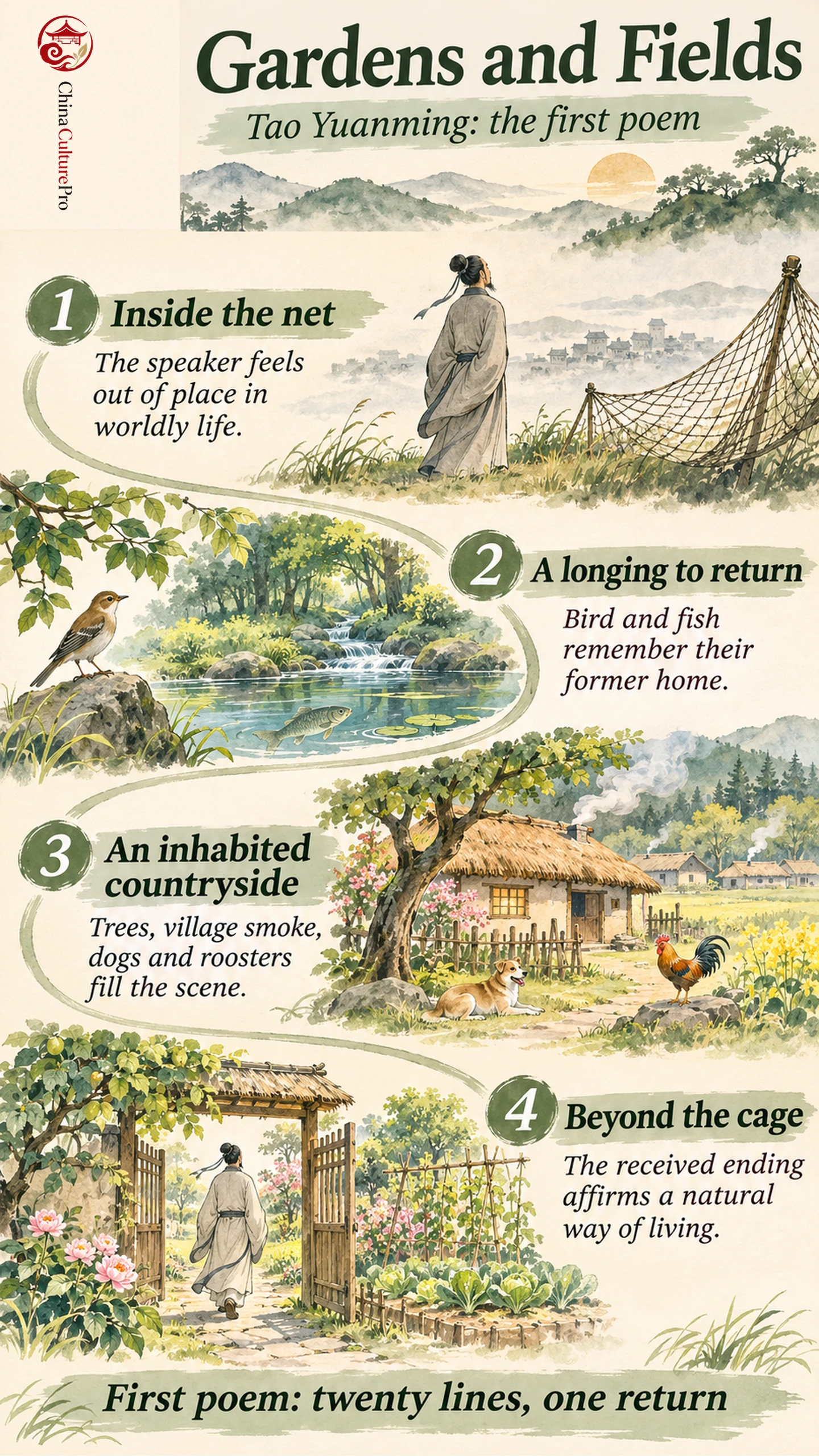
The countryside in this poem contains houses, smoke, barking dogs and a crowing rooster. Around that scene, images of a net and a cage frame the speaker’s account of leaving a life that did not suit him.
The Complete First Poem and an English Sense Translation
Each table row contains one couplet. The Chinese follows the received first poem in the cited collection; the English is an original sense translation. “Thirty years” is retained as written, without turning the line into a verified count of uninterrupted government employment.[1]
| Chinese text | English sense translation |
|---|---|
| 少無適俗韻,性本愛丘山。 | Since youth I lacked the disposition to fit the common world; my own nature loved hills and mountains. |
| 誤落塵網中,一去三十年。 | By error I fell into the dusty net, and thirty years passed in that departure. |
| 羈鳥戀舊林,池魚思故淵。 | A captive bird longs for its former woods; a pond fish thinks of the deep waters it once knew. |
| 開荒南野際,守拙歸園田。 | I clear uncultivated ground along the southern wilds; holding to my plain ways, I return to gardens and fields. |
| 方宅十餘畝,草屋八九間。 | The homestead extends over more than ten mu (畝, mǔ), with eight or nine rooms beneath thatch. |
| 榆柳蔭後簷,桃李羅堂前。 | Elms and willows shade the rear eaves; peach and plum trees stand before the hall. |
| 曖曖遠人村,依依墟里煙。 | A distant settlement appears through the haze; smoke from village hearths drifts softly. |
| 狗吠深巷中,雞鳴桑樹巔。 | A dog barks deep in a lane; a rooster crows from the top of a mulberry tree. |
| 戶庭無塵雜,虛室有餘閑。 | House and courtyard are free of worldly bustle; the quiet room holds ample leisure. |
| 久在樊籠裏,復得返自然。 | Long enclosed within a cage, I can return again to a natural way of living. |
Mu is a traditional land measure. It should not be replaced with “acres” as though the units were interchangeable. The homestead and room numbers give the scene tangible scale; they do not require a precise modern survey or a claim that the speaker owned eight separate cottages.
The Net, the Bird and Keeping to One’s Simplicity
The first line concerns temperament: the speaker has never fitted easily into conventional worldly life. Its word 韻 means disposition or bearing in this context, rather than a claim that he could not write rhyming verse.[1]
The net then turns that mismatch into confinement. Bird and fish give longing a bodily form. Each desires an earlier environment, so the return is toward something remembered, not merely away from an unpleasant situation.
Keeping to simplicity (守拙, shǒu zhuō) literally preserves a sense of “guarding one’s awkwardness.” Here it suggests holding to plain, unaccommodating ways instead of becoming skillful at worldly adjustment. It does not mean that the speaker cannot think or create. His carefully arranged account makes the choice legible through images.
For the wider circumstances of his public service and withdrawal, see the Tao Yuanming guide. The poem itself concentrates on the experience of constraint and return.[1]
A Home within a Living Rural Landscape
The middle couplets replace the net with a habitable arrangement. Trees shelter the rear of the house, while fruit trees stand before it. The view then widens toward the neighboring settlement and its rising smoke.
Sound completes what the distant eye cannot fully distinguish. The dog and rooster make the place audible. Their calls support the sense of ordinary habitation; they are not interruptions that the speaker wishes to eliminate.
The quiet room consequently belongs to a larger living environment. “Free of worldly bustle” need not mean a floor without physical dust, and village smoke is not evidence of ruined houses or war damage. The poem selects domestic details that make a different rhythm of life imaginable.[1]
Its attention to familiar surroundings invites comparison with Drinking Wine Number Five, where a hedge, flowers and mountains organize another experience of rural contentment.
What Returning to Naturalness Means
Naturalness (自然, zìrán) closes the poem by joining environment and disposition. Returning to fields matters because it allows the speaker’s way of living to accord with his character. The final cage image reaches back to the net, giving the rural scene an enclosing verbal frame.[1]
This explanation follows the affirmative received wording, “can return.” Xiaofei Tian discusses an alternative textual reading that turns the ending into a question about whether return remains possible. That variation matters: an assurance in the text printed here should not be presented as the only ending ever transmitted.[2]
Nor should the first poem’s release be extended into a claim that the entire sequence portrays effortless happiness. The later poems bring in crops and labor as well as other moods. This first piece establishes a chosen relation to the world; it does not settle every consequence of that choice.[1][2]
How to Follow the Poem’s Movement
- Identify the mismatch: Read the opening as an account of temperament and an unsuitable worldly life.
- Follow the enclosures: Connect the net, captive bird and pond fish with the cage near the end.
- Enter the middle scene: Notice house, trees, village, smoke and animal sounds as a coherent inhabited place.
- Return to the last line: Ask how the chosen setting answers the opening conflict in the received text.
FAQs About Returning to Dwell in Gardens and Fields
Is this the same work as Returning Home?
No. Returning Home (歸去來兮辭, Guīqùláixī Cí) is a separate rhymed declamation with a prose preface. This page discusses the first twenty-line poem of the gardens-and-fields sequence.
Is this a poem about doing no work?
No. The speaker explicitly clears uncultivated ground. Returning to rural life involves cultivation, even though this first poem emphasizes release and the character of the home environment.
Do the distant village and smoke describe ruins?
The lines describe a hazy settlement and drifting village smoke. Together with the dog and rooster, they create a scene of habitation; they do not describe an abandoned village.[1]
Sources
[1] Tao Yuanming; Chinese Wikisource. Returning to Dwell in Gardens and Fields: First Poem and Sequence
[2] Xiaofei Tian, Harvard University. Tao Yuanming’s Poetics of Awkwardness