


Quick Answer: Who Was Liu Yong?
Liu Yong (柳永, Liǔ Yǒng) was a Northern Song poet from Fujian who passed the highest civil-service degree examination in 1034. He is known for song lyrics (词, Cí), poetry composed to musical tune patterns.[1][6]
- For separation: Follow how a farewell becomes an imagined future.
- For longing: Notice whose viewpoint a lyric invites you to inhabit.
- For a wider range: Read a city-praise lyric beside the love and travel poems.
The author’s voice and the lyric’s speaker need not be identical.
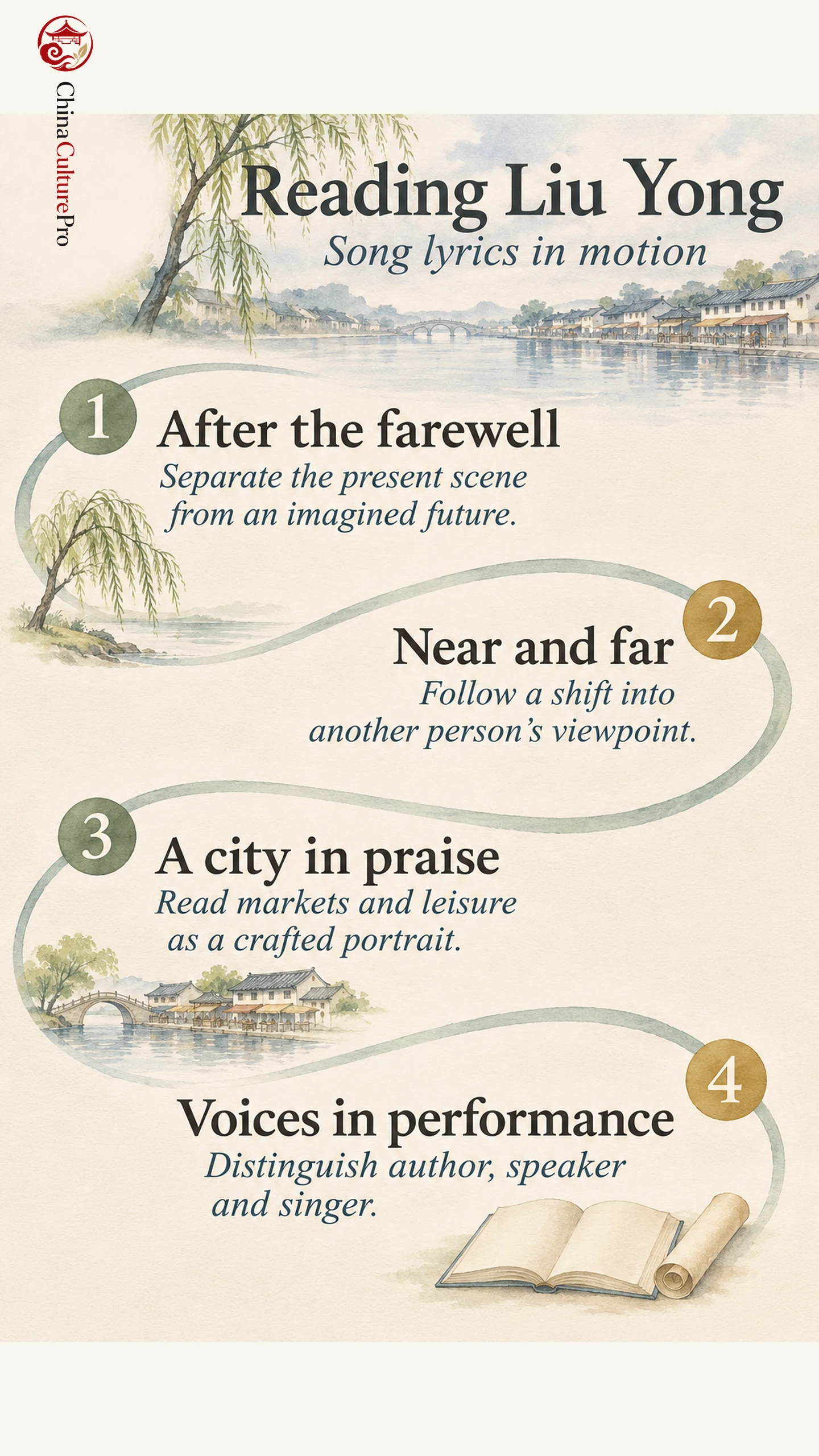
Liu Yong’s longer lyrics unfold through changes of scene and attention. Read them as movements rather than as a string of beautiful images. Before looking for a biographical explanation, ask when the scene occurs, who perceives it and whether the next moment is remembered, observed or imagined.
Why Slow Lyrics Matter
Within the Northern Song cultural world, Liu helped develop slow lyrics (慢词, Màncí), giving extended song forms a more prominent literary role. He built on earlier traditions rather than inventing every long form himself. Greater length allowed more elaborate description, narration and emotional development.[2]
His collection is Collected Songs (乐章集, Yuèzhāng Jí). For a first encounter, it is more useful to identify individual lyrics by tune and opening words than to approach the collection as a continuous narrative.[1]
The broader practice of Song ci poetry included composition for singers at banquets, as well as more private enjoyment. A tune pattern gives a lyric a formal framework; reading the surviving words does not by itself recover an original performance.[6]
Three Major Lyrics and Their Opening Words
These English tune-name glosses are paired with the Chinese openings to distinguish the particular works.
| Lyric | A reading question |
|---|---|
| Bells Ringing in the Rain (雨霖铃·寒蝉凄切, Yǔlínlíng · Hánchán Qīqiè). | When does the immediate farewell give way to an imagined tomorrow?[3] |
| Eight Beats of a Ganzhou Song (八声甘州·对潇潇暮雨洒江天, Bā Shēng Gānzhōu · Duì Xiāoxiāo Mùyǔ Sǎ Jiāngtiān). | How does a distant view become an imagined exchange between separated people?[4] |
| Watching the Sea Tide (望海潮·东南形胜, Wàng Hǎicháo · Dōngnán Xíngshèng). | How do markets, lake scenery and ceremonial display accumulate into praise of a city?[5] |
Follow Time and Point of View
The farewell lyric moves from shared tears and a departing boat toward the speaker’s imagined waking on a willow-lined shore. The famous future scene is anticipated loneliness, not simply the next item in a travel diary.[3]
The Ganzhou lyric turns from autumn rain and a vast river landscape toward someone imagined waiting for the traveler. It then returns to the speaker’s own position. Longing is produced through this movement between viewpoints.[4]
The city lyric assembles Qiantang’s markets, lakeside pleasures and official display into public praise of Hangzhou. Read its prosperity as a rhetorical portrait, rather than a neutral census.[5]
Try marking three kinds of passage: what the speaker sees, what the speaker imagines and what the speaker asks or judges. Then read the transitions aloud. The most important word may be the one that changes your position in time or space, rather than the most decorative noun.
Performed Voices and Social Reach
Liu’s appeal extended beyond a small circle of literary friends. His use of accessible expressions and sustained narration helped make his lyrics widely sung. Traditional accounts express that popularity through striking sayings; such accounts establish a reputation, not a measured count of listeners.[2]
A lyric may also speak in an adopted voice. Still Wind and Waves (定风波·自春来, Dìng Fēngbō · Zì Chūn Lái), in Stanford’s bilingual edition, is presented from the perspective of a woman troubled by an absent lover. That example makes it difficult to treat every first-person statement as a direct confession by the male author.[6]
Keep author, speaker and performer separate while reading. Who wrote the words? Who is represented as speaking? Who might sing them? Sometimes the text leaves a relationship or pronoun implicit, and the translator has to choose how explicitly to state it.
English Reading Routes
Stanford’s Global Medieval Sourcebook offers Qian Jia’s 2021 translation of Still Wind and Waves, with an introduction and notes by Dante Zhu. Parallel Chinese and English make its choices easy to compare.[6]
For a larger selection, CUHK’s Renditions index lists Julie Landau’s Eight Ci Poems in issue 72, pages 13–29, and Winnie Leung’s Thirteen Ci in combined issues 11 and 12, pages 62–82. These are identifiable selections, rather than a complete English collection.[7]
For detailed criticism, James J. Y. Liu’s Major Lyricists of the Northern Sung was originally published in 1974 and reissued by Princeton in 2015. Its method places Chinese, romanization, literal translation and idiomatic translation beside metrical diagrams and commentary.[8]
FAQs About Liu Yong
Did Liu Yong invent slow lyrics?
He was a major developer of the form, but slow lyrics had earlier precedents in the Tang and Five Dynasties periods.[2]
Are tune names the subjects of the poems?
Not necessarily. A tune name identifies a formal pattern; the opening words help identify a particular lyric written to it.
Is the speaker always Liu Yong himself?
No. Song lyrics can adopt a voice, including a female speaker. Interpret the represented situation before turning it into an assertion about the author’s life.[6]
Sources
[1] National Central Library, Taiwan. Liu Yong: Name Authority Record
[2] Pan Yumin, Shanghai Civil Affairs Bureau. Liu Yong and the Development of Northern Song Lyrics
[3] Liu Yong, via Wikisource. Bells Ringing in the Rain
[4] Liu Yong, via Wikisource. Eight Beats of a Ganzhou Song
[5] Liu Yong, via Wikisource. Watching the Sea Tide
[6] Stanford University, Global Medieval Sourcebook. Still Wind and Waves: Translation, Introduction and Notes
[7] Chinese University of Hong Kong, Research Centre for Translation. Renditions Authors and Translators Index
[8] Princeton University Press. Major Lyricists of the Northern Sung