

Quick Answer: Who Are the Hezhen?
The Hezhen people(赫哲族,Hèzhézú)are an officially recognized ethnic group in northeastern China, with communities in Heilongjiang’s river country. Their culture encompasses a Tungusic language, oral storytelling and material skills associated with fishing and other historical livelihoods. Hezhe is another common English spelling of the name.[1]
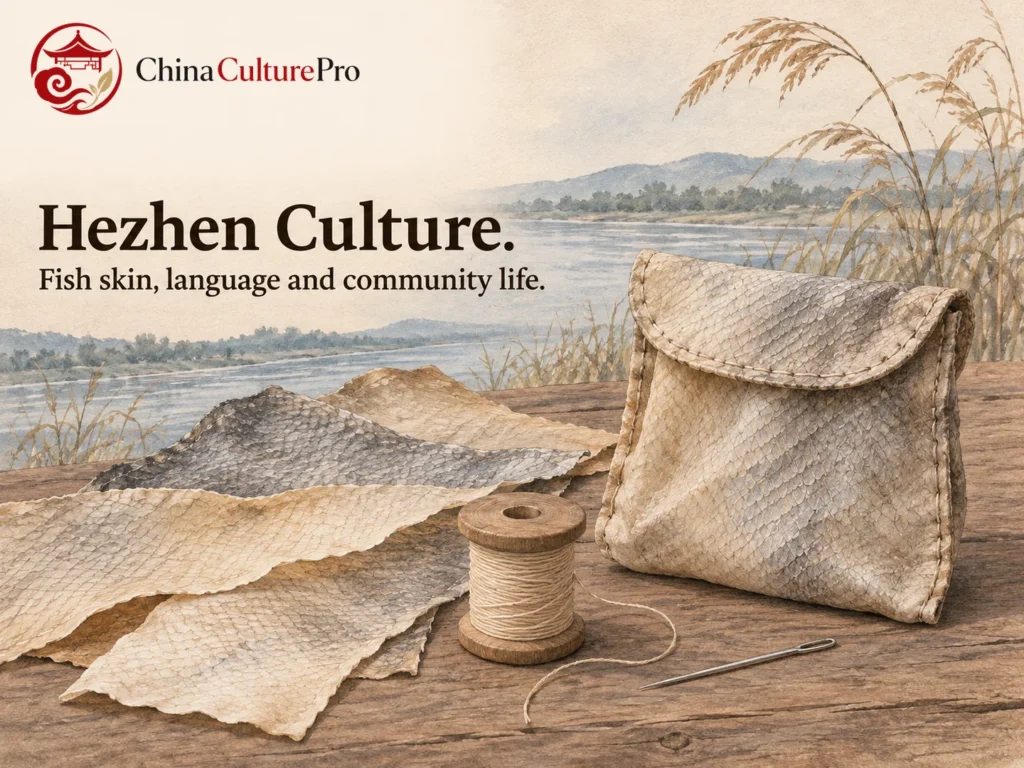
Fish-skin clothing is a distinctive part of this heritage. It involves working a natural material into usable garments, rather than wearing untreated fish skins. The craft belongs within a wider cultural life that also includes language, narratives, family teaching and community gatherings.
A stitched fish-skin garment brings together the river and the maker’s hand. Its small pieces have been prepared, softened and joined before becoming clothing. Looking closely at that work offers an introduction to Hezhen culture, while stories and community events reveal knowledge that cannot be read from the garment alone.
River Country and Historical Livelihoods
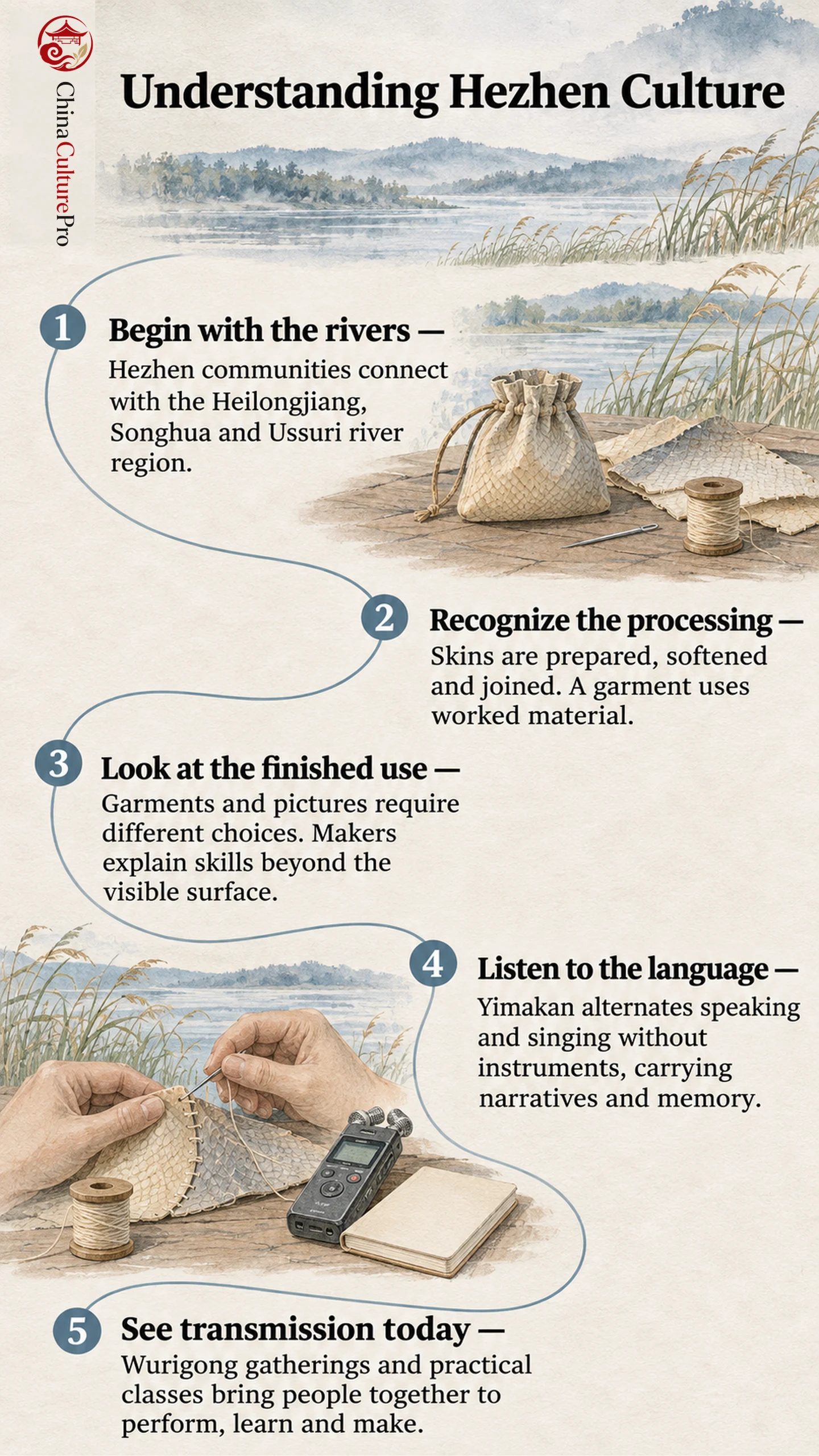
The Heilongjiang, Songhua and Ussuri rivers frame the setting of many Hezhen communities. Important localities include Jiejinkou and Bacha near Tongjiang, Sipai in Raohe, and Aoqi near Jiamusi. These place names keep the subject anchored in particular communities across the Sanjiang Plain.[1]
Historical fishing used nets, hooks, spears and boats, with equipment and work changing by season. Birch-bark vessels and wooden boats were among the forms used on the rivers. Hunting and gathering also contributed to livelihoods. The river supplied more than food, connecting transport, clothing materials and other household needs.[2]
These connections help explain why fish and other animals appear in material and oral traditions. A fishing tool belongs to a history of work, while its appearance in a performance may serve a different purpose. Historical descriptions of fishing should not be treated as a complete account of every Hezhen person’s occupation today.
The wider regional context includes Oroqen and Evenki communities, which also developed skills with local animal and plant materials. Comparing those traditions is useful when the community, material and use remain attached to each example.
How Fish Skin Becomes a Craft Material
Fish-skin craft begins with processing. A documented workshop at Jiejinkou involved separating and cleaning skins, drying them and working them until supple. Mechanical softening and rubbing changed the material’s handling qualities before it was used in textile work. Different fish-skin traditions elsewhere use other methods, so one workshop does not establish a worldwide standard.[3]
A May 2024 teaching event distinguished practical processing from artistic choices within fish-skin painting.[4]
| Part of the work | Its purpose |
|---|---|
| Preparing and softening | Turn a raw skin into material that can be handled and worked. |
| Cutting, joining and sewing | Bring separate pieces together into the intended form. |
| Decorating and composing | Arrange surface details or images for a particular finished object. |
At Jiejinkou, the craftsperson You Wenfeng taught methods learned through her mother and grandmother. The workshop project, documented for 2017–2018, brought community makers and fashion students together. The relationship between an experienced maker and a learner is central to understanding how a technique passes on.[3]
Garments, Images and the Knowledge of Makers
A garment’s meaning extends beyond its surface. A 2025 study focused on fish-skin clothing in Jiejinkou and examined work use, reuse and social functions. Its findings include connections with childcare and married women’s identity. These findings concern a particular community’s clothing and social life.[5]
Decoration also has context. The study describes patterns drawn from natural phenomena, plants and animals, with meanings such as harvest or longevity. Such associations belong to particular designs and uses. A generic fish image does not automatically carry one fixed message across every object.[5]
Fish-skin pictures offer another application. Work with pieces of processed skin can produce an image, while garment making must also solve the problems of fit, movement and seams. Both belong in an account of minority dress and material traditions, but a display picture cannot explain the construction of a coat.
Teaching gives learners access to choices that a finished object cannot explain alone, including how supple a skin should feel and why pieces are joined in a particular way.
Hezhen Language and Yimakan Storytelling
The Hezhen language(赫哲语,Hèzhéyǔ)belongs to the Tungusic family. It is a distinct part of community heritage alongside the craft objects through which many readers first encounter Hezhen culture. Knowing how to identify a garment does not provide access to the words or narrative forms of its makers.[1]
Yimakan(伊玛堪,Yīmǎkān)combines speaking and singing in oral storytelling, without instrumental accompaniment. Performers use changing melodies and character voices to carry stories of heroes, alliances, conflicts and community life. Learning has traditionally taken place through relationships within families and clans, with wider apprenticeship now also occurring.[6]
The UNESCO record changed in 2025. After its initial inscription on the Urgent Safeguarding List in 2011, Yimakan was transferred to the Representative List of the Intangible Cultural Heritage of Humanity. Teaching and the transmission of local language form part of the documented safeguarding work.[6]
The specialist guide to Hezhen Yimakan develops the storytelling tradition further. Within this broader introduction, the essential connection is between language, performance and collective memory. The recognition concerns a living oral practice and its transmission, alongside the distinct work of preserving material craft.
Community Gatherings and Contemporary Teaching
Wurigong(乌日贡,Wūrìgòng)brings cultural performance and traditional sports together in a community gathering. The modern congress form began in the 1980s, drawing on earlier traditions. It entered China’s fifth national intangible cultural heritage list in 2021, under project X-171. The modern congress organizes earlier traditions in a newer public form.[7]
A local example took place in Bacha on June 29, 2026. The programme included a blessing performance, music and dance, followed by sports rooted in fishing and hunting traditions. This was a particular community event, with its own participants and programme, rather than a description of every Wurigong gathering.[8]
Teaching also happens outside a festival. At a fish-skin painting class on May 7, 2024, Zhang Lin and his team introduced the craft to teachers and students in Harbin. Their explanations and practical work connected the finished images with the processes used to make them.[4]
Public gatherings and practical classes contribute differently to intangible cultural heritage. One assembles a community around performance and participation. The other gives learners sustained contact with a material and an instructor.
FAQs About Hezhen Culture
Do Hezhen people still wear fish-skin clothing every day?
Historical garments remain important in craft, collections and cultural presentation. They should not be treated as everyone’s present daily clothing.
Is Hezhen the same name as Hezhe?
Both spellings appear in English accounts of China’s Hezhen communities. The place and subject of the account provide further context.
What is the connection between Yimakan and the Hezhen language?
Storytelling carries words, narrative forms and community memory through spoken and sung performance. Learning the tradition also supports language transmission.
Sources
[1] National Ethnic Affairs Commission. Hezhen Community Overview
[2] National Ethnic Affairs Commission. Hezhen Historical Livelihoods and Customs
[3] E. Palomino and J. Boon. Preservation of the Hezhe People’s Fish Skin Tradition Through Fashion Education
[4] Harbin Engineering University. Fish Skin Craft Teaching Event, May 2024
[5] Chun Kong, Hironobu Aoki and Akira Ueda. Fish Skin Clothing in Jiejinkou Daily Life, 2025
[6] UNESCO. Decision 20.COM 7.c.2, Hezhen Yimakan, 2025
[7] China Intangible Cultural Heritage. Hezhen Wurigong Congress
[8] Tongjiang Government. Wurigong Event in Bacha, June 2026