


Quick Answer: What Is Hezhen Yimakan?
Yimakan(伊玛堪,Yīmǎkān)is an oral storytelling tradition of the Hezhen(赫哲族,Hèzhézú)people of northeastern China. In its traditional form, a performer moves between spoken narration and singing in the Hezhen language, without instrumental accompaniment.[1]
- Voice: Speech, melody and changing characterization
- Stories: Heroic episodes and other narrative or lyrical material
- Community: Knowledge learned through listening and teaching
Yimakan is a genre and living practice, rather than one fixed text. Its traditional performance form should be distinguished from contemporary stage and musical adaptations.
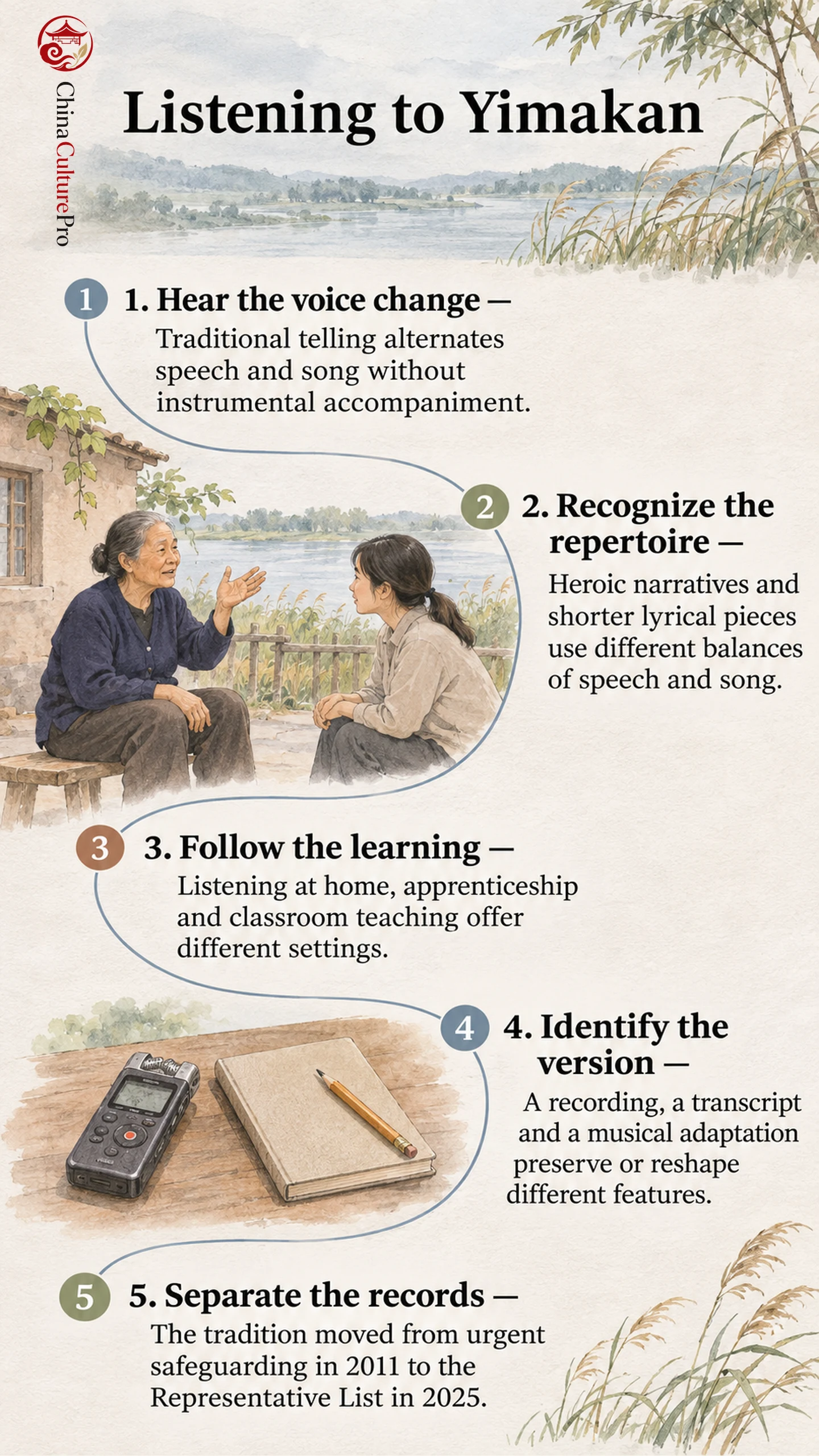
A storyteller can change a scene by changing the voice: narration gives way to melody, and a character becomes recognizable through sound. Understanding Yimakan means listening to that movement as well as following a plot. This guide connects the performance with its stories, teachers, recordings and changing heritage status.
The Voice, Language and Shape of a Performance
In traditional Yimakan, one performer carries the narrative. Spoken passages and sung sections alternate, while different melodies help distinguish characters and developments in the story. Verse and prose can coexist within an episodic account. The performer can shape the telling as it unfolds.[1]
The tradition is associated with Hezhen communities in Heilongjiang(黑龙江,Hēilóngjiāng)province. Melodies differ with locality and performer. Recognizing this range matters: a recording documents a particular voice and version, rather than a mandatory tune used by every storyteller.[2]
The Hezhen language and community setting are part of the art. A translated synopsis can explain who acted and what happened, but hearing a recording reveals the spoken and melodic features that a plot summary leaves out. Pinyin beside the Chinese names here supplies Mandarin readings, not a pronunciation guide to the Hezhen language.
Heroic Stories, Long Narratives and Short Songs
Yimakan includes more than one balance of speech and song. Two terms describe contrasting emphases, not two rigid lengths that every performance must meet.[2]
| Form | Typical emphasis |
|---|---|
| Dachang(大唱,dàchàng) | Spoken narration predominates, often in heroic, legendary or creation stories |
| Xiaochang(小唱,xiǎochàng) | Singing predominates in shorter, more lyrical pieces |
Mergen(莫日根,Mòrìgēn), a designation for a hero, recurs in the titles of different stories. It does not identify one fixed biography.[2] Accounts of alliances, battles and the defeat of monsters belong to the imaginative world of the tales. They carry cultural memory and values without becoming documentary evidence that every narrated event occurred.[1]
This combination of a recognizable repertoire and variation in telling places Yimakan within the wider world of oral storytelling. The genre cannot be reduced to either a song collection or a historical chronicle.
Learning through Families and New Teaching Spaces
A documented teacher–learner relationship makes transmission concrete. Wu Mingxin(吴明新,Wú Míngxīn)learned Yimakan from his father, Wu Liangui(吴连贵,Wú Liánguì). His bearer biography describes both that inheritance and his further development of the melodies into a personal style.[3]
Family learning also happened outside formal lessons. In interviews conducted during 2013–2015, You Xiuyun(尤秀云,Yóu Xiùyún)recalled hearing her mother perform while cooking, and listening to Wu Liangui in the family courtyard. Her daughter later learned from her, and the family encouraged the next generation to join in. The same interview describes her teaching at a transmission centre in Jiejinkou(街津口,Jiējīnkǒu)from 2012.[4]
School lessons add another setting. A December 2025 report describes Hezhen-language teaching materials used in local primary schools. Learning a passage, developing language fluency and sustaining an extended narrative are different accomplishments. A classroom excerpt shows only part of that learning.[5]
Recordings, Adaptations and Living Performance
Recordings preserve a performer’s voice at a particular time, and later listeners can use them as teaching material. They also allow comparison between different tellings. A printed transcription serves another purpose: it makes words available for reading and translation, while the performed voice supplies melody, pacing and vocal characterization.
In an October 2026 account, researcher Huang Renyuan(黄任远,Huáng Rènyuǎn)describes collecting Yimakan while living and working in Tongjiang(同江,Tóngjiāng)between 1969 and 1994. His account connects field recordings with later collections and the use of recordings in transmission classes. The recordings preserve earlier tellings and supply material for new learners.[6]
Adaptation creates further distinctions. The 2025 report describes younger bearer Hu Yi(胡艺,Hú Yì)combining Yimakan passages with electronic music and sharing them through social media. Such arrangements can introduce listeners to the tradition. They are contemporary musical adaptations of the traditional unaccompanied form.[5]
What Changed in UNESCO Recognition in 2025
The heritage has several recognition records. The national listing predates UNESCO’s involvement; the 2025 transfer and the recognition of safeguarding work are separate decisions.[2][7]
| Year | Recognition |
|---|---|
| 2006 | Inclusion in China’s first national intangible-heritage list |
| 2011 | UNESCO inscription on the Urgent Safeguarding List |
| 2025 | Transfer of the storytelling tradition to UNESCO’s Representative List |
| 2025 | Selection of its safeguarding programme for the Register of Good Safeguarding Practices |
The transfer decision describes growing participation, school-based language teaching and women’s involvement. The much-repeated figure of five storytellers refers to the earlier safeguarding crisis; it is not a current count of all performers or all Hezhen-language speakers.[7]
These records concern living heritage and its safeguarding. They recognize changes in transmission and protection; ongoing learning remains part of the tradition’s future.
FAQs About Hezhen Yimakan
Is traditional Yimakan accompanied by instruments?
Traditional storytelling is unaccompanied. Modern musical arrangements may add instruments or electronic sound.[1][5]
Is Yimakan a single written book?
No. It is an oral genre with different stories and versions. Published collections and transcripts document particular tellings.[1][6]
Can women perform Yimakan?
Yes. Women are documented performers and teachers, and their growing participation features in recent safeguarding records.[4][7]
Was Yimakan recognized by UNESCO in 2011 or 2025?
Both dates matter: urgent-safeguarding inscription came in 2011, followed by transfer to the Representative List in 2025.[7]
Sources
[1] UNESCO Multimedia Archives. Hezhen Yimakan Storytelling
[2] China Intangible Cultural Heritage Network. Hezhen Yimakan, national project V-42
[3] China Intangible Cultural Heritage Network. Wu Mingxin: representative bearer biography
[4] Hou Ru, Chinese Museum of Ethnology. Listening to You Tell and Sing: interviews with You Xiuyun
[5] Xinhua. Hezhen Yimakan: safeguarding and transmission, December 2025
[6] Huang Renyuan, Wenyi Bao. Hezhen Yimakan: the Mergen epics of the Three Rivers, October 2026
[7] UNESCO. Decision 20.COM 7.c.2: transfer and safeguarding programme