

Quick Answer: What Is Uyghur Muqam?
Uyghur Muqam (维吾尔木卡姆,Wéiwú’ěr Mùkǎmǔ) is a group of musical traditions combining sung poetry, instrumental music and dance. Associated with Uyghur communities in Xinjiang, it includes several regional repertoires with different structures, vocal styles and ensembles. Performances can move between solo and group singing, instrumental passages and music for dancing. The word therefore describes much more than a single tune or one dance: it names a broad, varied performance tradition.[1]
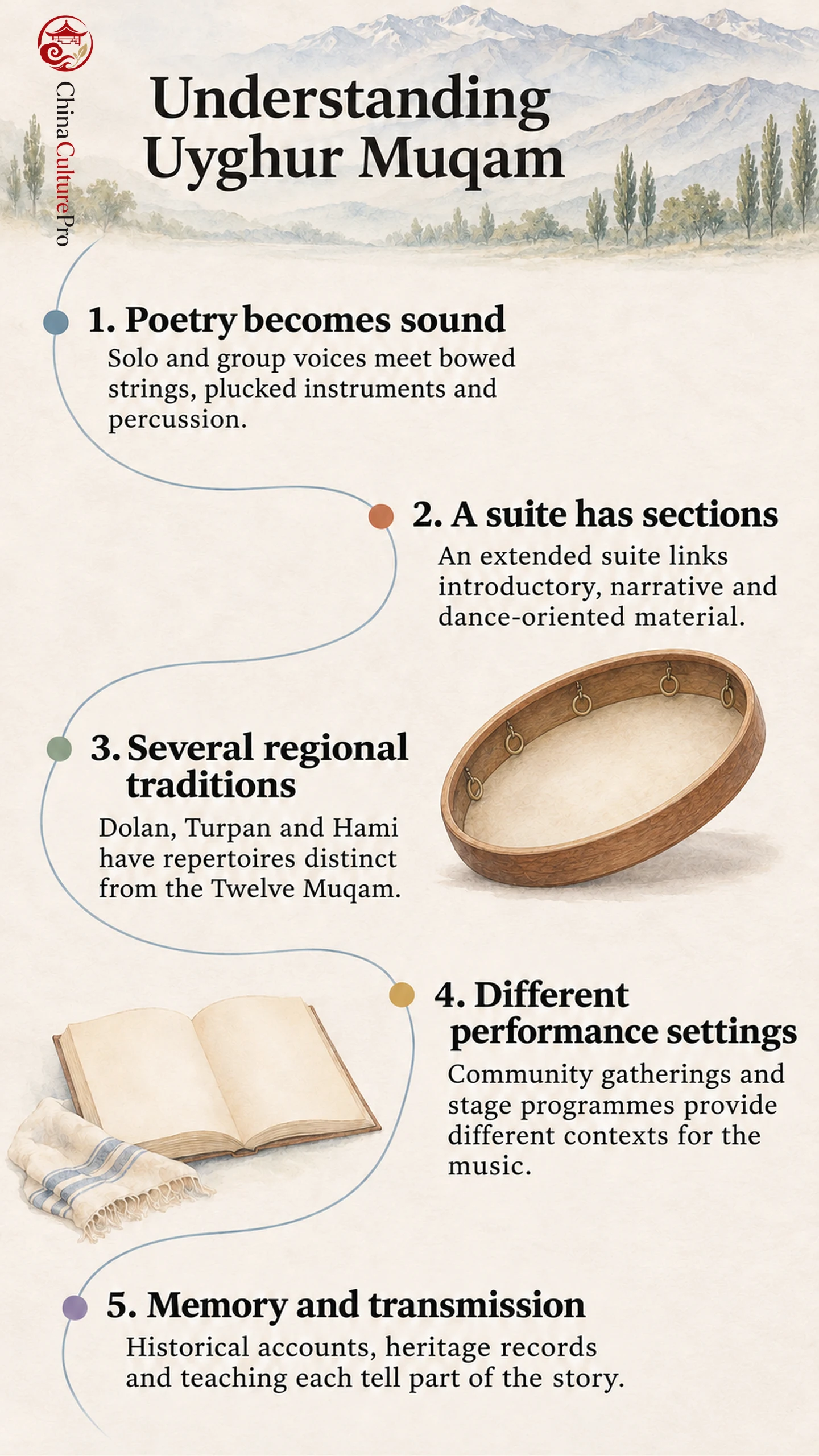
A solo voice can give way to an ensemble, then to music shaped for dancing. Following those changes helps a newcomer understand how the different elements fit together. This guide introduces the musical form, regional traditions and performance settings, alongside their place in Uyghur cultural life.
Song, Poetry and the Instrumental Ensemble
Words are central to muqam. Its texts draw on folk verse, stories and classical poetry, with themes that include love, reflection and spiritual experience. The vocal delivery changes with the material: a solo line has a different relationship to the music from a passage sung by several voices. Rhythm and melodic treatment shape how the poetry reaches the listener.[1][2]
Instrumental sound also changes across repertoires. Bowed and plucked strings can carry melodic lines, while wind-led ensembles appear in some traditions. The satar (萨塔尔,sàtǎ’ěr), a long-necked bowed lute, is associated with the classical suite tradition and its lead singer.[2]
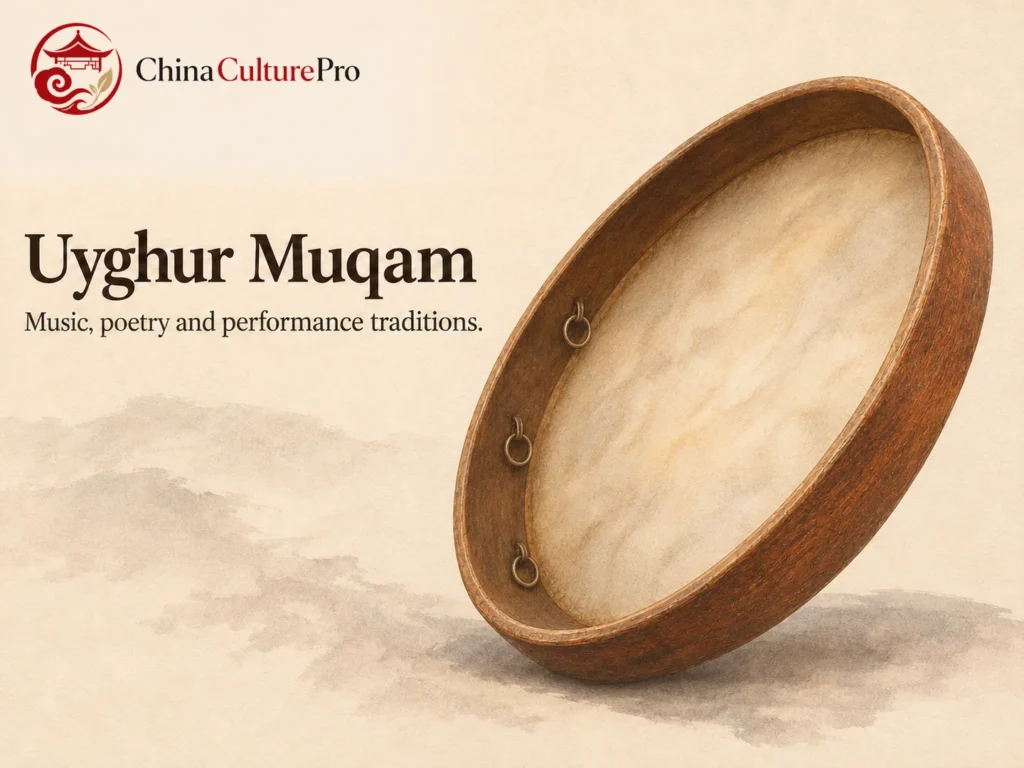
The dap (达甫,dáfǔ) is a single-headed frame drum: a wooden hoop supports a hide head, and some examples carry metal rings inside the frame. This makes it different from a deep-bodied drum with two opposing heads. Its form is useful to recognize, but a particular instrument list should not be treated as compulsory for every muqam ensemble.[3]
Inside a Twelve Muqam Suite
The Twelve Muqam (十二木卡姆,Shí’èr Mùkǎmǔ) is a major repertoire of twelve extended suites. Each suite contains a sequence of pieces, rather than being one ordinary song. The broad structure is commonly described through three sections, which connect different kinds of vocal and instrumental material.[4]
- Chong Naghma (穹乃额曼,qióngnǎi’émàn), or “great music,” develops a sequence of songs and instrumental passages. It begins with a solo introduction in free metre before measured pieces follow.
- Dastan (达斯坦,dásītǎn) brings narrative songs together with instrumental passages. Stories of lovers are an important source of the sung texts.
- Meshrep (麦西热甫,màixīrèfǔ), in this musical context, is the section of livelier songs associated with dancing.[2][4]
These sections make an extended suite more than a continuous dance sequence. A solo opening and a rhythmic dance song have different roles within its larger structure.
Regional Traditions Beyond the Twelve Muqam
The Twelve Muqam does not stand for all regional muqam. Three other major traditions have their own repertoires and arrangements. Regional labels identify separate repertoires and arrangements, rather than shortened versions of one set of suites.
| Tradition | Regional association | A distinguishing feature |
|---|---|---|
| Dolan Muqam (刀郎木卡姆,Dāoláng Mùkǎmǔ) | The Yarkand–Tarim river region, especially Makit. | Dance-centred suites open with a freer vocal introduction and draw extensively on local folk lyrics.[5] |
| Turpan Muqam (吐鲁番木卡姆,Tǔlǔfān Mùkǎmǔ) | Lukqin in Shanshan and surrounding Turpan communities. | Sung traditions include folk and classical poetry; wind-and-percussion forms also occur.[6] |
| Hami Muqam (哈密木卡姆,Hāmì Mùkǎmǔ), also called Qumul Muqam | Hami in eastern Xinjiang. | Its own named suites connect free introductions, measured songs and dance pieces.[7] |
Even within the Twelve Muqam, Kashgar, Hotan, Aksu and Ili practices can differ in melody, structure and instruments. [4]
Gatherings, Dance and Stage Excerpts
A Meshrep community gathering can include muqam, other music, oral literature, games and social activities. Music is part of the gathering’s wider organization. The gathering’s wider activities distinguish it from the similarly named musical section.[8]
A November 2024 report from Shanghai’s Jing’an district describes a cultural exchange featuring an excerpt from Nawa Muqam (纳瓦木卡姆,Nàwǎ Mùkǎmǔ) alongside a popular song. The ensemble included the dutar (都塔尔,dōutǎ’ěr), a two-stringed plucked lute, as well as bowed and other plucked instruments. A further community performance brought the visitors together with local opera musicians.[9]
For a recording or concert, look for the repertoire, suite name and whether the selection is an excerpt. Then follow the changing relationship between voice, instruments and dance rhythm. This provides a practical listening path without requiring an entire extended repertoire to be performed on one occasion.
History, Recognition and Transmission
Historical accounts connect muqam with both community music-making and courtly patronage. Its twentieth-century formalization helped establish the Twelve Muqam as a musical canon, drawing local repertoires into a more standardized presentation.[2]
Amannisa Khan (阿曼尼莎汗,Āmànníshā Hàn), associated with sixteenth-century Yarkand, is widely remembered as a musical culture figure. A 2012 study of her image traces the familiar “collector and organizer” narrative to additions made in the 1980s. This account of later cultural memory does not establish that she created or fixed the whole repertoire in her lifetime.[10]
UNESCO proclaimed Uyghur Muqam of Xinjiang in 2005, then inscribed it on the Representative List in 2008. The Twelve Muqam and the other principal regional forms appear in China’s first national heritage list of 2006 under project II-70. These dates record official recognition, not a single date of musical origin.[1][4][5][6][7]
Transmission also involves understanding the words. The Turpan heritage record notes that older Chaghatay-language poetry can be difficult for contemporary listeners. Preserving a melody alone does not explain its texts, while a staged excerpt presents only part of a wider repertoire and social practice.[6]
FAQs About Uyghur Muqam
Is Uyghur Muqam the same as the Twelve Muqam?
No. The Twelve Muqam is one major tradition within a broader group that also includes Dolan, Turpan and Hami Muqam.
Are the Twelve Muqam twelve individual songs?
No. They are twelve extended suites, each containing multiple pieces and sections.
Do you have to hear a complete suite?
No. Concerts and recordings can present excerpts. A clear programme label helps identify what has been selected.
Is every Uyghur dance performance a muqam?
No. Uyghur dance has a wider repertoire. A dance appearance alone does not identify the music as muqam.
Sources
[1] UNESCO. Uyghur Muqam of Xinjiang
[2] Rachel Harris. The Making of a Musical Canon in Chinese Central Asia: The Uyghur Twelve Muqam, preview
[3] The Metropolitan Museum of Art. Frame Drum, object 1986.467.87
[4] China Intangible Cultural Heritage Network. Uyghur Muqam: Twelve Muqam
[5] China Intangible Cultural Heritage Network. Uyghur Muqam: Dolan Muqam
[6] China Intangible Cultural Heritage Network. Uyghur Muqam: Turpan Muqam
[7] China Intangible Cultural Heritage Network. Uyghur Muqam: Hami Muqam
[8] UNESCO. Meshrep
[9] Jing’an District Media Center. Muqam performances and cultural exchange in Jing’an, November 2024
[10] Elise Anderson. The Construction of Amannisa Khan as a Uyghur Musical Culture Hero