


Quick Answer: What Is the Guanzi?
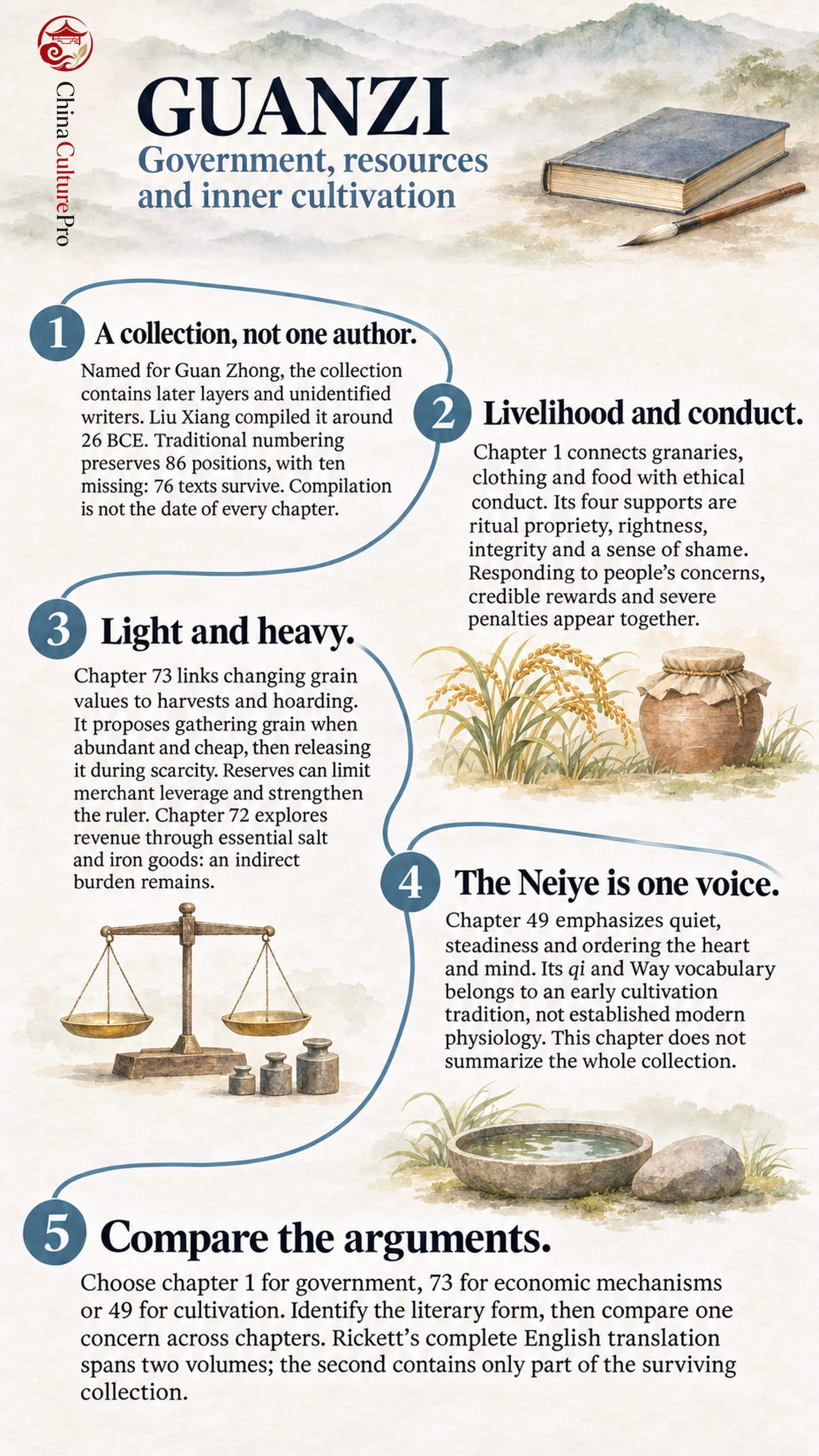
The Guanzi (管子, Guǎnzǐ), or Book of Master Guan, is an early Chinese collection of writings on government, economic management, ethics and self-cultivation. Its 76 surviving chapters contain different voices and layers of composition; individual authors are unidentified.[1]
- Political scope: How rulers secure order, resources and people’s cooperation.
- Economic scope: How grain, prices, reserves and essential commodities can be managed.
- Philosophical range: The collection also includes writings on inner cultivation and the relationship between body and mind.[4][5][6]
The book’s association with a famous minister does not make every dialogue or policy proposal his recorded words. Read each chapter as a particular argument within a layered collection.
Grain reserves, public authority and a quiet mind may seem unlikely companions in one book. The Guanzi brings them together without reducing them to a single continuous argument. Reading selected chapters reveals both its practical concerns and the differences among its voices.
Guan Zhong’s Name and a Later Compilation
The collection is named for Guan Zhong (管仲, Guǎn Zhòng), the historical minister who died in 645 BCE. Much of its material is substantially later. Individual authors remain unidentified, and the dates of particular pieces are uncertain.[1][2]
Liu Xiang (刘向, Liú Xiàng), a Han (汉, Hàn) scholar, compiled the collection around 26 BCE. That editorial milestone should be distinguished from the composition dates of its contents. It also does not mean that subsequent transmission left every passage untouched.[2][3]
The traditional numbering runs to 86, with ten missing chapters, leaving 76 extant texts. Editions can therefore refer to chapter 73 without implying that 72 complete chapters precede it. A table of contents preserving the gaps is useful when comparing references.[3]
Within Chinese philosophy, the Guanzi is best approached chapter by chapter. A change in subject or literary form may signal a different inquiry rather than the next stage of a continuous argument.
Governing People: Livelihood, Conduct and Authority
Chapter 1, Governing the People (牧民, Mùmín), connects material security with ethical conduct. Full granaries and adequate clothing and food are presented as conditions that help people recognize proper behavior and honor. Agriculture and stores consequently belong to the work of governing.[4]
The same chapter identifies four ethical supports of the state:[4]
- Ritual propriety (礼, lǐ): Observe appropriate limits.
- Rightness (义, yì): Do not advance oneself improperly.
- Integrity (廉, lián): Do not conceal wrongdoing.
- A sense of shame (耻, chǐ): Do not follow what is crooked.
It also argues that government succeeds by responding to people’s concerns and that punishment alone cannot win their hearts. Yet it retains severe penalties and credible rewards as governing tools. Welfare, ethical expectations and authority appear together; the chapter is neither a program of kindness alone nor a claim that force is sufficient.[4]
This concern with enforceable order offers a useful comparison with Legalism (法家, Fǎjiā). It does not justify assigning every part of the collection to one doctrinal category.
Light and Heavy: Prices, Reserves and Revenue
Light and heavy (轻重, qīngzhòng) concerns changing relative value and the ability to act upon it. In chapter 73, State Reserves (国蓄, Guóxù), good and bad harvests alter grain prices. Private hoarding and uneven access can produce hunger even where total resources appear adequate.[5]
The proposed response includes gathering grain when it is abundant and cheap, then releasing it when scarcity raises its value. Public stores and seasonal supplies can limit powerful merchants’ leverage. The argument links price management with the timing of agricultural work and access to necessities.[5]
These measures also strengthen the ruler. The chapter connects the control of grain and money with revenue, dependence and political command. Presenting it solely as consumer protection would remove that other purpose.[5]
Chapter 72, Hai Wang (海王, Hǎi Wáng), explores another fiscal mechanism through a dialogue: revenue obtained from salt and iron goods that people regularly need. It contrasts such receipts with conspicuous direct levies. The burden has been shifted into essential commodities, not made to disappear.[7]
Read these proposals with their governing purpose in view: the ruler seeks to manage necessities, secure revenue and maintain authority.
The Neiye and the Cultivation of the Heart and Mind
Chapter 49, the Neiye (内业, Nèiyè), often translated as Inward Training, turns toward the ordering of the heart and mind. It describes disturbances associated with desires and emotions, and emphasizes quiet, steadiness and an ordered bodily bearing.[6]
Its vocabulary includes qi (气, qì) and the Way (道, dào), connecting life, awareness and order through an early account of cultivation. These concepts should be explained within that intellectual world; the chapter is not evidence that its claims have been established by modern physiology.[6]
This material helps explain the collection’s importance for Daoist (道家, Dàojiā) thought. It does not make the Neiye a summary of all the Guanzi’s economic and political writing. A text focused on inner cultivation and a dialogue about salt revenue ask different questions.[2][6][7]
How to Read a Collection with Different Voices
- Select an entry point: Begin with chapter 1 for government and livelihood, chapter 73 for economic mechanisms, or chapter 49 for cultivation.
- Identify the argument’s form: Separate an aphorism, a dialogue, a proposed policy and a cultivation passage before drawing conclusions about authorship.
- Compare one concern: Follow a topic such as order across two chapters, noting differences instead of forcing agreement.
W. Allyn Rickett’s Guanzi: Political, Economic, and Philosophical Essays from Early China provides a complete English translation across two volumes. Check volume coverage: the second contains 42 chapters, not the entire surviving collection.[2]
For a separate text centered on arguments about state economic policy, continue with the Discourses on Salt and Iron (盐铁论, Yántiělùn). Use the comparison to ask how a policy is justified, rather than assuming the books express one continuous program.
FAQs About the Guanzi
Did Guan Zhong write the Guanzi?
It bears his name, but its surviving writings have unidentified authors and belong to later periods. A dialogue featuring Master Guan is not automatically a transcript of the historical minister.[1]
Is the Guanzi a Legalist or Daoist book?
Neither label adequately describes the whole collection. Questions of authority and resources coexist with ethical and inner-cultivation writing.[1]
Why do descriptions mention both 86 and 76 chapters?
The received numbering preserves 86 positions, of which ten are missing. There are 76 surviving texts.[3]
Is the Guanzi available in English?
Yes. Rickett’s complete translation spans two volumes; a listing for the second volume alone covers only part of the work.[2]
Sources
[1] V. Leung, Wiley. Guanzi, encyclopedia abstract
[2] W. Allyn Rickett, Princeton University Press. Guanzi: Political, Economic, and Philosophical Essays from Early China
[3] Public-domain Chinese text. Guanzi: received chapter list and later bibliographical notice
[4] Public-domain Chinese text. Guanzi, chapter 1: Governing the People
[5] Public-domain Chinese text. Guanzi, chapter 73: State Reserves
[6] Public-domain Chinese text. Guanzi, chapter 49: Inward Training
[7] Public-domain Chinese text. Guanzi, chapter 72: Hai Wang