


Quick Answer: Who Was Guan Hanqing?
Guan Hanqing (关汉卿, Guān Hànqīng) was a leading playwright of the Yuan period, associated with the northern capital Dadu, now Beijing. His exact life dates are uncertain, and little reliable biographical information survives. [1]
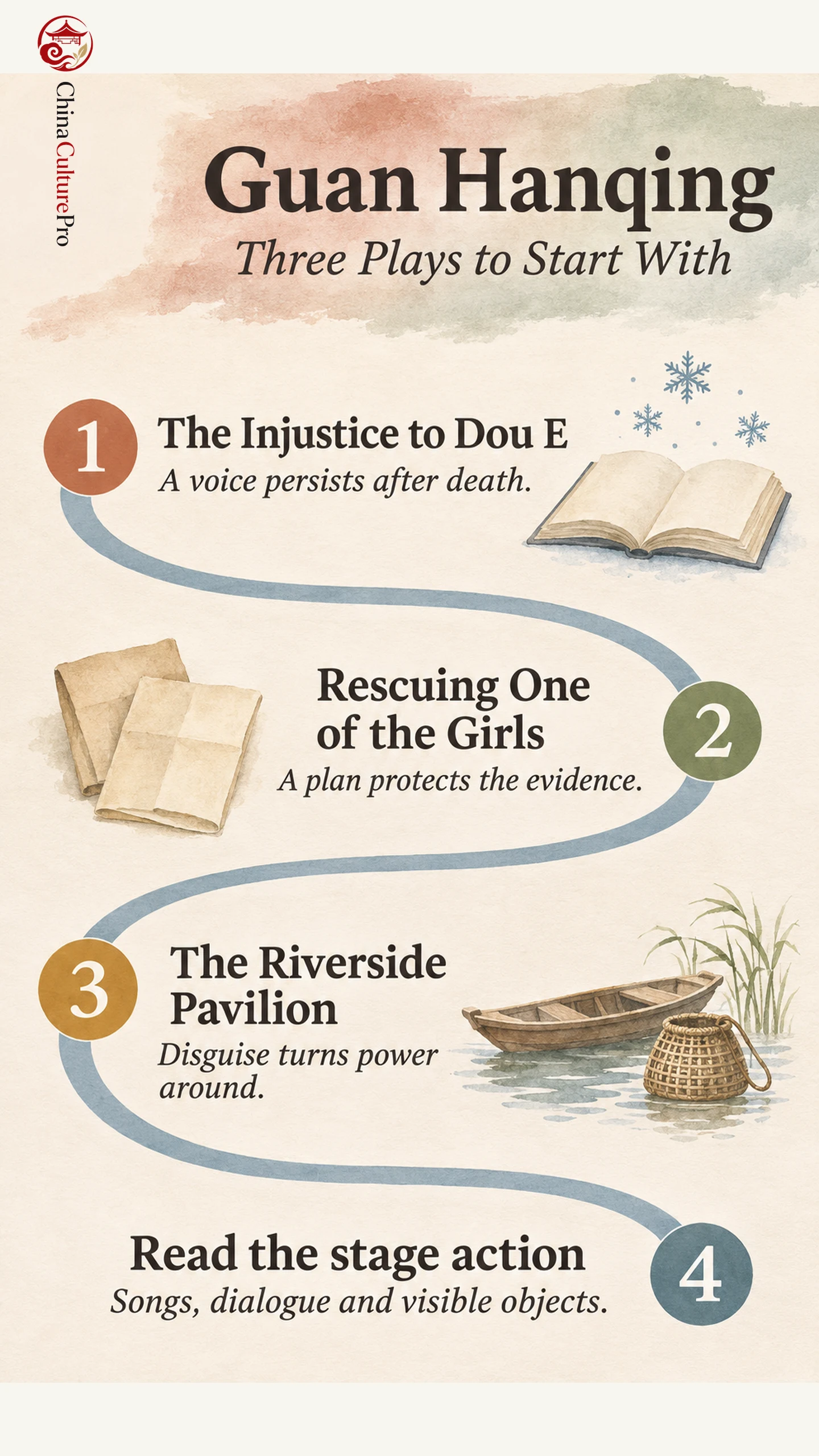
- Begin with the injustice play for a powerful tragic voice and its demand for recognition.
- Choose the rescue comedy for friendship, deception and control of evidence.
- Compare the riverside play for disguise and the exposure of an abusive official.
Read the plays as musical theatre: spoken exchanges, songs and visible actions perform different jobs.
A written confession can conceal the truth; a divorce document can enable escape; official credentials can become a villain’s weakness. Guan Hanqing makes such objects matter through action. Reading three plays together reveals different ways that vulnerable people try to be heard, obtain protection or turn another person’s power against him.
A Yuan Playwright and the Form of Zaju
Guan belongs to the theatrical world of the Yuan dynasty. He is studied alongside playwrights such as Bai Pu (白朴, Bái Pú), within a larger dramatic tradition. [1]
Northern zaju (杂剧, zájù) typically has four acts, often with a short additional prologue. Songs grouped into a suite form the core of an act, with one leading character singing and spoken dialogue between or within the songs. Entrances, self-introductions and announced actions help establish people and places. [2]
Stephen Owen identifies fuller printed versions as Ming-period recreations of performance. Their stage directions and repetitions help readers approach theatrical conventions, alongside the words assigned to characters. They help place these works within the wider history of Chinese musical theatre. [2]
Three Plays to Start With
- The Injustice to Dou E: This play (窦娥冤, Dòu É Yuān) follows Dou E (窦娥, Dòu É), a young widow falsely accused in a poisoning case. She confesses after the court threatens to torture her mother-in-law. Before execution, she demands three signs of her innocence: blood on a white cloth, snow in summer and three years of drought. The fourth act brings her ghost before her father, now an official, to force a review of the case. Read the movement from coerced testimony to a voice that persists after death. [3]
- Rescuing One of the Girls: This comedy (救风尘, Jiù Fēngchén) centres on Zhao Paner (赵盼儿, Zhào Pàn’ér), who helps Song Yinzhang (宋引章, Sòng Yǐnzhāng) escape an abusive marriage. Zhao pretends to offer the husband a more attractive match, persuading him to release Song. A substituted copy protects the original divorce paper when he tries to destroy the evidence. The courtroom resolution completes a rescue already made possible by performance, planning and practical knowledge. [4]
- The Riverside Pavilion: In this play (望江亭, Wàng Jiāng Tíng), Tan Jier (谭记儿, Tán Jì’ér) disguises herself as a fish seller to protect her official husband from a powerful rival. During a Mid-Autumn drinking scene, she obtains the sword, authority token and documents on which the rival relies. When he later tries to produce his warrant, he reads amorous poems instead; an investigating official ultimately settles the case. Notice the contrast between his formal position and her control of the encounter. [5]
Voice, Strategy and the Limits of Justice
In the tragedy, the audience knows why a confession was made while the court treats it as proof. The supernatural signs and the ghost’s intervention expose the gap between official judgment and the truth already visible to spectators. Clearing the conviction comes too late to save the woman. [3]
The rescue comedy gives deception a different role. Zhao understands the husband’s appetite and prepares for his attempt to recover control. Her courtroom account also strategically reshapes the relationship’s history. The play invites attention to what produces a humane result, rather than assuming that a successful plea is a complete, neutral record. [4]
The riverside drama makes authority material: documents, a sword and a token can be displayed, stolen or withheld. Tan’s intervention stops an immediate threat, but the final judgment still invokes a higher official. Her ingenuity and institutional confirmation both contribute to the ending. [5]
These differences help explain why a single label such as social protest cannot describe every dramatic effect. Compare what the audience knows with what a judge or antagonist believes, then follow the object or speech that changes the balance.
English Translations and Modern Adaptations
Selected Plays of Kuan Han-ching, translated by Yang Hsien-yi and Gladys Yang, was published by Foreign Languages Press in 1958. The older romanization in the title names the same author as Guan Hanqing. [6]
Stephen Owen’s 1996 An Anthology of Chinese Literature includes Rescuing One of the Girls on pages 746–770, preceded by an introduction to variety plays. This offers a substantial English reading with help on the form. [2]
Check the creator credits when choosing a version of the injustice story. The Royal Shakespeare Company’s 2017 Snow in Midsummer, written by Frances Ya-Chu Cowhig, is a contemporary reimagining based on Guan’s drama. Its modern factory-town setting and new characters belong to that adaptation. [7]
For readers exploring Chinese literature, keeping author, translator and adapter distinct makes comparison more useful: a change in setting or ending can be an artistic decision in a later work.
FAQs About Guan Hanqing
Does the injustice play end with the execution?
The fourth act follows the wrongful execution. The dead woman’s intervention prompts her father to reopen the case and clear her name; it does not restore her to life. [3]
Why do characters introduce themselves to the audience?
Self-introductions and descriptions of intended actions are conventions of the theatre. They establish identity, situation and movement in a performance tradition that used relatively few props. [2]
Is the modern Snow in Midsummer a literal translation?
The RSC identifies Cowhig’s version as a contemporary reimagining of Guan’s classical drama. It is a later play based on the source, so its added modern plot should be read as adaptation. [7]
Sources
[1] Chinese University of Hong Kong, Renditions. Guan Hanqing: Author Profile and English Works
[2] Stephen Owen, Harvard University faculty bibliography and linked book. An Anthology of Chinese Literature: Variety Plays and Rescuing One of the Girls, Pages 744–770
[3] Guan Hanqing, Chinese text hosted by Wikisource. The Injustice to Dou E
[4] Guan Hanqing, Chinese text hosted by Wikisource. Zhao Paner Rescues a Woman from the Entertainment Quarter
[5] Guan Hanqing, Chinese text hosted by Wikisource. The Riverside Pavilion: Full Chinese Dramatic Title and Text
[6] National Institute of Informatics, CiNii Books. Selected Plays of Kuan Han-ching: 1958 Translation Record
[7] Royal Shakespeare Company. Snow in Midsummer: Cowhig Adaptation and 2017 Production