

Quick Answer: Were Cowrie Shells Used as Money in China?
Cowrie shells (貝, bèi) were objects of value in early China. Shang and Zhou records mention shells in grants and other transfers. Western Zhou inscriptions give stronger evidence for their use as a measure of value, although scholars disagree about how widely shells served as everyday money.[1][2][3]
- Early records: Inscriptions can specify how many groups of shells were transferred.[1][2]
- Counting unit: A peng (朋, péng) was a unit of grouped cowries. Some archaeological examples support ten shells arranged in two strands of five.[1][3]
- Regional currency: Later sources document cowries circulating in markets in Yunnan.[1][5]
A burial deposit, a written valuation and a market payment provide different kinds of evidence.

Shells in a tomb can show what people included among the objects of a burial. An inscription can show how they counted or transferred them. Together they help distinguish gifts, valuations and later evidence of market payments.[1][2]
What Shang and Zhou Inscriptions Record
Shang and Zhou inscriptions mention transfers of cowries, often involving a ruler, a lord or another person of high status. A reward for service tells us who could receive shells and how a gift was expressed. Its setting differs from a record of exchange between buyers and sellers.[1][2][3]
One Western Zhou inscription on the Kang ding (亢鼎, Kàng dǐng), a bronze vessel, associates a jade object with a sum of 50 peng. Some scholars read the text as evidence of purchase. Others emphasize that early wording for these transfers can carry meanings of recompense or redemption. The recorded amount supports the idea that cowries could express value. The surviving text gives less evidence about everyday retail use.[1][2][3]
What a Peng of Cowries Meant
In the inscriptions, peng is a unit for counting groups of shells. Excavated arrangements of two strands with five shells apiece give one basis for reading the unit as ten shells. Those finds give a physical basis for the proposed conversion. The exact number represented by peng in a particular text still depends on whether the same arrangement applied there.[1][3]
This distinction affects how a reader interprets large figures. An inscription gives a number in a historical unit. An archaeological group can give a physical count, where its arrangement survives. A conversion based on one find should be treated as conditional when applied to another place or date.[1][3] The later practice of counting copper cash strings raises a similar question about physical bundles and named units.
What Burials and Imitations Can Show
More than 6,000 cowries were found in the late Shang tomb of Fu Hao (婦好, Fù Hǎo). Their presence in a burial identifies a deliberate deposit alongside other valued objects. It gives archaeologists evidence for wealth and funerary practice. Inferring ordinary market prices or frequency of exchange would require another kind of record.[1][2] The guide to Chinese women in archaeology explains the fieldwork behind the tomb’s excavation.
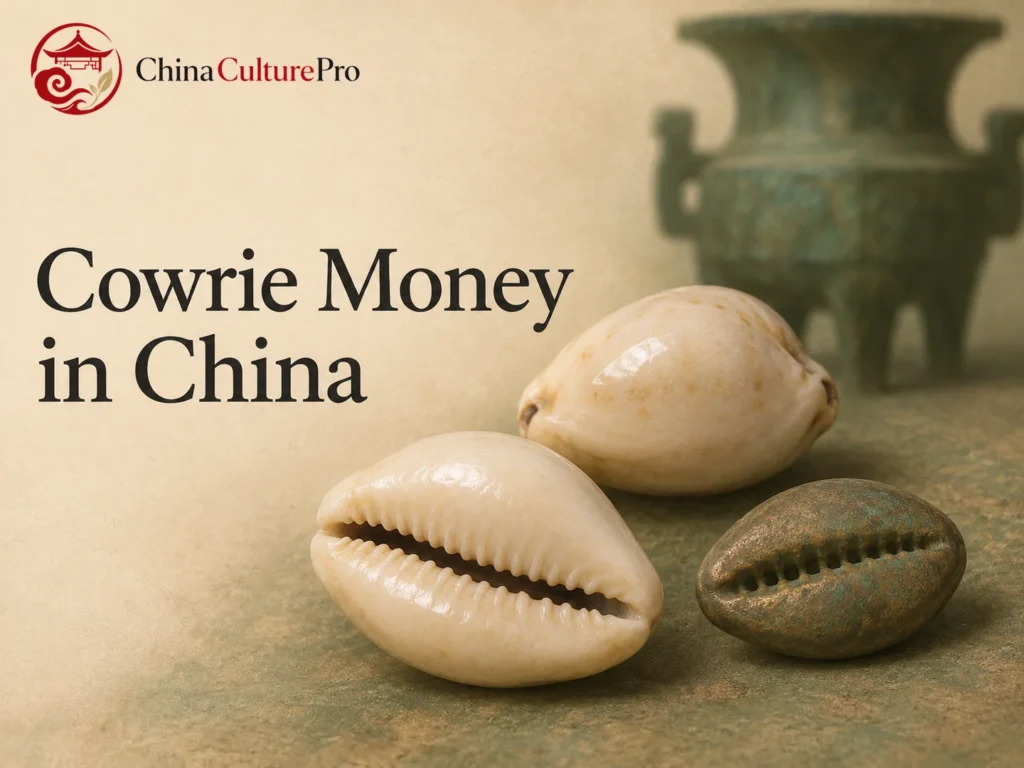
Some makers copied the shape of cowries in other materials. A bronze example at Henan Museum was excavated in 1953 at Yinxu (殷墟, Yīnxū), Anyang. It measures 1.8 centimeters long and 1.4 centimeters wide. It shows that the shell’s form was reproduced in metal. Some researchers and museums interpret such copies as monetary, while others emphasize the need to examine the use and context of each object.[1][2][4]
The written shell character 貝 also appears in later characters associated with wealth and exchange, including 買 (mǎi), “buy,” and 貸 (dài), “lend.” This vocabulary preserves the connection between shells and value. Dating a currency practice requires archaeological or documentary evidence from the period.[6]
Why Yunnan Is a Separate Monetary Case
Later records from southwestern China describe cowries used in markets in Yunnan, including during the Ming period. Exchange there was connected to routes reaching mainland Southeast Asia and the Indian Ocean trading world. Accounts show cowrie use persisting until around the middle of the seventeenth century.[1][5]
These records provide a regional example of repeated monetary use. They come from different institutions and a much later period than Shang royal burials or Zhou bronzes. The networks described in the trade records are part of the wider history of Yunnan culture.[1][5]
FAQs About Cowrie Money in China
Were Cowries China’s First Coins?
Natural cowries are shells. Cast bronze examples also reproduce the shape of the shell. Whether an early object was routinely accepted in exchange depends on its historical context.[1][2][4]
Can Fifty Peng Be Converted to Exactly Five Hundred Shells?
Five hundred is the result if each peng represents ten shells. For a specific inscription, the conversion depends on evidence that the same counting convention applied.[1][3]
Where Did Early Chinese Cowries Come From?
They were marine shells, and many finds are far inland. Scholars have proposed long-distance imports from the Indian Ocean. The route for a particular early find may be uncertain.[1]
Sources
[1] Mikael Fauvelle. Shell Money: A Comparative Study
[2] Yung-ti Li. On the Function of Cowries in Shang and Western Zhou China
[3] Yōhei Kakinuma. Money, Markets, and Merchants
[4] Henan Museum. Bronze Cowry Shell
[5] Bin Yang. The Laws of King Mengrai, Cowrie Shells, and Intra-Asian Interactions
[6] The British Museum. Money Gallery Room 68 Large Print Guide