
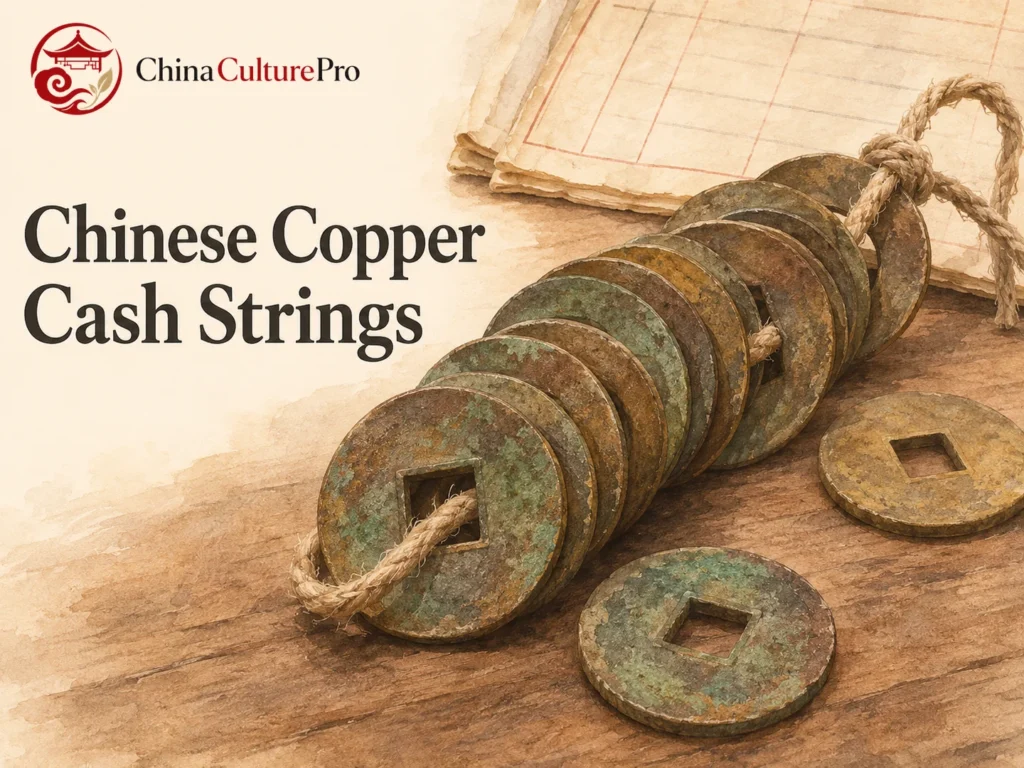

Quick Answer: What Was a String of Copper Cash?
A string of copper cash was a bundle of coins threaded through their center holes. It also gave people a unit for stating larger amounts. An individual standard cash coin usually counted as one wen (文, wén). A string unit called guan (貫, guàn) was conventionally reckoned as 1,000 cash, though the number of physical coins could differ.[1][2][3][4][5]
- Handling: Cord kept a group of small coins together for storage and payment.[1][4]
- Counting: A locally accepted short string could count for more cash than it held in pieces.[2][3]
- Value: The coins’ quality and the local exchange rate mattered when cash was exchanged for another currency.[4][5]
To interpret a historical amount, separate the nominal unit, the number of coins and the terms of payment.

A surviving cord can show how coins were bundled. A price written in strings may record an amount that was paid in a different way. Both uses belong to the history of copper cash.[1][2][5]
How Coins Were Threaded and Counted
Many Chinese cash coins were made with a square center hole that allowed them to be threaded. A cord let people lift and transfer several coins at once. Historical groups could be sized for different payments, including bundles of 100, 500 or 1,000 coins.[1][4]
A small object in the Fitzwilliam Museum retains six coins on a string, corroded together. The museum tentatively associates the coins with the Northern Song. The surviving piece records the method of threading. Its six surviving coins establish the physical arrangement. The original number of coins on the cord remains unknown.[1]
How a String Could Count as 1,000 With Fewer Coins
When cash was counted in strings, the accepted number of coins for the unit could be set by a particular practice. In one Song convention, 770 coins represented 1,000 nominal cash. The same relationship appears in a smaller bundle of 77 coins accepted as 100. An account could retain a round figure even when payment used fewer coins.[2][3]
| Example | Stated quantity | What was present |
|---|---|---|
| Song short-string convention | 1,000 nominal cash | A bundle of 770 coins could be accepted for the unit. |
| Ming one-string paper note | 1,000 cash denomination | The note depicts a string and represents its stated amount on paper. |
| Modern display using Qing coins | 1,000 coins in a display string | A museum reconstruction uses an actual count of 1,000. |
The display string was assembled in 1996 with Qing coins and weighs 3.8 kilograms. That figure describes the museum example. Historical strings could hold fewer pieces and a different mixture of coins. The weight of any particular string depended on the count and the coins used.[2]
Why the Coins Inside a String Mattered
The coins in a bundle could differ in age, metal composition or acceptability. In late Ming circulation, older coins remained in use after new issues appeared. Debased copies and officially cast coins could also circulate at the same time. Local market custom affected which mixture would be accepted as a string, so checking the count was only part of assessing the payment.[2][4]
The distinction matters when comparing historical prices. If two market records use the word “string,” check the place, period and kind of cash accepted. Two prices expressed in strings can involve different numbers or grades of coin.[4][5]
From a Physical String to an Account or Note
The term diao (吊, diào) was also used for a string unit in late imperial accounts. An account could use the unit even when no cord and coins changed hands. A one-string denomination on a Great Ming Circulating Treasure Note, a type first issued in 1375, makes this visible. Its printed string shows the coin unit in which the note is denominated.[2][5] The same distinction between an accounting unit and a form of payment helps explain paper money in Song China.
Copper cash also circulated alongside silver. The Qing state used an official reckoning of 1,000 cash to a tael of silver. Local exchange rates varied. Copper was counted, while the silver side of the transaction involved standards of weight and value. The Chinese monetary weights guide explains how those standards affected silver accounts.[5]
FAQs About Chinese Copper Cash Strings
Did All the Coins on a String Come From One Reign?
Strings could mix coins from different periods. In late imperial circulation, older pieces could remain in use alongside newer issues. To date the bundle, look at the range of coins and the circumstances in which it was found.[2][4]
Was One String Always Worth One Silver Tael?
One thousand cash per tael was an official reckoning in the Qing context. Actual exchange depended on local conditions, the types of cash and the silver standard. Check the rate for the relevant time and place.[5]
Can a Museum String Show Its Original Count?
It depends on its provenance. A surviving fragment shows how the cord passed through the coins. A reconstructed display shows how a full string could look. The collection record identifies which kind of evidence the object supplies.[1][2]
Sources
[1] The Fitzwilliam Museum. Cash (Chinese Money), CM.869-2002
[2] The British Museum. Money Gallery Room 68 Large Print Guide
[3] Christian de Pee. Urban Life and Intellectual Crisis in Middle-Period China, 800–1100
[4] Sui Wai Cheung. Debased Copper Coin Circulation and Monetary Policy in the Late Ming, 1500–1644
[5] Debin Ma. Money and Monetary System in China in the 19th–20th Century: An Overview