
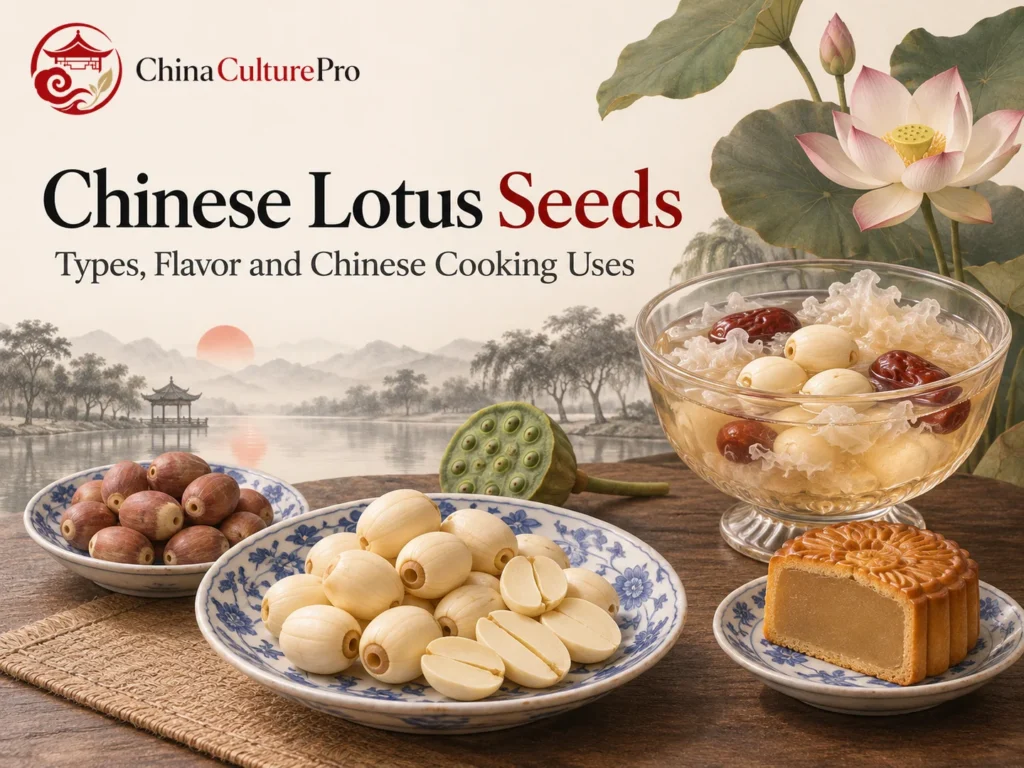

Quick Answer: What Are Chinese Lotus Seeds?
Chinese lotus seeds (莲子, liánzǐ), or lian zi, are edible seeds of Nelumbo nucifera. They appear whole in soups and porridge or processed into a smooth pastry filling.[1][4][6]
- Product state: Fresh and dried seeds require attention to different preparation and storage directions.
- Processing: Removing the reddish seed coat differs from removing the green center.
- Cooking role: Whole seeds provide a soft bite; a prepared filling has another texture and composition.
Check the plant name, seed form and ingredient list rather than relying on an English nickname.[1][2][3][4]
A small pale seed in a sweet soup and a smooth mooncake filling begin with the same plant food. To understand the difference, separate fresh from dried seeds, the outer coat from the green heart, and a whole ingredient from a sweetened paste.
Fresh and Dried Seeds: Texture and Product State
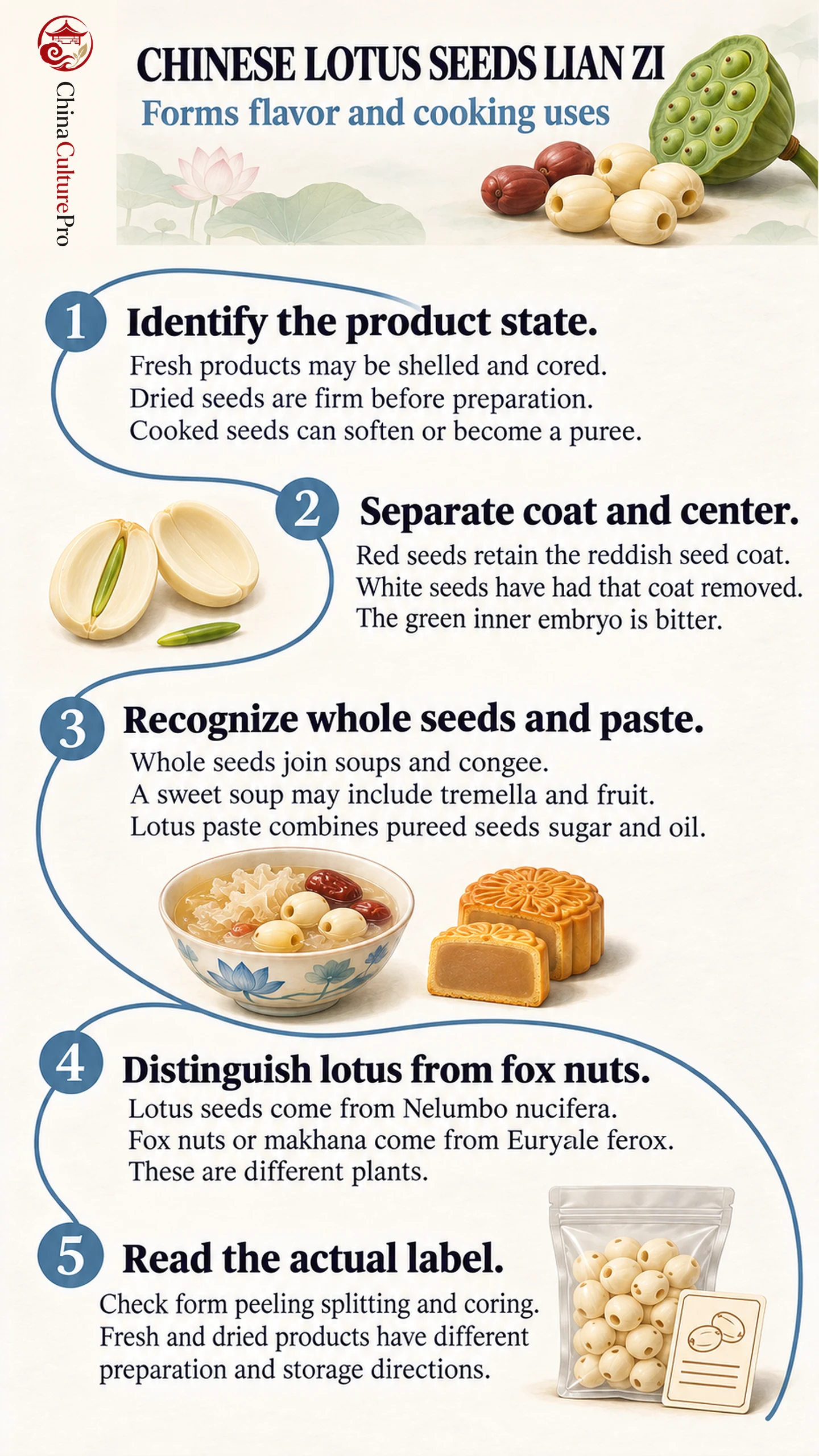
Fresh products may be sold shelled and de-cored. One farmers’ association product describes a gently sweet, soft character and lists chilled storage.[7]
Dried cooking seeds are firm before preparation. Cooked seeds can soften while retaining their shape, or be puréed into a smooth filling.[3][4]
Red Skins, White Seeds and the Green Heart
| Product description | What has changed |
|---|---|
| Red lotus seeds (红莲子, hóngliánzǐ) | The reddish seed coat remains. |
| White lotus seeds (白莲子, báiliánzǐ) | The seed coat has been removed. |
| De-cored lotus seeds (去芯莲子, qùxīn liánzǐ) | The inner green center has been removed. |
Mechanical peeling removes the red seed coat, so white appearance does not establish an earlier harvest. Peeling does not automatically remove the inner center.[2][3]
The lotus seed heart (莲子心, liánzǐxīn) is the bitter green embryo inside the pale seed flesh. Seeds are sold whole or halved; check separately whether the center remains.[3][4]
Whole Seeds in Dishes and Lotus Seed Paste
Whole seeds appear in congee and savory soups, including chicken-based preparations.[3][4]
A Tongjiang example of sweet soup pairs dried lotus seeds with tremella, red dates, goji berries and rock sugar. This published version also includes lard, so a sweet soup is not automatically vegan.[5]
Lotus seed paste (莲蓉, liánróng) is a processed filling: cooked seeds are puréed and combined with sugar and oil into a soft paste that holds its shape. It is used in mooncakes, sesame balls and steamed buns. Its texture and composition differ from whole seeds.[4]
Lotus Seeds Are Different from Fox Nuts
Fox nuts (芡实, qiànshí), or makhana, come from Euryale ferox. Lotus seeds come from Nelumbo nucifera: these are different plants.[1][6]
The qianshi guide covers that ingredient. Use the product identity rather than a confusing English nickname.[1][6]
Choosing the Form and Reading Storage Directions
Check fresh or dried, peeled or skin-on, whole or split, and de-cored or not. Read a finished paste or dessert’s added ingredients.[2][3][4][5]
The fresh product specifies chilled storage; dry-seed guidance calls for dry storage protected from pests. Follow the actual food label.[3][7]
FAQs About Chinese Lotus Seeds
Are white lotus seeds always harvested younger than red seeds?
No. Removing the red coat also produces white seeds.
Why can lotus seeds taste bitter?
The green embryo is bitter. Check whether the seed has been de-cored.
Is lotus seed paste the same as whole lotus seeds?
No. Paste is processed smooth and may contain sugar and oil.
Are lotus seeds and makhana the same?
No. Lotus seeds are Nelumbo nucifera; makhana comes from Euryale ferox.
Sources
[1] Royal Botanic Gardens, Kew. Nelumbo Nucifera: Edible Seeds and Mooncake Filling
[2] Wang Faxiang and colleagues, Food Science. Comparison of Dried Lotus Seeds and Their Polishing Powder
[3] Songling District Market Supervision Administration. Lotus Seed Structure and Culinary Preparations
[4] Judy, The Woks of Life. Lotus Seed Paste: Texture, Ingredients and Pastry Uses
[5] China Tourism News. Tongjiang Tremella and Lotus Seed Sweet Soup
[6] Indian Council of Agricultural Research. Makhana: Euryale Ferox Identity
[7] New Taipei City Farmers Association, Ubox. Fresh Baihe Lotus Seed Product