


Quick Answer: What Is Yibin Ya Cai?
Yibin ya cai (宜宾芽菜, Yíbīn yácài) is a preserved mustard ingredient from Sichuan, used to add concentrated savory flavor to food. It is not a bag of fresh bean sprouts.
- Raw material: Local leaf-mustard varieties provide the vegetable for preservation.
- Flavor: Salt, drying, fermentation and, in sweet preparations, sugar and spices build its character.
- Shopping: Read both the flavor description and the cut; finely minced and sweet are not mutually exclusive categories.
Choose the actual product your dish needs rather than assuming every packet translated as “preserved mustard greens” is the same.
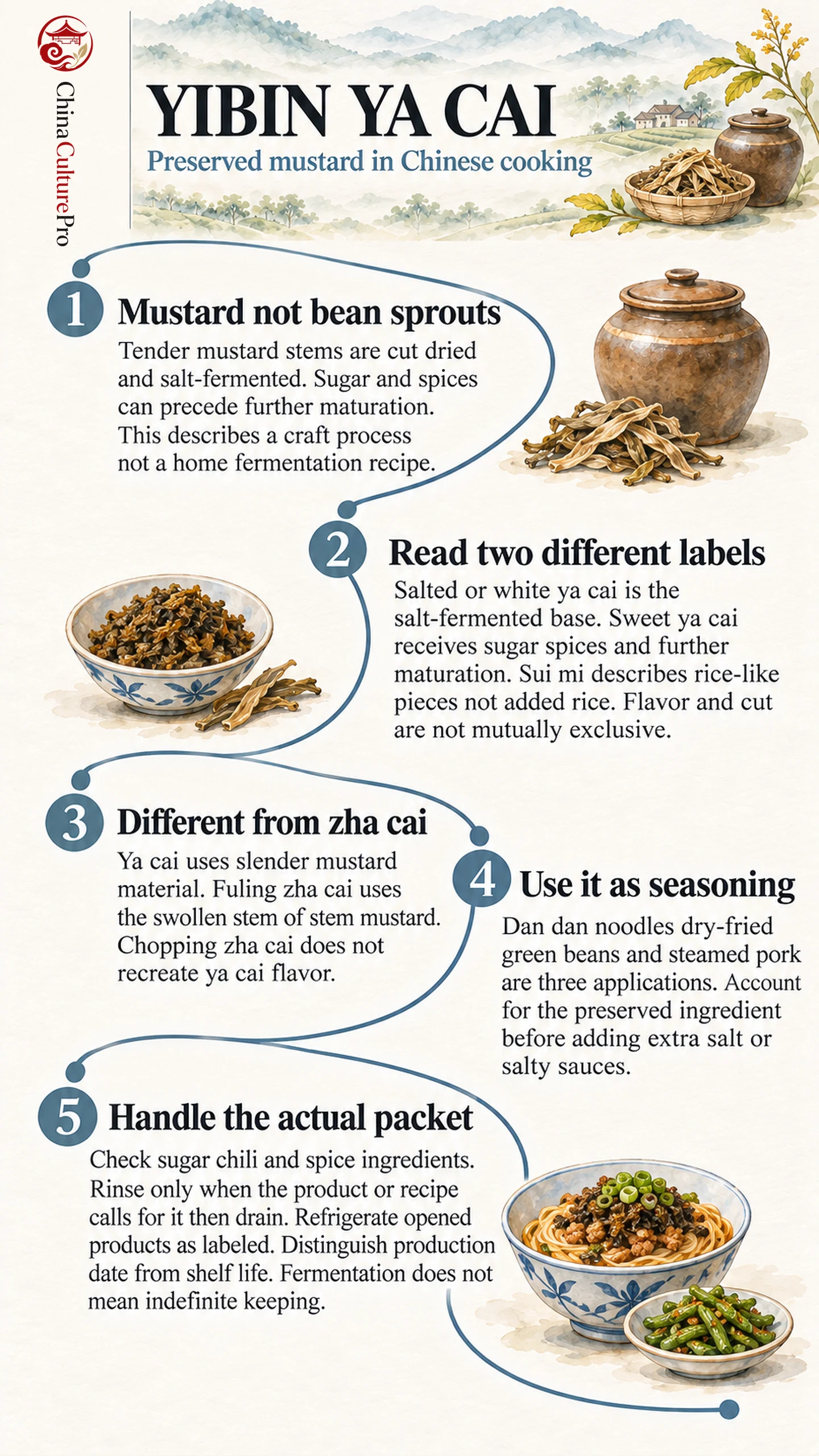
A small quantity of dark preserved vegetable can change the character of a noodle bowl. Understanding this ingredient’s names helps you reproduce that effect without replacing it with an unrelated pickle. Its home context is Sichuan cuisine.
How Mustard Becomes Ya Cai
The raw material is a type of leaf mustard, rather than the swollen mustard stem used for some other pickles. Agricultural guidance for the Yibin crop lists local leaf-mustard varieties selected for processing.[1]
In a documented traditional method, tender stems are selected, split into narrow strips and dried. Salting and sealed fermentation follow; sugar and spices are added before a further maturation stage. This explains why the finished ingredient contributes more than the flavor of fresh greens.[2]
These are preservation stages, not instructions for fermenting vegetables at home. Different craft descriptions give different durations, so a mandatory three-year aging claim would be misleading. For the wider context, see Chinese fermented foods.
Salted, Sweet and Sui Mi: Reading the Labels
Two kinds of description can appear together: the treatment that shapes flavor and the size into which the preserved vegetable is cut.
| Label | Meaning | What it tells the cook |
|---|---|---|
| salted ya cai (咸芽菜, xián yácài), also called white ya cai (白芽菜, bái yácài) | The salt-fermented base before the later sugar-and-spice treatment. | Do not assume it has the same sweetness as a finished sweet preparation. |
| sweet ya cai (甜芽菜, tián yácài) | A preparation with sugar and spices added before further maturation. | Sweetness accompanies the preserved vegetable’s savory character. |
| sui mi ya cai (碎米芽菜, suìmǐ yácài) | Preserved mustard cut into small, rice-like particles rather than long strips. | The name describes the cut; it does not say rice was added. |
The first two names belong to traditional processing descriptions; the third concerns appearance and convenience. They are not three mutually exclusive vegetables.[3][4]
Ya Cai and Zha Cai Are Different Ingredients
The similar English labels can hide a real difference. Zha cai (榨菜, zhàcài), especially the Fuling product, uses the swollen stem of stem mustard. Its firm, crisp pieces are a different starting point from the slender mustard material processed for ya cai.[1][5]
Finely chopping zha cai can make its pieces fit a noodle topping, but it does not recreate ya cai’s flavor or processing. Treat it as an adaptation and rebalance the dish, particularly when the replacement is strongly seasoned.
Using Ya Cai in Chinese Cooking
Think of ya cai as part of the seasoning, rather than a green vegetable added in large portions. These three applications show different ways it can enter a dish.
- Noodle topping: Dan dan noodles (担担面, dàndànmiàn) can combine sautéed minced ya cai with a cooked pork topping. It supplies a preserved-vegetable note alongside the noodle sauce rather than replacing that sauce.[7]
- Vegetable stir-fry: Dry-fried green beans (干煸四季豆, gānbiān sìjìdòu) can use ya cai with pork and aromatics before everything is tossed with the cooked beans. The small particles spread the seasoning through the dish.[8]
- Steamed pork: Prepared ya cai is also sold for use with steamed pork. This gives its preserved flavor a different role from a dry noodle topping.[6]
Use the dan dan noodles guide for the dish’s broader context. In everyday Chinese home cooking, account for the preserved ingredient before adding extra salt or salty sauces.
Buying, Rinsing and Storing Your Packet
Check the Chinese name, ingredient list and preparation instructions, not just the package color. A minced product is convenient for scattered toppings; longer strips may need cutting to suit the dish.
- Seasoning: Read the sugar, chili and spice ingredients; the name does not specify heat.[4]
- Rinsing: A larger portion may need rinsing to reduce saltiness; a small seasoning amount may not. Follow the product and recipe, and drain if rinsed.[4]
- Storage: Refrigerate opened packets in a sealed container as directed. Distinguish the production date from the stated shelf life.[4]
Do not transfer an unopened packet’s storage life to an opened container. Fermentation is not a promise of indefinite keeping, and a long soak is not an automatic preparation step for every chopped product.
FAQs About Yibin Ya Cai
Does sui mi ya cai contain rice?
It describes rice-like mustard pieces. Check the ingredient list rather than inferring added rice.
Should I rinse ya cai before cooking?
Follow the packet and recipe: the quantity and desired saltiness determine whether rinsing is useful.
Can I substitute zha cai for ya cai?
You can adapt a dish with it, but expect a different texture and flavor. Chop as needed and adjust the other seasonings.
Is ya cai always spicy?
Not necessarily. Check the chili ingredients and flavor description.
Sources
[1] Sichuan Department of Agriculture and Rural Affairs. 2022年度农业主推技术推介汇总表:宜宾芽菜专用青菜标准化栽培技术
[2] 非遗美食.中国. 非遗美食·宜宾芽菜
[3] 非遗网. 宜宾芽菜制作技艺(宜宾市)
[4] The Mala Market. Yibin Yacai: product description and use instructions
[5] China National Intellectual Property Administration. Geographical indication protection requirements, section 1221: Fuling zha cai
[6] Wai Yee Hong. Sichuan Yibin SuiMi Ya Cai Preserved Vegetable: product directions
[7] Judy Leung, The Woks of Life. Dan Dan Noodles
[8] Judy Leung, The Woks of Life. Sichuan Dry Fried Green Beans