


Quick Answer: What Is Tianjin Dongcai?
Tianjin Dong Cai (天津冬菜, Tiān jīn dōng cài) is a preserved cabbage seasoning associated with Tianjin in northern China. Common commercial versions combine Chinese cabbage, garlic and salt.[1][2]
- Flavor: Expect concentrated saltiness, savory cabbage and a noticeable garlic aroma.[1]
- Role: Use it as a seasoning ingredient in a larger dish, rather than a portion of fresh greens.
- Chinese uses: Add it to steamed pork, wonton or noodle soup, and stir-fries.[1][3]
- Preparation: Check the product and recipe for rinsing or soaking instructions before chopping and cooking.[3][6]
Winter vegetable is a translated preserved-food label here; it does not mean any fresh vegetable harvested in winter.
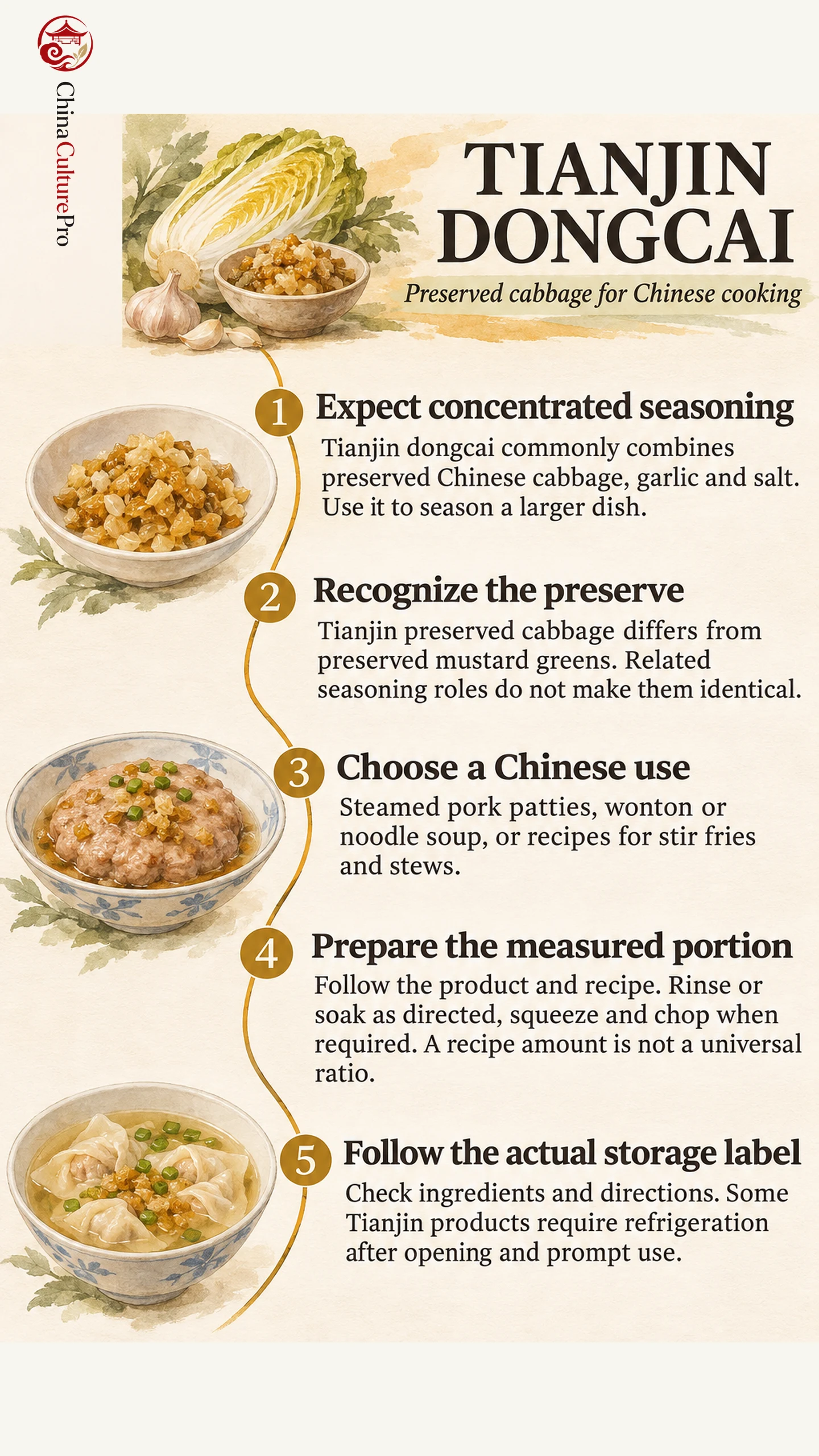
A small jar can season several kinds of food. The useful question is how much salt and cabbage flavor the dish needs, not how much vegetable you would normally put on a dinner plate.
A Concentrated Cabbage and Garlic Seasoning
The traditional process includes cutting cabbage, drying it, mixing in salt and garlic, packing it into jars and allowing fermentation. The result is often golden to light brown, with a savory aroma and a remaining crisp-tender bite.[1]
This explains why it works as a condiment: drying and preservation change the role of the cabbage. It is no longer interchangeable with a handful of fresh cabbage leaves. The garlic is also part of the product’s flavor, so check the ingredients before treating it as plain salted cabbage.[2]
The process description explains the ingredient; it is not a complete home-preservation recipe or a storage guarantee for a homemade batch.
Recognizing Tianjin Dongcai and Similar Preserves
| Ingredient | Meaning | Difference for the cook |
|---|---|---|
| Tianjin preserved cabbage | Chopped, salted cabbage, commonly with garlic | Use the actual product’s salt level and preparation directions.[2][3] |
| Mei Cai (梅菜, méi cài) | Preserved Chinese mustard greens, sold in sweet or salted forms | A different preserved ingredient that can make a different version of a steamed pork dish.[4] |
These products can serve related seasoning jobs without being identical. If a recipe gives a choice of preserves, use its variation for that ingredient; do not assume a sweet mustard preserve will give exactly the same flavor as garlicky dongcai.
Three Chinese Cooking Uses
- Steamed pork patty: Mix prepared dongcai through minced pork for a homestyle steamed dish associated with Cantonese cuisine, using this northern preserved ingredient.[3]
- Wonton and noodle soup: Add a little to the soup for salty, savory depth. In Tianjin it appears in both wonton broth and soup noodles; explore Chinese noodles for the wider range of bowls.[1]
- Stir-fries and stews: Chopped preserved cabbage can season a cooked dish instead of serving as its main vegetable. Follow a recipe that calls for that flavor.[1]
Choose the dish first, then follow its seasoning balance. More dongcai is not automatically better when soy sauce, stock or other salty ingredients are already present.
How to Prepare and Measure Dongcai
Use the selected recipe’s measured portion; preparation changes how much water and salt enters the dish.
- Check the directions: Some products specify a short soak and rinse. One salted dongcai product gives a five-minute soak before rinsing; that is a product instruction, not a universal time.[6]
- Rinse and drain when required: For a steamed pork patty, rinse off excess salt, squeeze out the water and chop the cabbage. Do this before mixing it into the meat.[3]
- Measure for the recipe: One pork-patty recipe uses 65 grams of dongcai with 350 grams of ground pork. Follow its other seasonings too; this is not a universal ratio.[3]
Follow the dish’s complete cooking method after preparing the preserve. Measuring the cabbage does not replace cooking the meat or the other ingredients properly.
Buying and Storing It
Check the product name and ingredients. A common Tianjin dongcai label lists Chinese cabbage, garlic and salt; the jar alone cannot establish its contents.[2]
Follow the particular package’s storage directions. A cool, dry storage statement on one product should not be read as permission to leave every opened jar at room temperature; another Tianjin product explicitly requires refrigeration after opening and prompt consumption.[2][5]
FAQs About Tianjin Dongcai
Do I always need to rinse dongcai?
Follow the product and dish: some instructions call for rinsing and squeezing, others for soaking first.[3][6]
Can preserved mustard greens replace it?
They can create another version of steamed pork, but sweet or salted mustard greens change the flavor and need their own preparation.[4]
Does winter vegetable mean fresh cabbage?
Not on this label. It refers to a preserved cabbage product, so buy the preserve the recipe names.[2]
Is it only for Tianjin dishes?
No. Tianjin dongcai also seasons Cantonese-style steamed pork patties.[3]
Sources
[1] Tianjin Library. Tianjin Dongcai and the Minor Cold Solar Term
[2] Sin Guo. Tianjin Dong Cai Product Information
[3] The Woks of Life. Steamed Pork Patty with Preserved Vegetables
[4] The Burning Kitchen. Steamed Minced Pork with Preserved Ingredients
[5] Wai Yee Hong. Tianjin Dongcai Preserved Cabbage
[6] Wai Yee Hong. Hengmao Preserved Salted Dongcai