


Quick Answer: What Are Chinese Red Dates?
Chinese red dates (红枣, hóngzǎo) are jujube fruits, commonly sold dried for Chinese cooking. They come from Ziziphus jujuba, not the date palm that produces Medjool dates.[1][2]
- Appearance: Dried fruits usually have reddish-brown, wrinkled skins.
- Flavor: Sweet and fruity, with apple-like or caramel-like notes.
- Uses: Soups, porridge, rice desserts and fruit fillings.
Fresh fruit, dried fruit and prepared fillings have different textures and purposes.[1][2]
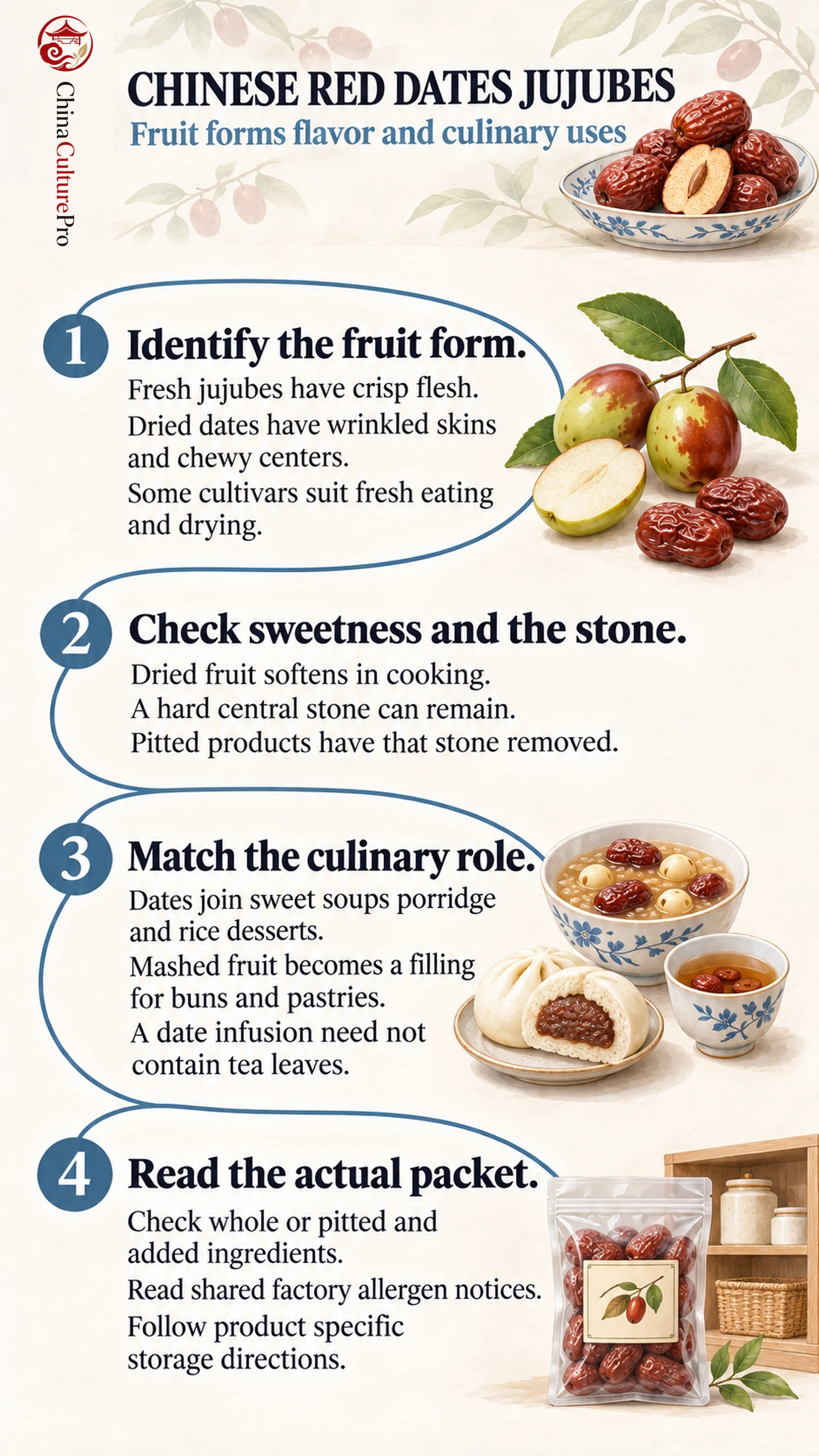
A small wrinkled red fruit in a soup bowl may be a jujube rather than a berry or palm date. Its role can be subtle sweetness, a soft piece of fruit or a smooth filling, depending on how it has been prepared.
Fresh Jujubes, Dried Dates and Processed Forms
| Form | What distinguishes it |
|---|---|
| Fresh jujube | Crisp flesh; skin can combine green and reddish-brown areas. |
| Dried red date | Wrinkled skin and a denser, chewy interior. |
| Pitted dried date | The central stone has been removed; check the product label. |
Cultivars suit fresh eating, drying or both. A pitted dried product can list only red dates: drying does not itself mean making a sweetened preserve.[1][3]
Sweetness, Skin and the Central Stone
Dried jujubes become softer when rehydrated. Their apple and caramel notes describe flavor, without implying added apple or caramel.[2]
Jujubes are stone fruits with a hard central pit that can contain seeds. Pitted describes removal of that stone; check whole-fruit preparations before eating.[1][3]
Chinese Soups, Rice Dishes and Date Paste
Dried dates add fruit sweetness to red bean sweet soups and pair with lotus seeds. They also appear in congee and sticky-rice desserts. In savory soups, the surrounding ingredients may include fish, chicken or pork.[2]
Red date paste (枣泥, zǎoní) is a mashed fruit filling. Northern Shaanxi examples include filled buns and pastries.[5] A ginger-and-date infusion, by contrast, can contain fruit without tea leaves.[2]
Choosing Packs and Following Storage Labels
Check whole versus pitted and the ingredient list. Two documented products list only fruit, but one also carries a shared-factory allergen notice.[3][4]
One product specifies cool, dry storage; another adds protection from sunlight and refrigeration after opening. Follow the actual packet.[3][4]
FAQs About Chinese Red Dates
Are Chinese red dates the same as Medjool dates?
No. Jujubes and date-palm fruits come from different plant families.
Do red dates always contain a stone?
Whole fruit normally has a central stone, but pitted products are sold.
Are naturally sweet dried dates necessarily candied?
No. Some dried products list only the fruit; sweetened products need a separate ingredient check.
Is red date tea always made with tea leaves?
No. A date infusion can contain fruit and ginger without tea leaves.
Sources
[1] Shengrui Yao, New Mexico State University Extension. Jujube: Chinese Date in New Mexico
[2] The Woks of Life family. Chinese Red Dates: Flavor and Culinary Uses
[3] Sun Kee product label, NTUC FairPrice. Seedless Dried Red Dates: Ingredients and Storage
[4] On Kee product label, Wai Yee Hong. Dried Jujube: Product Directions and Storage
[5] Yan’an University, Northern Shaanxi Historical Culture Research Center. Northern Shaanxi Jujube Foods: Buns, Fillings and Rice