


Quick Answer: What Was Chinese Imperial Hunting?
Chinese imperial hunting included organized chases and excursions in landscapes reserved for the ruler and his entourage. A hunt might display court wealth, put riding and shooting skills to the test, or bring the emperor and regional leaders together. Its purpose depended on the court and the occasion. [1][3][4][5]
- Landscape: An imperial preserve set aside space for court excursions and the pursuit of game.
- Training: The Qing court used the hunt to see how soldiers rode, shot and worked together.
- Political gathering: Attendance, hospitality and rewards made the Qing autumn hunt an occasion for managing relations with Mongol nobles. [1][3][4][7]
The Han park and the Qing preserve illustrate two settings separated by many centuries.
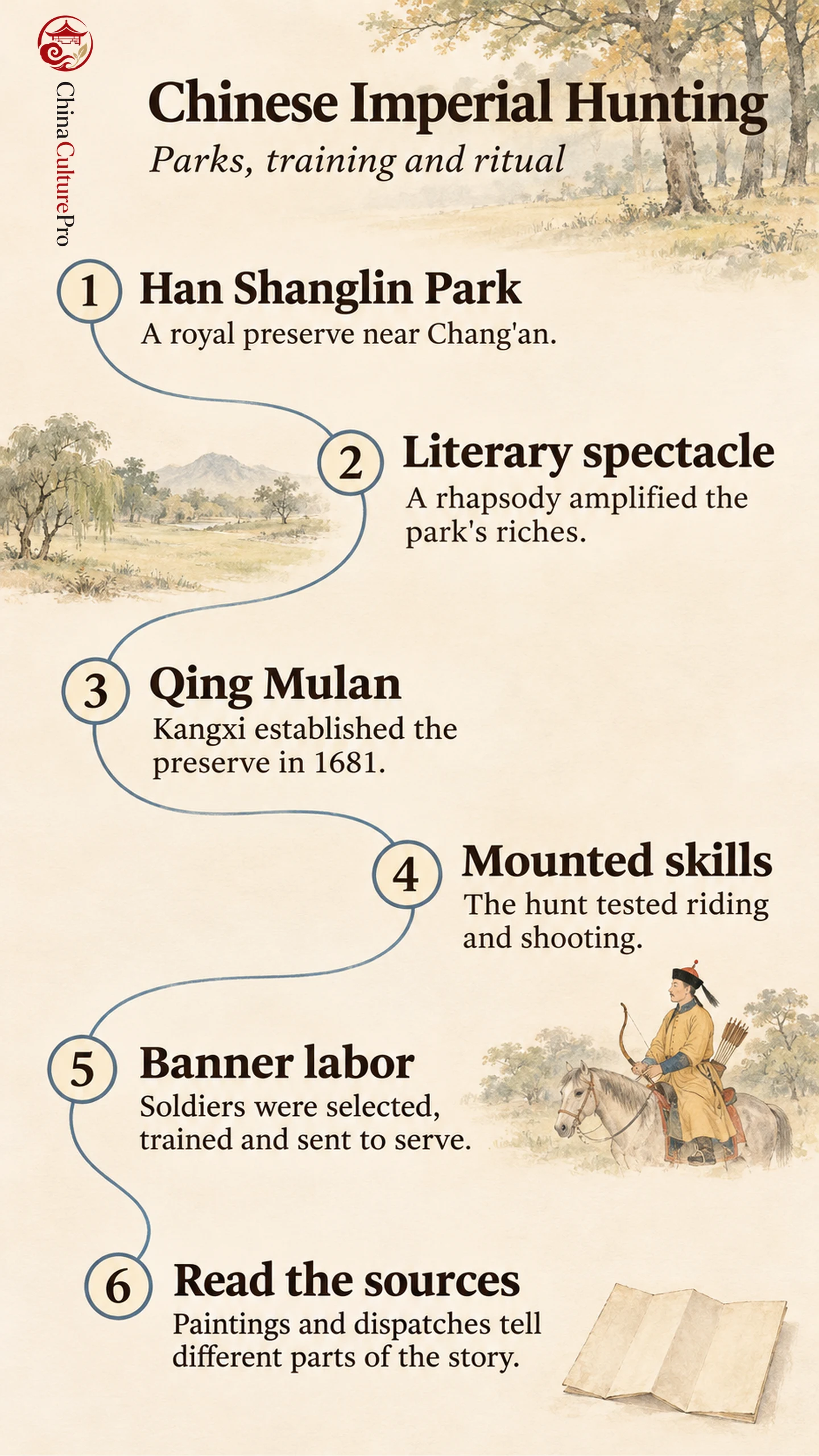
A hunt could put a ruler at the center of a vast landscape. It could also require travel and careful preparation by people who scarcely appear in the finished picture. Two well-documented examples show how poets, court artists and officials recorded different parts of the event. [1][2][4][6]
Shanglin Park and the Han Imperial Hunt
Shanglin Park (上林苑, Shànglín Yuàn) was a Western Han imperial preserve outside Chang’an, near modern Xi’an. Emperor Wu used it for hunting and excursions. The park also became the subject of a rhapsody by Sima Xiangru (司馬相如, Sīmǎ Xiàngrú), who took the hunt as an occasion to describe terrain, animals and the extent of imperial power. [1][2]
Read the rhapsody as a crafted account of the hunt, with room for invention. Its descriptions expand the real park into a landscape fit for a ruler imagined at the center of the world. Toward the end, the emperor questions the extravagance that the text has just made vivid. The work gives us both a display of abundance and a reflection on excess. [2]
A surviving handscroll titled The Shanglin Park: Imperial Hunt reinterprets that theme in paint. It is catalogued as a work from around 1640 attributed to Qiu Ying. The long interval between the Han subject and the painting is part of what the object tells us. Its dress, architectural details and arrangement should be read as part of a later artistic interpretation. [1]
What Happened at the Qing Mulan Autumn Hunt?
The Qing Mulan Autumn Hunt (木蘭秋獮, Mùlán qiūxiǎn) took place in the imperial preserve north of Chengde. The Kangxi emperor established the preserve in 1681. Hunts there brought together members of the imperial entourage, banner soldiers and Mongol nobles, and developed into a recurring court occasion. [3][4][5]
During an organized drive, participants formed lines to bring game into a narrowed space. The emperor and selected participants could then shoot, with results recorded and rewards distributed. The day continued after shooting ended. Recorded tallies, banquets and gifts allowed the court to recognize participants in different ways. These meetings took place within the political relationships of the Qing empire. [3][5][7]
Who Did the Work Behind a Qing Imperial Hunt?
The spectacle depended on the Eight Banners (八旗, bāqí), the Qing military and social organization. Selected banner soldiers escorted the court, helped carry out the hunt and demonstrated military skills. Mounted archery (騎射, qíshè) was valued alongside other work on the ground. Attending the hunt was a duty for soldiers who were assigned to it. [4][5]
Manchu-language correspondence from the lieutenant governor’s office in Hunchun records a side of the occasion that a painting seldom makes visible. Officials discussed who was capable of serving, how to prepare them and how to provide travel expenses. A display in front of the emperor thus began with decisions far from the imperial viewing position. The letters document the obligations of soldiers whose presence made the performance possible. [4]
How to Read Paintings and Records of an Imperial Hunt
A Qing hanging scroll of the Qianlong emperor hunting, credited to Giuseppe Castiglione and other artists, gives the viewer a named imperial figure to recognize. A dispatch about soldiers answers a different question. It shows who had to travel and how they were organized. You can use the two sources together if you keep their purposes separate. The article on Chinese historiography explains how the purpose of a record affects what it preserves. [4][6]
| Source | What it can show | What to check before drawing a conclusion |
|---|---|---|
| Han rhapsody | How a writer presented an imperial park and the costs of extravagance. [2] | Whether the detail belongs to the real park or to literary embellishment. |
| Qing court painting | Which image of the emperor and the hunt the court commissioned or preserved. [6] | The date, attribution and subject in the catalogue. |
| Banner correspondence | Selection, preparation and costs for personnel who were sent to the hunt. [4] | Which unit, year and place the letter concerns. |
FAQs About Chinese Imperial Hunting
Was Mulan the Same Place as Chengde?
The hunting preserve lay north of Chengde. Chengde and its Mountain Resort formed part of the broader setting for Qing court activity. The name Mulan in this context refers to the preserve and its autumn hunt. [3][7]
Did Every Qing Emperor Hold an Autumn Hunt?
Kangxi began the practice. The large court hunt was discontinued for a time under Yongzheng and revived under Qianlong. Its regularity varied even in periods when it had become an important court occasion. [5][8]
Why Did the Qing Court Value Mounted Archery?
Riding and shooting together demonstrated skills useful to the banner forces. The court also presented them as practices inherited from Manchu ancestors. At Mulan the same skill could carry military and ceremonial meaning. [4][5]
Sources
[1] Smithsonian National Museum of Asian Art. The Shanglin Park: Imperial Hunt
[2] Martin Kern. Early Chinese Literature, Beginnings Through Western Han
[3] The Palace Museum. Mulan Hunting Preserve
[4] Seonmin Kim. The Qing Hunt at Mulan and the Banner Soldiers of the Three Eastern Provinces
[5] The Palace Museum. Eternal Abundance From Heaven: Auspicious Deer Artifacts at the Palace Museum
[6] The Palace Museum. Painting of the Qianlong Emperor Hunting
[7] Qing History Encyclopedia. The Autumn Hunt
[8] Mark C. Elliott and Ning Chia. The Qing Hunt at Mulan