

Quick Answer: What Were Chinese Imperial Granaries?
State granaries (官倉, guāncāng) were places where imperial administrations stored grain for public purposes. Their jobs included supplying courts and armies, holding grain in transit and keeping reserves for civilian use. The same building could serve more than one purpose. [1][2][3]
- Supply: A capital or garrison drew on stores to feed people who depended on official provisions.
- Transport: A warehouse could hold shipments before they moved farther along a canal or toward another city.
- Civilian reserves: Officials could hold stocks to release when supplies tightened or food prices rose. [1][2][3]
A granary’s role is best identified through its location, records and links to other stores.
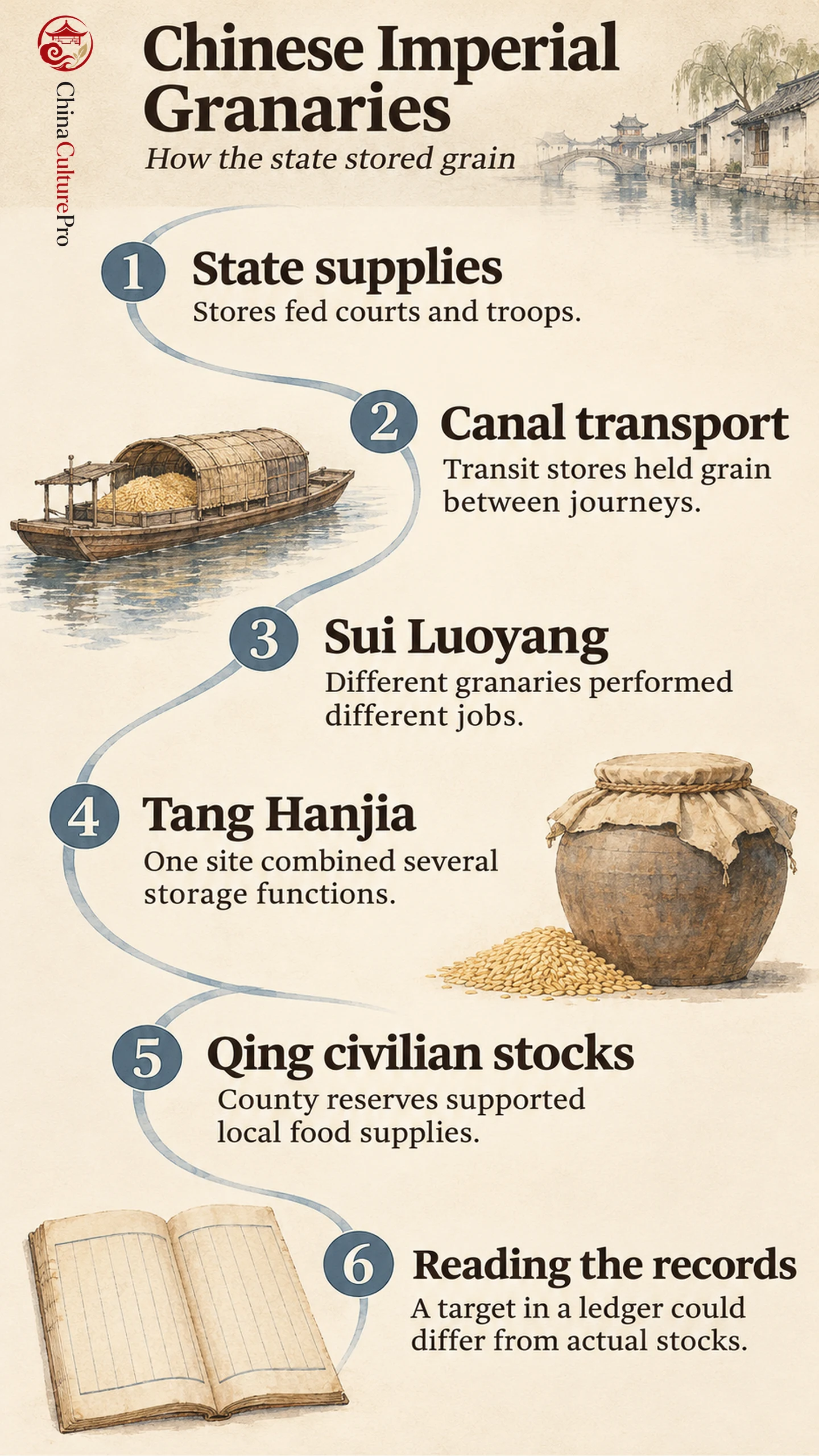
A pit excavated near Luoyang and a Qing county store listed in a ledger both point to the same challenge. Officials had to get grain where it was needed, preserve it until use and keep track of what could still be issued. Their institutions tackled different parts of that problem. [2][3][5]
How Grain Moved From Collection to Distribution
A state could collect grain and send it toward a capital or other place with a regular need. Routes connected producing regions, transit warehouses and the places where grain would be issued. The storage points gave officials room to hold arrivals before sending them on. In some locations, a warehouse could both move grain along and supply a nearby garrison. [1][2]
The caoyun (漕運, cáoyùn) system organized state-controlled grain transport by water and its supporting administration. The Grand Canal grew from earlier waterways and was first conceived as an integrated imperial network under the Sui. Successive dynasties adapted the route and the grain supply arrangements to serve different capitals and administrative priorities. [1]
A provincial shortage posed a different problem from the routine supply of a capital. If the county had civilian grain reserves and could release them, it could supply households without waiting for a new shipment. If there was little on hand, obtaining supplies elsewhere meant finding grain and moving it into the region. Waterways mattered to both tasks, but a grain convoy passing through a county was not necessarily a reserve that its officials could use. [1][3][4]
What Luoyang’s Granaries Reveal About Sui and Tang Rule
Excavated underground pits and descriptions in legal texts show that stores in and around Luoyang had complementary roles in the late Sui. The sites together suggest that the location of a store mattered as much as its size when the court planned supplies. [2]
| Granary | Period | Role identified from sites and records |
|---|---|---|
| Ziluo Granary (子羅倉, Zǐluócāng) | Sui | Supplied the imperial court’s daily needs. [2] |
| Luokou Granary (洛口倉, Luòkǒucāng) | Sui | Held grain in transit and supplied troops in the north. [2] |
| Huiluo Granary (回洛倉, Huíluòcāng) | Sui | Served as the principal granary for the capital at Luoyang. [2] |
| Hanjia Granary (含嘉倉, Hánjiācāng) | Tang | Combined several tasks that had been handled by separate Sui facilities. [2] |
Hanjia took shape in the early Tang under Emperor Gaozong. Archaeology and the surviving regulations suggest that the court could make more effective use of underground storage by reorganizing operations. The Hanjia remains are one component of the Grand Canal World Heritage property. [2][6]
How Qing Granaries Worked Alongside Private Markets
In the Qing, the county-level ever-normal granaries (常平倉, chángpíngcāng) were one part of a larger civilian storage system. They kept reserves to make grain available and temper price increases. The magistrate’s staff could be responsible for management. Early Qing plans also distinguished community granaries (社倉, shècāng), especially in rural areas, and charity granaries (義倉, yìcāng), associated with towns. Local arrangements could involve officials and local elites in different combinations. [3]
Public stores existed alongside private stocks held by producers, landowners and merchants. A bad local harvest could be offset by grain brought from another region if it was available and the transport and trade networks could deliver it. Building reserves in county seats committed officials to purchasing, keeping and replenishing grain. Moving supplies through the market depended more on the availability of surplus and the ability of traders to deliver it. Neither approach could make up for a region-wide lack of grain by itself. See ever-normal granaries for how one type of reserve operated, and Chinese magistrates for the local offices involved. [3][4]
Why a Full Ledger Did Not Guarantee a Full Granary
A report can record a target, a balance that should be in stock or a verified amount actually in store. Some totals from the Qianlong period were compiled from prescribed levels. They do not establish that the same quantity was physically present. To interpret a reported surplus or shortfall, look for the date, the basis of the figure and whether anyone checked stocks against the report. [5]
Archaeological estimates pose a related but different problem. A pit’s dimensions help estimate how much it could hold. Actual reserves changed as grain arrived, left or became unusable. A store built for a large volume might still be short of grain at the moment officials needed it. [2][3][5]
FAQs About Chinese Imperial Granaries
Was Every Imperial Granary Used for Famine Relief?
Relief was one purpose, especially in civilian systems. A store used for routine palace provisions, military supply or shipment could have different beneficiaries and rules for release. [2][3]
Were All Chinese Granaries Underground?
The excavated Sui and Tang stores near Luoyang include underground pits. That is evidence for particular places and periods. The name granary identifies a storage function, and it does not specify a single building type. [2][3]
Can an Excavated Pit Tell Us How Much Grain Was Stored?
Measurements help establish possible capacity. To estimate a particular year’s stocks, researchers also need evidence of when a store was used and what grain was actually on hand. [2][5]
Sources
[1] UNESCO World Heritage Centre. The Grand Canal
[2] Miki Utsunomiya. The Granaries of Luoyang During the Sui and Tang Periods
[3] Pierre-Étienne Will and R. Bin Wong. Nourish the People: The State Civilian Granary System in China, 1650–1850
[4] Robert B. Marks. There Is Only a Certain Amount of Grain Produced: Granaries and the Role of the State in the Food Supply System
[5] He Weiguo. A Research on the Data and Operation of Granary System During the QianLong Reigns
[6] UNESCO World Heritage Centre. The Grand Canal: Maps