
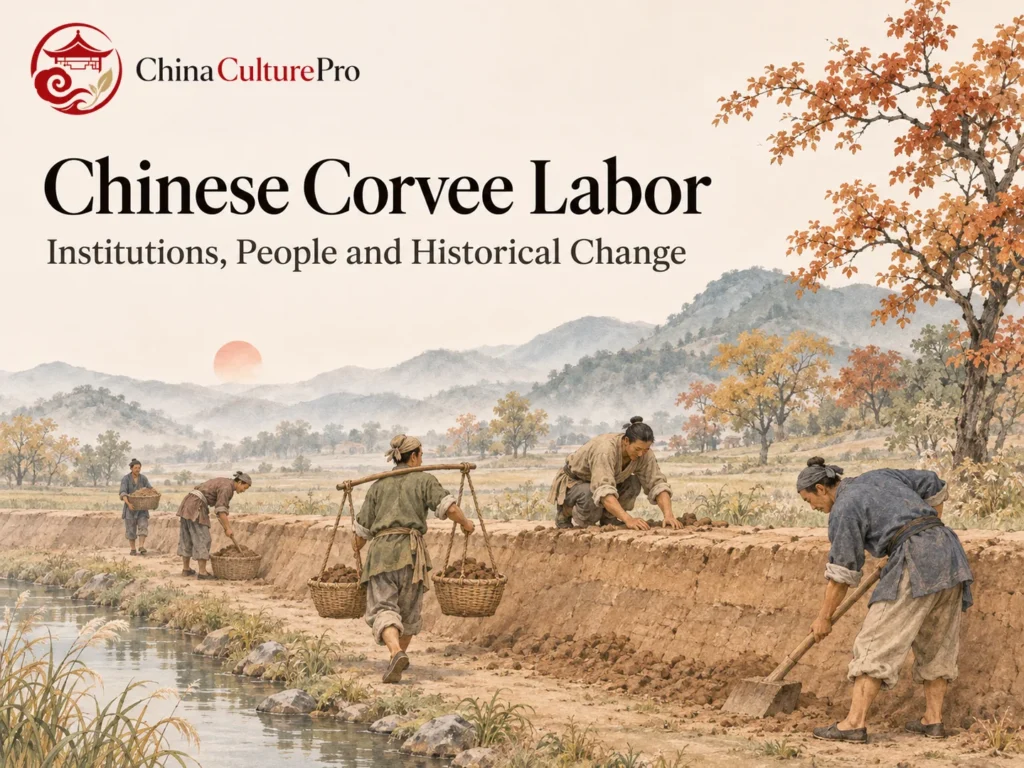

Quick Answer: What Was Corvée Labor in Imperial China?
Corvée labor (徭役, yáoyì) was work that a government could require from people who owed a service obligation. It could include construction or maintenance. Some administrations allowed a payment in goods or silver to replace specified service. What counted as fulfilling the duty depended on the place, period and kind of work.[1][3][4][5]
- Service: Report for the work required.
- Substitution: Supply an approved payment where the rules allow it.
- Records: Check who owed the duty and what the office counted as fulfillment.
State labor records can also refer to workers with other legal statuses.

A person could owe the state a period of work, a delivery of grain or a payment in cloth. A payment could also replace labor under some rules. The distinction matters when reading a law or a tax record.
Qin Labor Statutes: Calling Up Workers and Counting Work
Bamboo slips from Shuihudi preserve a statute on service for the Qin state and empire. The text distinguishes failure to report from lateness and sets progressively greater penalties for longer delays. It also has a clause allowing for water or rain in the rules on call-ups. These are provisions for the summons described in the text.[1]
The same statute discusses walls built by requisitioned workers. For the walls described in the statute, if one failed before the year was up, the work crew could be ordered to rebuild it without having the repairs count toward service. Under that rule, doing the repair and earning credit toward the obligation were separate matters.[1]
Tang Service and Payment in Cloth
The Tang dynasty system known as zu–yong–diao (租庸调, zū yōng diào) distinguished different obligations. Zu referred to a grain levy. Yong concerned labor service or a textile payment in its place. Diao was a levy in kind that could itself be collected in textiles.[3]
A piece of cloth could therefore represent a payment in place of work or a separate obligation assessed in goods. Research on tax textiles from Turfan uses surviving textiles to investigate the fiscal system. The payment category has to come from more than the material. An inscription, document or excavated context can give information about how the cloth entered state hands.[3]
Ming Silver Payments and Continuing Service
In the Ming dynasty, reforms often grouped under the name Single Whip (一条鞭法, yītiáobiān fǎ) consolidated assessments and expanded payment in silver in place of some duties. Paying silver to discharge a labor obligation changed how the service was financed. Local offices still needed people to perform public work.[4][5]
A study of Jiangxi shows that silver payment and compulsory service could operate together. The study describes community heads and neighborhood households receiving money but still bearing expenses or providing services under public spending limits. A tax summary may record a silver payment. Records of local expenditure can show who still did the work and who paid for it.[4]
How to Identify a Labor Obligation in a Record
Start by identifying why the person was assigned to the work. A laborer listed in a Qin record could belong to a different legal category from a person answering a routine service summons. A document from Liye, for instance, concerns how officials assigned laborer-servants to agricultural work. It provides evidence of another part of Qin labor administration.[1][2]
Then identify what the record counts. A measurement of fields is an input into assessment, as the guide to historical land measurement shows. Grain accounted for during caoyun was a shipment for state supply. Look for a summons, a service credit or a receipt before deciding whether the obligation concerned work or payment.[1][3][4]
FAQs About Chinese Corvée Labor
Was corvée labor the same as convict labor?
Corvée was a work obligation imposed on people subject to a service requirement. Convict labor arose from a penal status. A state project could use several categories of labor.
Could people pay instead of working?
Some systems accepted goods or money instead of specified work. Cloth in the Tang and silver in the Ming illustrate different kinds of substitution. The terms depended on the particular levy.
Did the Single Whip reforms end corvée labor?
The reforms expanded the use of silver for some duties. Evidence from Jiangxi shows that direct service and local expenses could persist alongside payments.
Sources
[1] Shuihudi Qin Slips, Wikisource. Statutes on Corvée from the Shuihudi Qin Slips
[2] Early China, Cambridge University Press. Categorizing Laborers: Glimpses of Qin Management of Human Resources
[3] Binghua Wang and Helen Wang, Journal of the Royal Asiatic Society. A Study of the Tang Dynasty Tax Textiles from Turfan
[4] Ming Studies, National Chi Nan University. Between Corvée and Public Expenditure: Ming Jiangxi
[5] International Review of Social History, Cambridge University Press. Work Ethics and Work Valuations in a Period of Commercialization: Ming China