
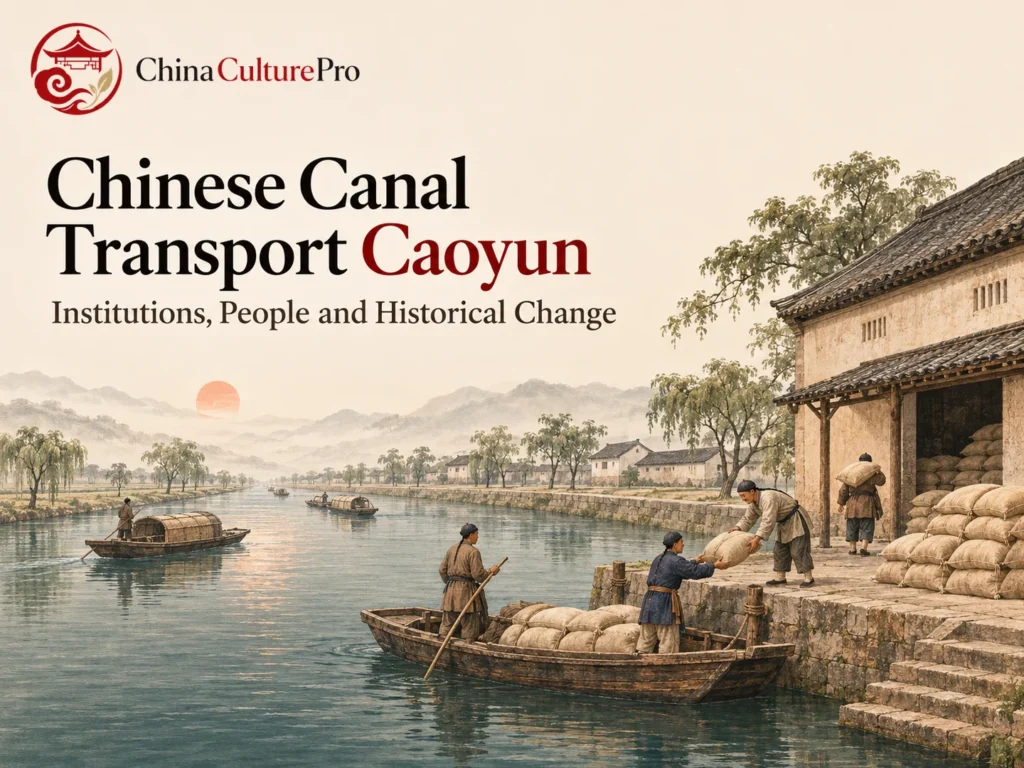

Quick Answer: What Was Caoyun?
Caoyun (漕运, cáoyùn) was the state system for moving tax grain by water. The cargo, known as tribute grain (漕粮, cáoliáng), supplied the capital and official institutions. The Ming and Qing used the Grand Canal to move much of this grain north. Officials organized its collection, dispatch, inspection and receipt.[1][2][4][5]
- Collection: Local offices assembled and transferred grain for shipment.
- Transit: Officials supervised fleets and monitored their passage.
- Delivery: Receiving granaries took the grain into storage.
Routes and handoffs changed as officials responded to local conditions.

A boat could arrive at a granary after passing through several jurisdictions. At each stage someone had to check the grain, account for it and see it on its way. Those jobs explain why caoyun required both waterways and officials.
From Grain Tax to a Boatload
In the Ming and Qing examples, part of the land tax could be paid in grain for shipment to the capital. A land assessment set an obligation. Caoyun dealt with the physical grain and the arrangements needed to move it. The guide to historical land measurement covers the records that established the area of taxed land.[2][5]
Local officials had to assemble cargo and deliver it to the designated fleet. The Shandong gazetteer names six prefectural jurisdictions with officers assigned to hand over grain to the fleets, including Jinan, Dongchang and Yanzhou. Boats under the same provincial administration also took loads from jurisdictions in Henan. The organization of fleets therefore did not always match the boundaries where the grain was first collected.[3]
Why Huai’an Mattered to the Transport System
The Ming dynasty established the governor-general’s grain transport headquarters at Huai’an. The office continued under the Qing dynasty. It supervised grain transport across supplying regions. The site of its headquarters survives near the canal, while documents identify inspectors posted at different points along the route.[2][4]
Nearby Qingkou shows another side of the same work. The junction joined waterways with different water levels and exposure to floods. Canal sections, locks and embankments helped keep boats moving where the canal met the Huai River and what was then a course of the Yellow River. The headquarters coordinated fleets and people, and the hydraulic works made their passage possible.[4]
Receiving the Grain at Tongzhou
Tongzhou (通州, Tōngzhōu) near Beijing was a major receiving point. Boats carried grain from the southern and central provinces toward the capital region, where officials checked deliveries and transferred them into granaries. The Shandong records distinguish officers who stopped at Linqing after certifying the grain from others who continued to Tongzhou.[3][5]
The certification and the receipt at a granary were different moments in the journey. One concerned the state of the cargo as it moved along the route. The other established what had arrived for storage. The history of the Grand Canal gives the wider story of the channel network these offices used.[1][2][3][5]
How Sea Transport Changed the Route
In 1826, during the Daoguang reign, the Qing tested sea shipment for some tribute grain. A study of a historical map identifies a route between Shanghai and Tianjin. This carried grain north without using the full inland route. The change was in how the grain reached the capital region. It was still a shipment for official supply.[2][6][7]
Historians have questioned whether the 1826 voyage actually cost less than the canal alternative. A completed voyage establishes that a shipment could go by sea. To judge its cost or reliability, records of expenses, delays and delivered quantities must be compared with the inland system.[6]
FAQs About Caoyun
Was caoyun the same as the Grand Canal?
The Grand Canal was a network of waterways. Caoyun was the system for organizing state shipments. Commercial boats used the waterways too, and officials sometimes sent tribute grain by sea.
Did every shipment go straight from the grower to Beijing?
Collection, transfer to fleet boats, inspection and receipt could involve different offices and routes. The paper trail for any one shipment may be spread across several places.
What does tribute grain mean in this context?
Here it means grain owed to the state and dispatched for official supply. It was part of taxation in kind.
Sources
[1] UNESCO World Heritage Centre. The Grand Canal
[2] Ye Xiuyun, Palace Museum Journal. An Introduction to the Qing Palace Memorials on Tribute Grain
[3] Shandong Local Gazetteer Archive. Qing Grain Administration Offices
[4] ICOMOS, UNESCO World Heritage Centre. Evaluations of Nominations of Cultural and Mixed Properties, Grand Canal
[5] Huai’an Municipal CPPCC, Local Historical Materials. Grain Transport from County Collection to the Tongzhou Granaries
[6] Ni Yuping, Studies in Qing History. Several Issues on the Sea Transportation of Tribute Grain in 1826
[7] Paris Musées. A Study of the Complete Map of Rivers and Coastline and Daoguang-Era Water Routes