

Quick Answer: What Is the Avatamsaka Sutra?
The Avatamsaka Sutra (华严经, Huáyán Jīng), often called the Flower Garland or Flower Ornament Sutra, is a large Mahayana collection that explores awakened vision and the bodhisattva path. In China it became the central scripture of the Huayan tradition.[1]
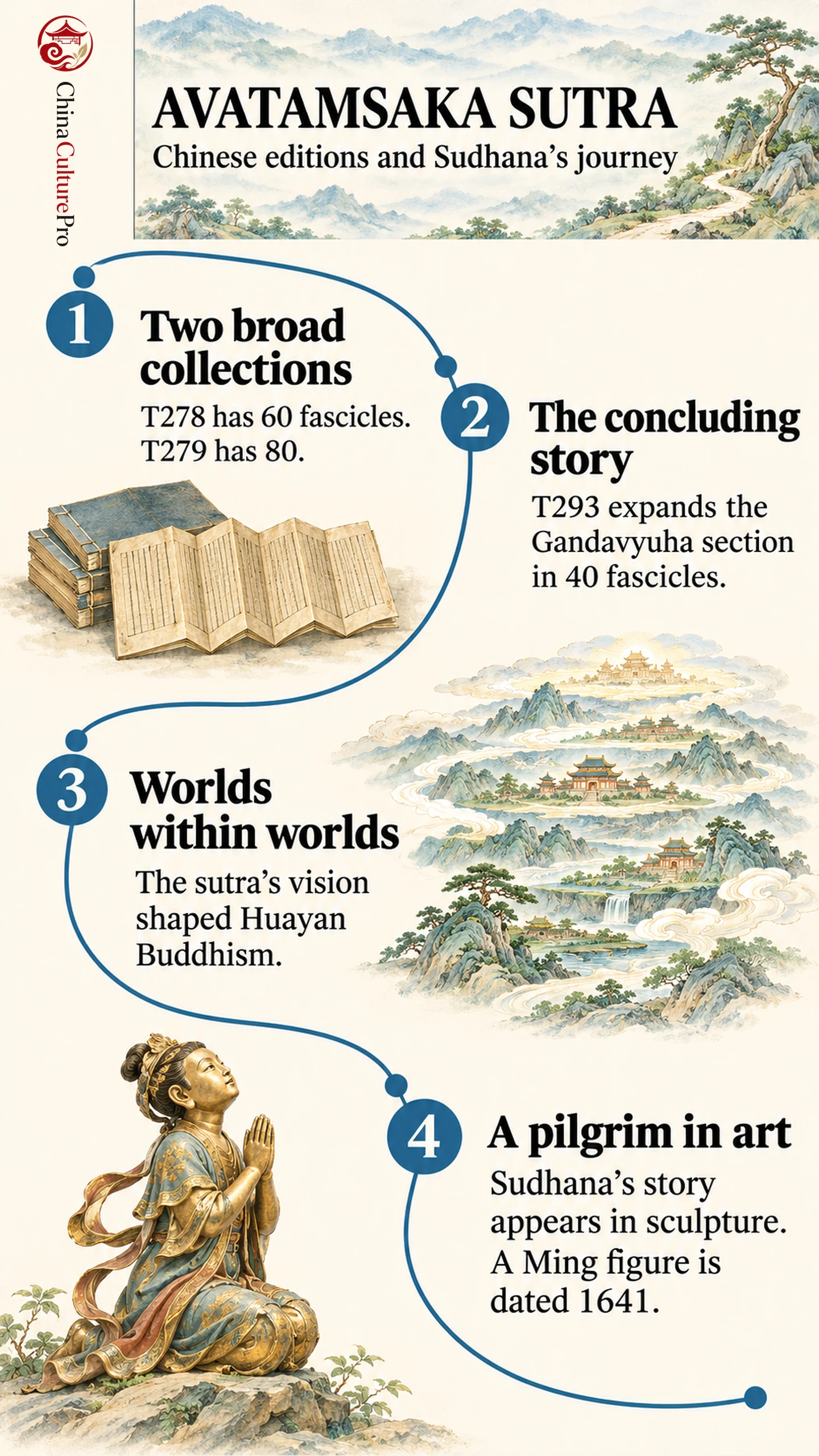
- Broader collections: The 60-fascicle Chinese version is T278. The 80-fascicle version is T279.[2][3]
- The 40-fascicle text: T293 is an expanded version of the concluding Gandavyuha section (入法界品, Rù Fǎjiè Pǐn in the broader editions).[2][3]
- A familiar figure: Sudhana (善财童子, Shàncái Tóngzǐ) journeys from teacher to teacher in the Gandavyuha. He appears in Chinese Buddhist sculpture as a young pilgrim.[4][5]
The number on a catalogue entry identifies a particular version. Even a separate book about Sudhana can belong to this larger scriptural tradition.
The length of the Flower Garland Sutra can make it difficult to know where to begin. An edition number tells you how much of the collection you have. Sudhana’s journey offers a starting point with a recognizable character and a sequence of encounters.
Which Chinese Version Are You Reading?
Buddhabhadra’s team completed the 60-fascicle text in the early fifth century. Shikshananda’s team completed the 80-fascicle text at the end of the seventh century, with sponsorship from Wu Zetian. Both versions contain the concluding story of Sudhana’s journey.[2][3][6]
The later 40-fascicle text, translated by Prajna’s team in 796–798, covers the Gandavyuha alone in a fuller form. A fascicle is a division of the text, so 40 fascicles of this one narrative can be more extensive than the corresponding portion of either larger translation.[2][3]
From a Cosmos of Worlds to One Pilgrim’s Journey
The Vision Behind Huayan
The collection presents worlds within worlds. Its vision of an awakened cosmos is closely associated with the Buddha Vairocana (毗卢遮那佛, Pílúzhēnà Fó). Chinese commentators in Huayan Buddhism drew on the scripture to explain how distinct phenomena can interpenetrate. The Ten Stages chapter approaches the path from another angle by describing the progress of a bodhisattva toward awakening.[1][6]
Sudhana’s Teachers
Manjushri (文殊, Wénshū) sends the young pilgrim to seek a teacher, who then refers him onward. The chain of encounters takes him among people in different walks of life as well as bodhisattvas. He eventually reaches Samantabhadra (普贤, Pǔxián), who closes the journey with the importance of putting wisdom into practice.[1][4]
How to Read a Chinese Image of Sudhana
A gilt copper alloy figure exhibited at the Met bears an inscription on its lotus pedestal identifying the Ming imperial workshop and dating the casting to 1641. Other figures with the same inscription support the museum’s interpretation that it belonged to a larger altar group. Sudhana’s encounter with Guanyin (观音, Guānyīn) is a useful clue when comparing this figure with a boy pilgrim beside the bodhisattva in a Water-Moon Guanyin image.[5]
FAQs About the Avatamsaka Sutra
Are Flower Garland and Flower Ornament the same sutra?
They are two English titles for the Avatamsaka Sutra. Look for the source edition or the Taisho number if you need to match a passage across translations.
Is the 40-fascicle text the shortest version of the whole sutra?
It contains an expanded translation of the concluding Gandavyuha narrative. For the broader collection, look for T278 or T279.
Where should I start reading?
Start with the Gandavyuha if you want a narrative that follows one character. The Ten Stages chapter is a better entry point if you are looking for a description of the bodhisattva path.
Sources
[1] Dharma Realm Buddhist University. Buddhist Classics, Avatamsaka Sutra
[2] Marcus Bingenheimer, Jen-Jou Hung and Cheng-en Hsieh. Stylometric Analysis of Chinese Buddhist Texts
[3] Märt Läänemets. Bodhisattva Avalokiteshvara in the Gandavyuha Sutra
[4] 84000. The Stem Array
[5] The Metropolitan Museum of Art. Sudhana (Shancai Tongzi)
[6] Oberlin College Libraries. Buddhist Texts in Oberlin College Library, Finding Guide