

Quick Answer: Who Was Amoghavajra?
Amoghavajra (不空, Bùkōng, c. 704/705–774) was a Buddhist monk and translator who helped establish esoteric Buddhist ritual at the Tang court. His work linked Indian Ocean Buddhist networks, Chinese translation teams and later lineages in Japan.[1][5]
- Training: He studied under Vajrabodhi (金刚智, Jīngāngzhì) and traveled to Sri Lanka and southern India after his teacher’s death.[1]
- Court work: A new Chinese version of the Humane Kings Sutra (仁王经, Rénwáng Jīng) in 765 was tied to rites for protecting the realm.[2]
- Images: In a later Japanese Shingon scroll, he appears under the Japanese name Fukū among the tradition’s patriarchs.[4]
The Tang texts show what his circle produced. The Japanese scroll shows how a later tradition remembered him.
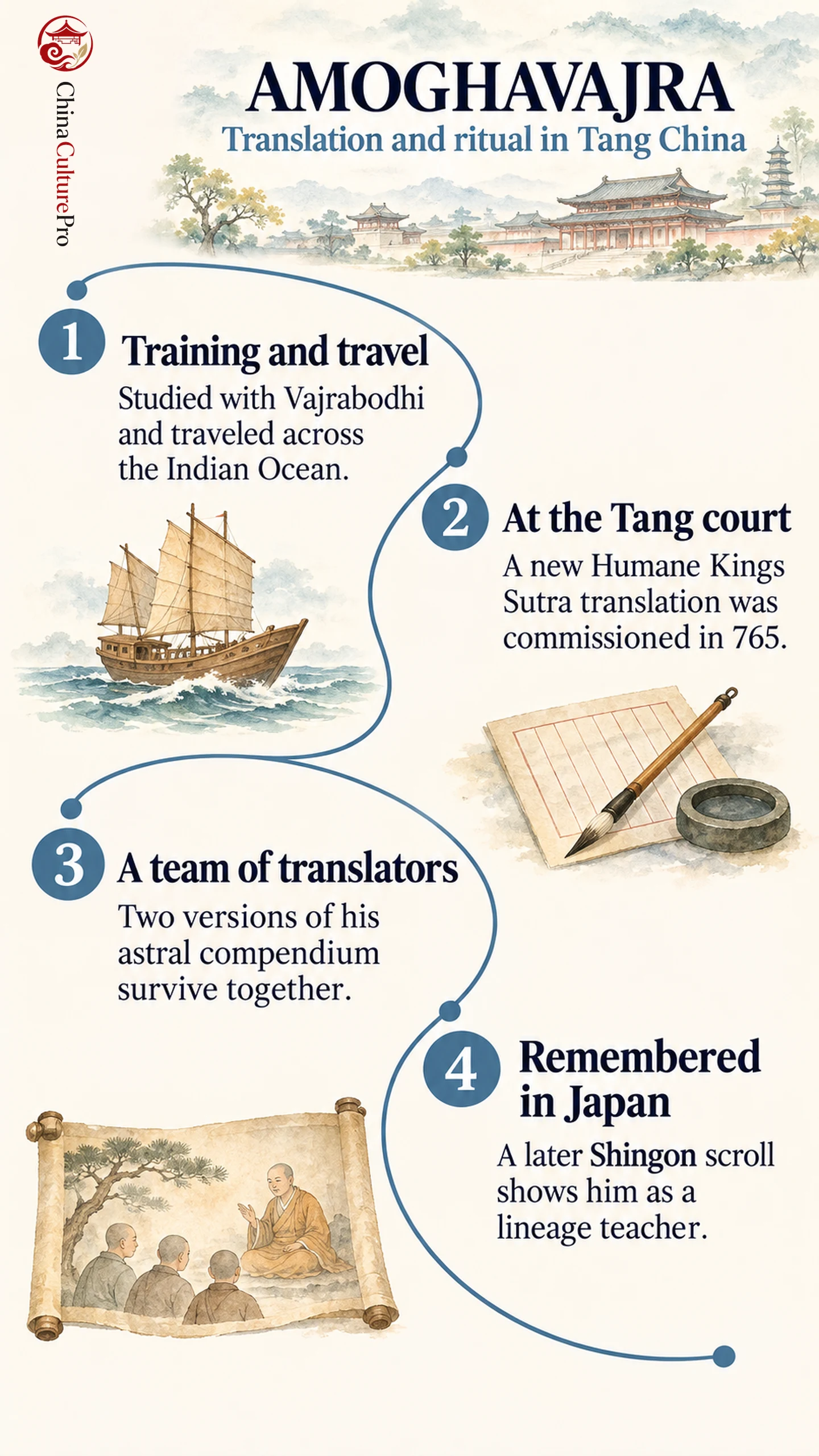
A translation credited to one monk can preserve the work of several hands. That is especially clear in a Tang text on lunar mansions and planets. It survives in two versions transmitted together, each with its own history of drafting and revision.
From Vajrabodhi’s Student to Tang Translator
Amoghavajra arrived in China young and trained with Vajrabodhi. His voyage after Vajrabodhi died took him across the sea to Sri Lanka and southern India. He subsequently worked as a translator in Tang China. The route places him in a network that carried texts and ritual knowledge between South and East Asia.[1]
Some of the texts his circle put into Chinese were intended for initiated practitioners, whose training could involve a mandala, recitations and ritual hand gestures. In this setting, a translation could preserve a set of actions as well as explain a teaching. See Chinese esoteric Buddhism for the broader ritual context.[1][4]
Two Projects That Show What Translation Meant
A Scripture for Protecting the Realm
Emperor Daizong commissioned a new version of the Humane Kings Sutra and ordered the Hundred Seat Ritual. Historian Sem Vermeersch connects the 765 translation with ceremonies intended to seek rain and protection from invaders. The two commissions show the court’s expectations of Buddhist specialists in times of uncertainty.[2]
An Astral Compendium With Two Versions
The Treatise on Lunar Mansions and Planets (宿曜经, Xiùyào Jīng) takes the form of a teaching attributed to Manjushri. Shi Yao helped put a version into writing in 759. Five years later, the court astronomer Yang Jingfeng prepared an annotated revision after the earlier wording was found difficult to understand. The two were transmitted as separate fascicles of the same work.[3]
Finding Amoghavajra in a Shingon Scroll
One line of transmission runs through his student Huiguo (惠果, Huìguǒ), who later taught the Japanese monk Kukai in China.[5]
A thirteenth- or fourteenth-century hanging scroll at the Met sets small figures on either side of a vertical mantra. The museum identifies Amoghavajra at the bottom of the left column. Huiguo and Kukai appear at the lower right. The later grouping records Amoghavajra’s place in Shingon’s lineage. It cannot establish what he looked like in Tang China.[4]
FAQs About Amoghavajra
What are Amoghavajra’s Chinese and Japanese names?
Bukong is the usual short form of his Chinese name, also recorded in full as Bukong Jingang. Japanese sources commonly use Fukū.
What did Amoghavajra translate in 765?
He produced a new Chinese version of the Humane Kings Sutra. Its translation was part of an imperial commission associated with rites of protection.
Did Kukai study directly under Amoghavajra?
Kukai studied under Huiguo, who had trained with Amoghavajra. Kukai was born in the year Amoghavajra died, according to the dates commonly used in catalogues.
Sources
[1] Geoffrey Goble. Amoghavajra
[2] Sem Vermeersch. Who Is Legitimating Whom? On Justifying Buddhism’s Place in the Body Politic
[3] Bill M. Mak. Two Eighth-Century Recensions of Amoghavajra’s Buddhist Astral Compendium
[4] The Metropolitan Museum of Art. Mandala in Sanskrit with Buddhas, Bodhisattvas, and Eight Patriarchs of the Shingon Sect
[5] Ronald S. Green. Kūkai in China, What He Studied and Brought Back to Japan