


Quick Answer: What Is Ullambana in Chinese Buddhism?
Ullambana is the observance associated with the Yulanpen Sutra (盂兰盆经, Yúlánpén Jīng). In the scripture, a disciple named Mulian (目连, Mùlián) seeks help for his deceased mother. The Buddha directs him to make offerings to the Buddhist monastic community on the fifteenth day of the seventh lunar month.[1][2]
- Story: Mulian’s first attempt to feed his mother fails.[2]
- Offering: He makes a communal offering for her benefit.[1][2]
- Calendar: The observance is part of a wider set of Chinese seventh-month practices.[3]
The story gives a Buddhist setting to concern for parents and ancestors.
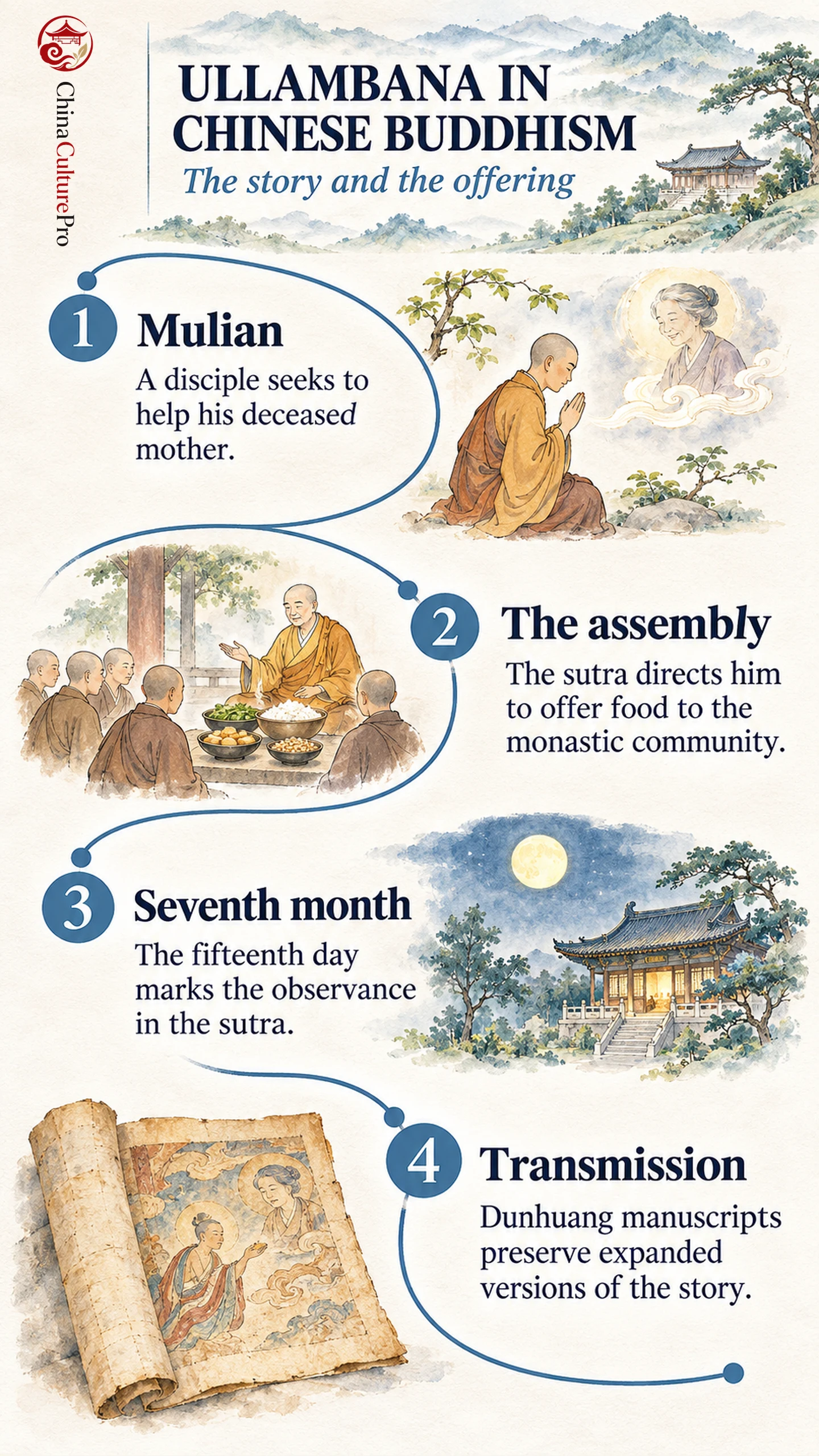
The Yulanpen Sutra (盂兰盆经, Yúlánpén Jīng) moves from a son’s distress to an act of giving through the monastic community. It helps explain how care for family and support for the Buddhist community came together in an annual observance.
Why Mulian Offers Food to the Community
In the story, Mulian (目连, Mùlián), the disciple known in Sanskrit as Maudgalyayana, finds his mother in a state of suffering. In the sutra, the food he offers turns to charcoal before she can eat it. The Buddha directs him to make offerings to the assembled monks instead. The change from one person’s gift to a communal act is central to the story’s account of filial piety.[1][2]
The Fifteenth Day of the Seventh Month
The scripture links the offering to the end of the monastic retreat. It extends the practice beyond Mulian’s own mother, directing care toward present parents and earlier generations. In Chinese religious life, the date is also associated with Zhongyuan (中元, Zhōngyuán) and the wider Ghost Festival. The Buddhist offering provides one strand within these overlapping observances.[1][3]
How the Story Traveled Beyond the Sutra
Dunhuang manuscripts preserve expanded stories about Mulian. The reverse of Pelliot chinois 4524 contains verses associated with his rescue of his mother. Its illustrated front tells a different story about Shariputra. Reading the two sides separately shows how textual and visual evidence can preserve two distinct stories on a single object.[4][5]
Chinese Buddhist communities developed other ways to make offerings and dedicate merit for the deceased. The Water and Land Ritual is a separate ceremony with its own structure and images.
FAQs About Ullambana in Chinese Buddhism
When does the Yulanpen Sutra place the observance?
It specifies the fifteenth day of the seventh month. The Gregorian date changes with the lunar calendar.
Who is Mulian?
Mulian is the Chinese name used for Maudgalyayana, a disciple of the Buddha and the central figure in the story.
Is Ullambana another name for every Ghost Festival custom?
Ullambana here refers to the Buddhist observance associated with the Yulanpen Sutra. The wider festival includes other traditions and local customs.
Sources
[1] CBETA, Dharma Drum Institute. Foshuo Yulanpen Jing, T0685
[2] Bukkyō Dendō Kyōkai. Apocryphal Scriptures: The Ullambana Sutra
[3] Princeton University Press. Stephen F. Teiser, The Ghost Festival in Medieval China
[4] International Dunhuang Programme. Pelliot chinois 4524
[5] Sino-Platonic Papers. Ryu Takai, A Study of Dunhuang Manuscript S.2614V