


Quick Answer: What Is the Vimalakirti Sutra?
The Vimalakirti Sutra (维摩诘经, Wéimójié Jīng) is a Mahāyāna Buddhist text featuring Vimalakirti (维摩诘, Wéimójié), a householder who teaches through conversations. Kumarajiva’s Chinese version dates to 406 and became especially influential in East Asia.[1][2]
- Visit: Manjushri goes to see Vimalakirti during an illness.[2][5]
- Silence: Vimalakirti responds without words when asked about nonduality (不二, bù’èr).[2]
- Art: Chinese artists used pavilions and attendants to set the encounter in a visible space.[3][4]
The visit and the silence are distinct moments. Both help explain why this lay figure became prominent in Buddhist literature.
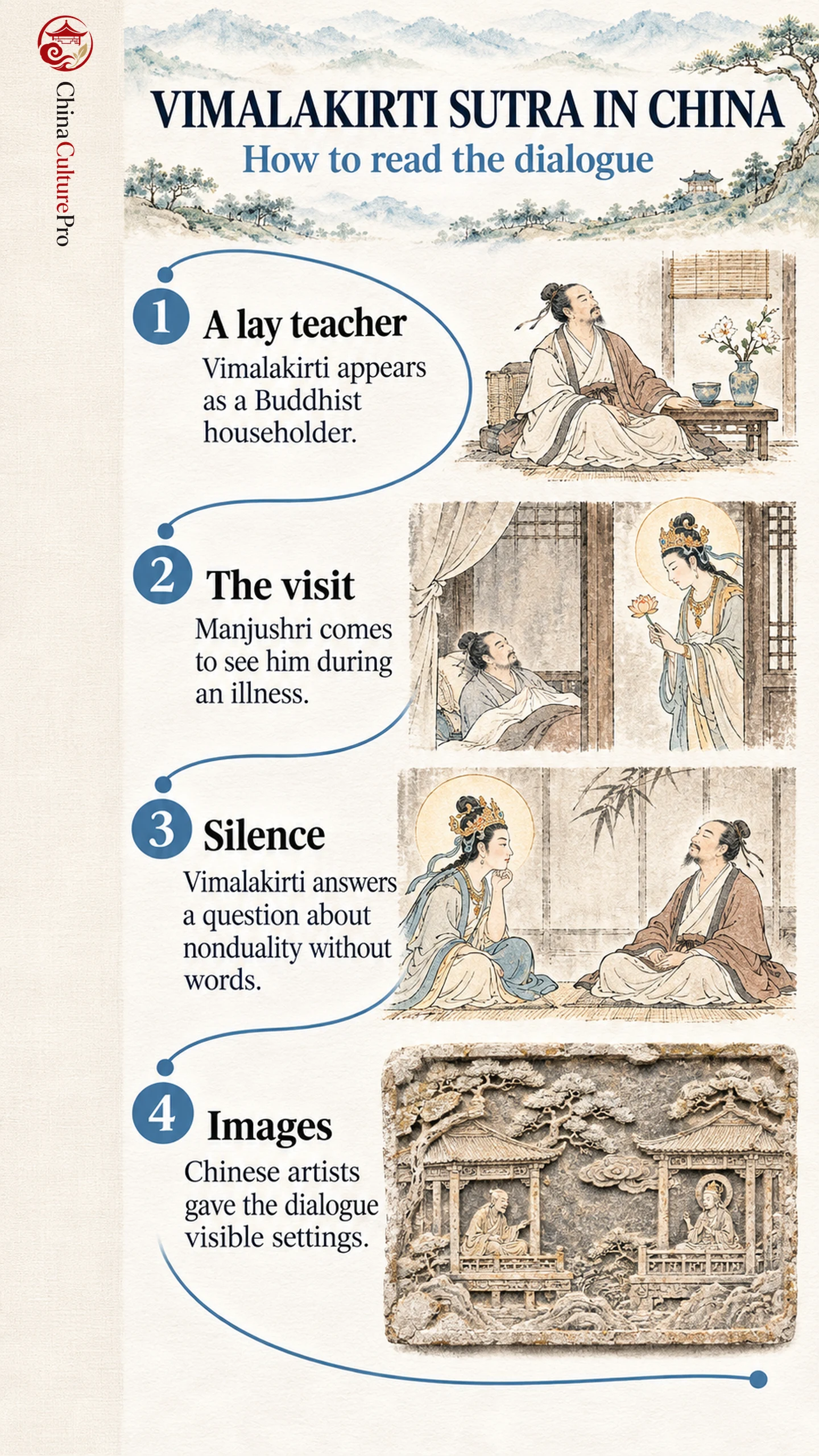
The Vimalakirti Sutra (维摩诘经, Wéimójié Jīng) puts a Buddhist householder at the center of discussions shared by monks, bodhisattvas and a lay teacher. The Chinese version by Kumarajiva gave later readers a way to follow both his arguments and the story in which they appear.[1]
A Lay Teacher and a Visitor
Vimalakirti (维摩诘, Wéimójié) is ill in the story. The bodhisattva Manjushri visits him and asks about his condition. Their exchange connects the layman’s illness with the suffering of others and gives him an opportunity to teach. His life as a householder is part of how the text frames access to Buddhist understanding.[2][5]
What the Silence Does
In a later discussion of nonduality (不二, bù’èr), a group of bodhisattvas gives spoken answers. Vimalakirti answers by remaining silent. His response comes after the verbal explanations and draws attention to the limits of the distinctions they have used. The placement of the silence within the conversation is part of its meaning.[2]
How Chinese Artists Staged the Encounter
A stone relief at the Met, with an inscription dated 533–43, places the two speakers in a detailed scene. Vimalakirti sits under a tasseled canopy, with attendants nearby. Manjushri has a separate retinue. The position of each figure lets the viewer locate both sides of the exchange, a useful clue when reading related scenes in cave temple art.[3]
A mid-tenth-century painting on paper found at Dunhuang also depicts the visit. Its medium and scale differ from the stele, and it belongs to the broader visual culture also represented by the Dunhuang murals. The artwork’s label and the relationship of the figures help identify the episode.[4]
FAQs About the Vimalakirti Sutra
Was Vimalakirti a monk?
The sutra presents him as a lay Buddhist householder.
Why does Vimalakirti stay silent?
His silence responds to a question about nonduality after several others have answered in words.
What scene often appears in Chinese art?
Artists frequently depict Manjushri visiting Vimalakirti during his illness. The speakers and their attendants can help identify the scene.
Sources
[1] Columbia University Press. Burton Watson, The Vimalakirti Sutra
[2] 84000: Translating the Words of the Buddha. The Teaching of Vimalakirti
[3] The Metropolitan Museum of Art. The Visit of Manjushri to Vimalakirti (base of stele)
[4] British Library, International Dunhuang Programme. References: Whitfield 1983, page 3
[5] Getty Research Institute. Vimalakirti and Manjushri Iconography Record