


Quick Answer: Who Was Kumarajiva?
Kumarajiva (鸠摩罗什, Jiūmóluóshí) was a Buddhist monk from Kucha (龟兹, Qiūcí) and a major translator of Buddhist scriptures into Chinese. He arrived in Chang’an (长安, Cháng’ān) in 401, where the Later Qin ruler Yao Xing supported his work.[1][2]
- Translation: His circle produced influential Chinese versions of the Lotus, Vimalakirti and Diamond sutras.[2][3][5]
- Method: A group of collaborators helped prepare Chinese texts for study and circulation.[3]
- Surviving object: A Diamond Sutra print dated 868 preserves the version associated with Kumarajiva.[5]
The translator’s lifetime and the date of a surviving copy can be centuries apart.
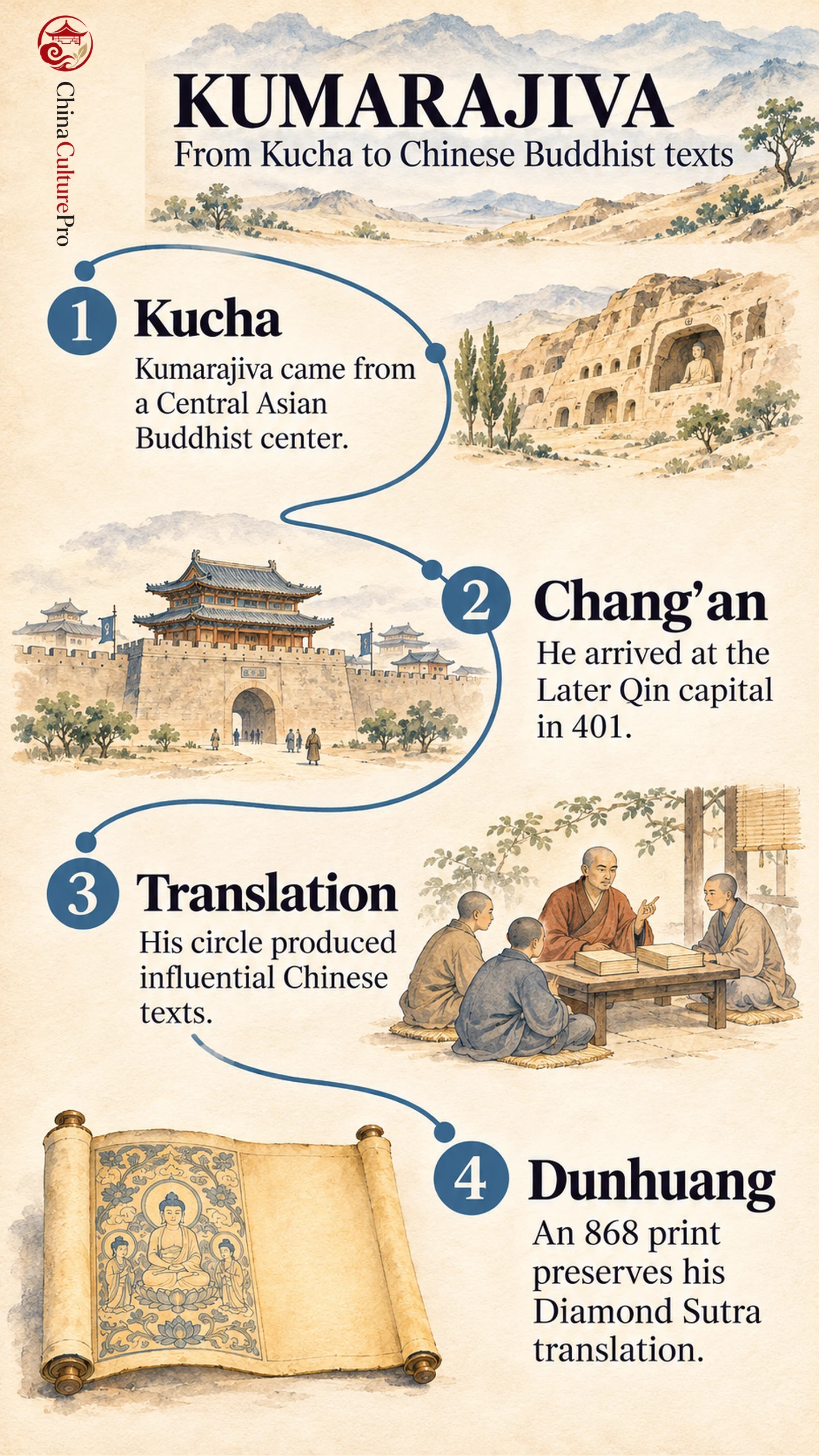
Kumarajiva (鸠摩罗什, Jiūmóluóshí) is remembered through texts that readers still encounter in Chinese. The path from an Indian Buddhist scripture to a Chinese printed book passed through several kinds of work. His translation circle made choices about wording, and later scribes and printers carried those versions to new readers.
From Kucha to the Later Qin Capital
Kucha (龟兹, Qiūcí) was a Buddhist center in Central Asia. Kumarajiva received Buddhist training and later became known for teaching Mahāyāna Buddhism. He came to Chang’an (长安, Cháng’ān) in 401 under the Later Qin ruler Yao Xing. Sources give different dates for his birth and death, but his arrival at the capital anchors the story of the translation circle.[1][4]
How a Translation Circle Worked
Kumarajiva worked with Chinese collaborators. They could condense repeated phrasing or add explanations to make a passage intelligible. The versions linked to the circle therefore show how translation and explanation worked together.[3]
His Chinese Lotus Sutra and Vimalakirti Sutra became important texts for later readers. The team’s work also included Indian philosophical treatises that later Chinese interpreters studied in the Sanlun tradition. The results shaped Buddhist scholarship as well as the reading of scriptures.[2][3]
What the Dunhuang Scroll Preserves
The British Library’s Diamond Sutra from Dunhuang is a woodblock-printed scroll dated 868. Its illustrated opening shows a religious assembly. A note at the end names the sponsor, Wang Jie, and gives the date of production. The Chinese text is the version associated with Kumarajiva. The frontispiece and dated note document a later use of the translation, a distinct part of the history of Chinese Buddhist printing.[5][6]
FAQs About Kumarajiva
Did Kumarajiva work alone?
His work in Chang’an involved other monks and collaborators. They helped turn explanations and source texts into Chinese versions that could circulate.
Is the Diamond Sutra dated 868 his original translation manuscript?
The date belongs to the surviving printed scroll. It preserves a Chinese translation associated with him from centuries earlier.
Is Kumārajīva the same name as Kumarajiva?
Yes. Kumārajīva is a scholarly spelling with diacritics. Kumarajiva represents the same name without them.
Sources
[1] Chinese University of Hong Kong, Renditions. Kumarajiva
[2] Indira Gandhi National Centre for the Arts. Chongfeng Li, Kumarajiva and Early Cave-temples of China
[3] Wiley, A Companion to World Literature. Rafal Felbur, Kumarajiva
[4] Nichiren Buddhism Library. Kumārajīva
[5] British Library, International Dunhuang Programme. Or.8210/P.2
[6] British Library, International Dunhuang Programme. Buddhism on the Silk Roads: Collection Items